


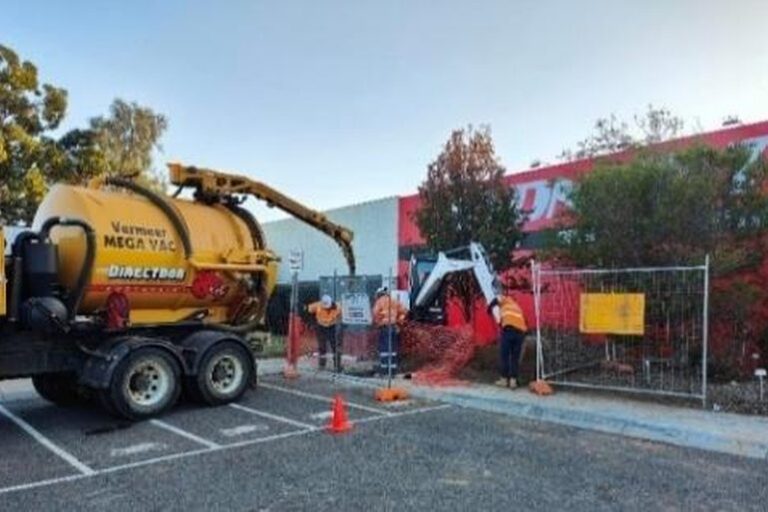
Buying electric vehicles may be the visible part of fleet electrification, but much of the hard work can happen underground.
Trenching, conduits, electrical upgrades, switchboards, charger foundations, communications, traffic management and electrical shutdowns all need to be completed while the depot continues doing its normal job.
For fleet managers, the lesson is that a depot charging project is also a live-site construction project.

The depot can’t simply close
The sites involved in the WAGA project support services including roads, maintenance, open space and waste operations.
Although many services operate during normal daytime hours, others require access around the clock.
That meant charger construction needed to accommodate existing traffic movements, staff safety and uninterrupted access.
Planning included traffic management, trenching and boring schedules, concreting, asphalting, charger installation and electrical shutdowns and reconnections.
Site coordinators and operational managers were involved in planning, while electricity network shutdowns were arranged during lower-impact periods.
These details can easily be overlooked when an initial fleet electrification business case focuses primarily on the cost of vehicles and chargers.
Trenching isn’t always possible
Wyndham’s experience shows the trade-offs. Trenching was the preferred and more economical way to install conduit.
But the main internal road and depot entry and exit points needed to remain open because the site operated 24/7.
For some crossings, underground directional boring became the only practical option.
Trenching was still used elsewhere on the site where it could be completed without interfering with operations.
The change kept the depot operating, but introduced another risk.
Clay had been expected beneath the site. Instead, rock was encountered along much of the bore path at a depth of around 1.5 metres.
The unexpected conditions extended drilling by about a week and increased project costs. The infrastructure report suggests previous bore logs or exploratory drilling may have provided better information for estimating the work.
An earlier project Lessons Learnt Report provides another useful detail: a 10 per cent cost contingency was insufficient to cover the additional rock-drilling cost, requiring an internal budget variation.
Importantly, sufficient time contingency had been built into the schedule, so the work was still completed within the original timeframe.
Contingency should reflect the site, not just the project value
That experience provides a useful lesson for fleet charging budgets.
Applying a standard percentage contingency may not adequately reflect the risks of a particular depot.
Older sites can have incomplete drawings, undocumented services, contaminated soil, difficult ground conditions or limited options for closing roads and parking areas.
A relatively small charging project could therefore have disproportionately complicated civil works.
The project recommends early utility investigations and involvement from depot stakeholders to identify operational and underground constraints before work starts.
Time contingency matters as well as money.
For fleet managers coordinating EV delivery dates with charger commissioning, a delay in infrastructure can leave vehicles sitting in the yard without their intended charging system.
Not every job belongs in the charging contract
Another lesson from Wyndham was that putting every component of the project into a single turnkey EV charging contract was not necessarily the most efficient approach.
The council separately delivered enabling works including security fence realignment, vegetation removal, drainage and asphalt resurfacing.
Using existing council-preferred local contractors was found to be more cost-effective and timely for those tasks and allowed the council to use its internal expertise.
The project also found that contractors already familiar with council sites could require less oversight and be better placed to deal with site-specific requirements.
That does not mean splitting contracts will suit every organisation.
A single contractor can simplify accountability and coordination. But fleets should assess which works genuinely benefit from being included in the charging package and which can be delivered more effectively using established facilities or civil works arrangements.
Specifications matter before anyone starts digging
The procurement process also highlighted the value of detailed, itemised requests for quotation.
Rather than asking suppliers for a broad turnkey price, the project recommends identifying components including project management, inductions, safety documentation, switchboards, cabling, trenching, conduits, pits, charger hardware, load management, commissioning and civil works.
Quantities, unit rates and technical specifications can help clarify exactly what has been priced and reduce the potential for variations later.
Ongoing costs such as software subscriptions and maintenance beyond the defects liability period can also be requested during procurement to improve visibility of the longer-term operating cost.
Treat depot access as a project requirement
For fleet managers, the biggest takeaway is that maintaining services should be specified alongside electrical performance.
Before work starts, understand which roads cannot close, when vehicles return, where plant moves, which areas must remain accessible and when an electrical shutdown can realistically happen.
Then investigate what is underground.
EV charging construction can be staged successfully around a working depot, as the WAGA project demonstrates.
But maintaining fleet operations can change the construction method, project cost and delivery schedule considerably.
Those issues are much easier to manage when they are discovered during planning rather than after the excavator arrives.