

For Fleet Managers considering electric vans, range, payload and charging usually dominate the discussion. But there is another factor that can have just as much influence on whether a new vehicle succeeds in a fleet: what drivers think of it after spending an entire working day behind the wheel.
That was one of Kia’s priorities when developing the PV5 for Australia.
The electric van was launched locally earlier this year and has since been well received, with sales exceeding expectations and demand strong across fleet segments. While its 416km WLTP range and 4.4 cubic metres of cargo capacity help make the business case, Kia believes the way the PV5 drives could also help fleets make the transition from diesel.
Rather than accepting the traditional commercial vehicle compromises of a firm unloaded ride and vague steering, Kia put the PV5 through a local ride and handling development program aimed at making it comfortable enough to spend all day in.
A van is also a workplace
For drivers in delivery, service and maintenance fleets, the vehicle can effectively become their office.
Kia Australia ride and handling engineer Graham Gambold said that reality influenced the way his team approached the PV5.
“People are going to be in it for a long time, all day,” Gambold said at the Australian launch. “So having it quiet, comfortable, you know, good ride, balanced with dynamics that you’re not chasing all the time” was important.
His assessment of the finished vehicle was straightforward: “It’s a confident, comfortable all-day drive.”
For Fleet Managers, that matters beyond driver preference. A vehicle that is easier and less tiring to operate potentially makes the transition to an unfamiliar powertrain less confronting, particularly for drivers who have spent years in conventional diesel vans.
And the electric drivetrain provides some inherent advantages. There is no diesel engine idling beneath or in front of the cabin, acceleration is smooth, and power delivery is immediate.
Kia described the PV5 during the launch as quiet, smooth and easy to drive, with its single front electric motor producing 120kW and 250Nm.
Kia didn’t tune it only for an empty van
One of the difficulties in developing any commercial vehicle is that it needs to behave properly under very different operating conditions.
A van might leave the depot heavily loaded in the morning and return almost empty. A service vehicle may carry a relatively consistent load, while another fleet vehicle might operate unloaded for much of the week.
Gambold said Kia deliberately tested both conditions.
“We did both,” he said when asked whether the PV5 had been tuned laden or unladen.
The development team concentrated on a partially loaded vehicle rather than optimising the suspension at one extreme.
“We tuned at about 300 kilograms of load in it and confirmed that that’s okay unladen,” Gambold said. “We tried to keep that dynamic change as minimal as we could.”
That approach is particularly relevant for fleets because a van that feels composed carrying equipment can behave very differently once the cargo has been removed.
Kia wanted to avoid solving one problem by creating another.
“We didn’t want to make a vehicle that was really hard and rough in the unloaded condition just to maximise load capacity,” Gambold said.
The battery can actually help
The weight of an EV battery is normally discussed as a disadvantage, particularly when payload is important.
But its position can also provide a dynamic benefit.
The PV5 has its battery mounted beneath the floor, creating a low centre of gravity. Gambold said this helped reduce the handling compromises engineers normally encounter when balancing loaded and unloaded behaviour.
“The design of the vehicle, low down battery, lowdown centre of gravity means that those compromises aren’t high,” he said.
Gambold also compared some of the PV5’s road behaviour with Kia’s passenger EVs.
“It’s got all the traits of an EV6 in terms of being flat and having a stable stance on the road,” he said.
Nobody is going to mistake a cargo van for an EV6, and that isn’t the point. What matters to a fleet driver is that a tall commercial vehicle remains predictable through corners, lane changes and emergency manoeuvres.
For Kia, the dedicated electric architecture provided another tool for achieving that.
Steering needed its own Australian treatment
The local work went further than suspension tuning.
Kia said one objective was to remove some of the vague, disconnected steering feel traditionally associated with vans while retaining the relatively light effort needed for urban work.
That meant looking not only at how heavy the steering felt, but how the vehicle responded around the straight-ahead position and during low-speed manoeuvres.
“We do a lot of work on centre straight running on freeways, that sort of thing, to make sure that the steering is very accurate in that first one degree of movement,” Gambold said.
The team also considered how quickly the steering returned from full lock when manoeuvring into parking spaces.
“A vehicle like this is going to be a bit of an urban rat runner,” Gambold said. “It’s going to be going down lanes and zipping through car parks and all that sort of thing.”
That means keeping steering effort relatively light without removing feedback.
“Keeping the feel in it’s a big part of what we do,” he said.
For a last-mile delivery driver making dozens of stops, or a service technician navigating suburban streets and underground car parks, those details can arguably matter more during a working day than outright performance figures.
The launch drive backed up the theory
The PV5’s Australian launch included both loaded and unloaded vehicles so drivers could experience the difference.
During Fleet News Group’s approximately 45-minute drive, the van was carrying an estimated 500kg load.
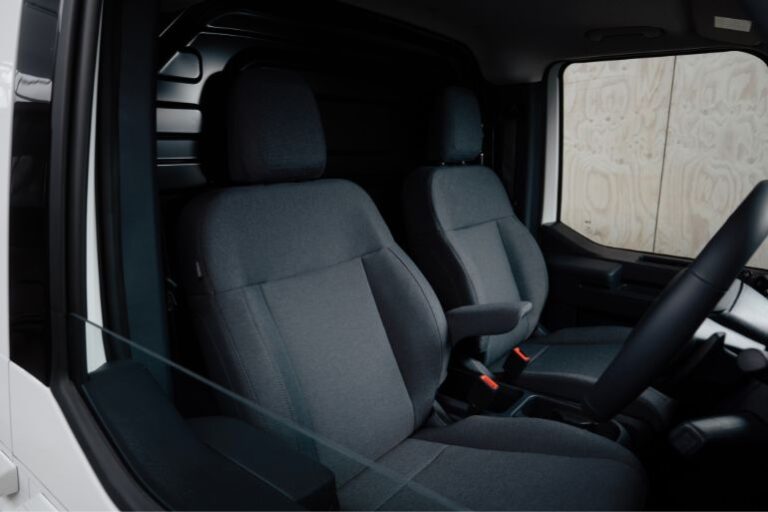
The impression was positive: the PV5 drove comfortably with the weight onboard, with good forward visibility, smooth power delivery and the quietness expected from an EV. The seats were also comfortable, with the driver’s seat including an armrest and both front occupants receiving height adjustment and lumbar support.
There are still areas drivers may need to adapt to.
The Cargo version does not have rear windows, with rear vision instead provided through the camera system and central 12.9-inch display. That could take some adjustment for drivers accustomed to looking through the rear-view mirror, particularly in fleets transitioning long-term van drivers into the PV5.
That highlights why Fleet Managers should include drivers in vehicle trials rather than evaluating an EV solely from a specification sheet.
Driver acceptance is part of fleet electrification
Much of the electric vehicle conversation understandably revolves around total cost of ownership, charging infrastructure and whether a vehicle can complete its daily duty cycle.
But once those boxes are ticked, somebody still has to drive it.
The PV5 offers a claimed 416km WLTP range and a maximum payload of 740kg, making it suitable on paper for a range of metropolitan fleet applications.
The less obvious part of Kia’s proposition is that electrification might also improve the working environment for the person behind the wheel.
A quieter drivetrain, low centre of gravity, locally developed steering and suspension, and a cabin designed as a mobile workplace could make the PV5 easier to live with over a long shift.
For fleets trying to convince drivers that moving away from diesel does not have to mean accepting a compromise, that could be one of the PV5’s most useful attributes.
Kia’s argument is effectively that an electric van shouldn’t merely be capable of replacing the existing work vehicle.
It should be a better place to spend the working day.