


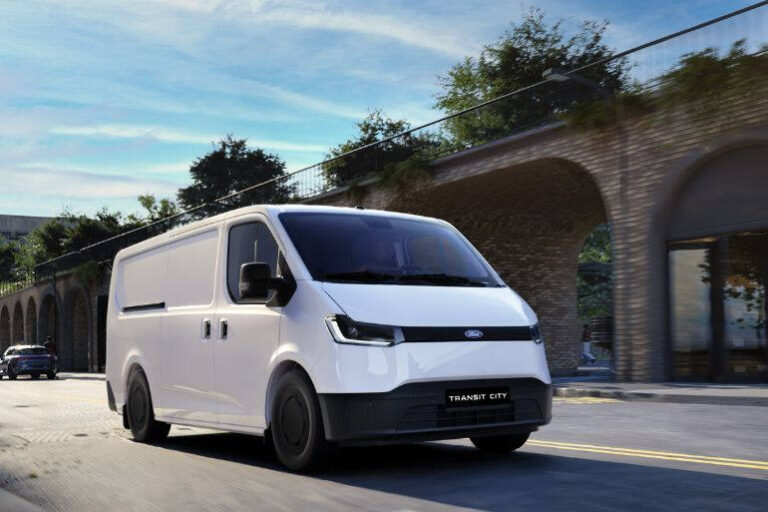
Ford’s new Transit City has been designed around a clearly defined urban fleet role, and that has required some deliberate choices around range, towing, connectivity and equipment.
Rather than trying to maximise every specification, Ford has focused on providing the capability it believes metropolitan delivery and service fleets are most likely to use.
For Fleet Managers, that makes Transit City an interesting procurement proposition. The key question is not what the vehicle leaves out, but whether those features are actually required for the job.
Ford has defined a clear urban role
Transit City will be equipped with a 56kWh LFP battery and offer up to 254km of WLTP combined range.
It also provides up to 1,085kg of payload and 6.4 cubic metres of cargo space, with power delivered through the front wheels.
However, towing will not be offered in the specification outlined by Ford at the launch.
Ford Australia and New Zealand President and CEO Fadi Mawal said the specification reflected a deliberate balance between product capability and affordability.
“we feel it’s a really good balance between a great product and a great price point”
For an urban delivery fleet, the absence of towing capability may have virtually no impact on operations.
For a service fleet where vehicles regularly tow trailers, plant or equipment, it could immediately remove Transit City from consideration.
That makes the compromise application-specific. The question is not whether towing is a desirable feature, but whether the fleet genuinely needs it to complete its daily tasks.
Connectivity is another consideration
Transit City will also differ from some other Ford commercial vehicles when it comes to connectivity.
Ford confirmed at the launch that Transit City will not initially be connected to the Ford data-services platform being introduced predominantly across Ranger and Everest.
Michael Elias, General Manager – Ford Pro Australia, said fleets would still have the option of using third-party telematics providers through OBD devices.
“Of course, the telematic service providers in the industry have got OBD devices for basic telemetry that’s available today as well.”
For fleets already using an established third-party telematics platform, that may not be a significant disadvantage.
However, Fleet Managers should understand exactly what information will be available, how it will integrate with existing fleet management systems and whether it provides the operational and uptime information they require.
Transit City sits at a different point in the Transit range
Ford is not positioning Transit City as the most capable vehicle in the Transit family.
Larger Transit Custom models offer additional functionality, including towing, while updated electrified versions also add features such as 2.3kW Pro Power Onboard.
Instead, Transit City is intended to provide a more focused package for fleets whose operating requirements are relatively straightforward.
Ford Australia General Manager, Product Marketing Karen Larkin said:
“Transit City fits in perfectly as the entry point to our transit product range.”
That positioning gives Fleet Managers a useful way to assess the vehicle.
Rather than comparing electric vans purely on battery capacity, maximum range or the length of their equipment lists, fleets can start with the operational task and work backwards.
How far does the vehicle travel each day? Does it tow? What payload and cargo volume are required? What telematics data does the organisation need? And are features such as onboard power actually used?
The answer to those questions will determine whether Transit City’s specification represents a compromise or simply removes capability the fleet would otherwise be paying for but rarely using.
With a starting price around $50,000, Ford is clearly aiming to make Transit City accessible to fleets considering the move to an electric van. But its stronger argument may be the way the vehicle has been configured around a specific duty cycle rather than simply chasing headline specifications.
For fleets operating predictable metropolitan routes where towing and embedded Ford telematics are not essential, Transit City could offer most of the capability required for everyday operations.
Where those requirements are fundamental, however, a different vehicle in the Transit range may be the better fit.
The decision for Fleet Managers therefore comes back to matching the vehicle to the task – and deciding whether Transit City’s deliberate compromises align with the way their fleet actually operates.