


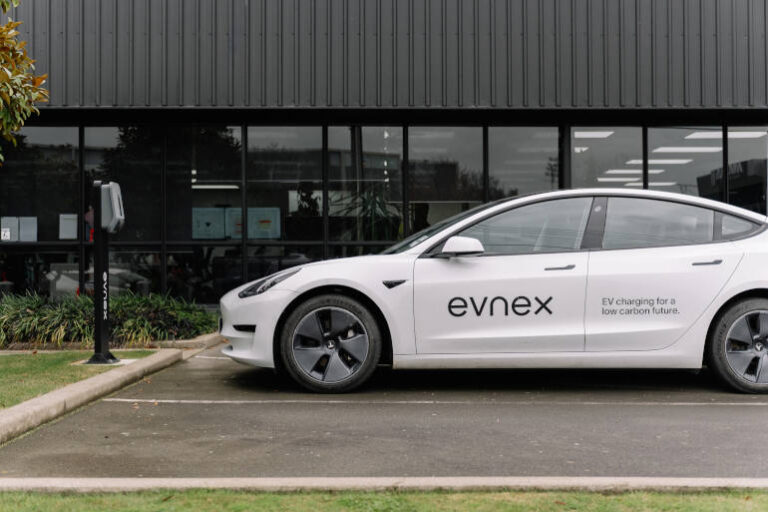
Evnex has passed 20,000 connected charger installations across Australia and New Zealand, with rapid growth reflecting the shift of home EV charging from an early-adopter product to mainstream infrastructure.
The Christchurch-based manufacturer shipped its first charger in 2017. While reaching the first 10,000 installations took eight years, the next 10,000 were added in just nine months.
Australia is now Evnex’s largest sales market, with the company selling around twice as many chargers locally as it does in New Zealand. The number of operational Evnex chargers in the two countries has also drawn level earlier than the company expected.
“Crossing 20,000 chargers is a proud moment for me and the entire team,” Evnex founder and CEO Ed Harvey said.
“I started the company from my parents’ farm in Marlborough, NZ, as a slightly naive 22-year-old simply because I wanted a charger for the 1997 Honda Accord I’d converted into an EV. What’s followed has been a wild but enormously gratifying journey.”
The milestone comes as Australia records strong growth in battery-electric and plug-in hybrid vehicle sales. That growth is increasing demand for charging solutions that can make better use of rooftop solar, off-peak tariffs and periods of abundant renewable energy.
“When we started out, an EV was a rare sight on either side of the Tasman,” Harvey said.
“Now more than one in five new cars sold in Australia is fully electric. Home charging is moving from an early-adopter product to mainstream household infrastructure.
“Our answer has always been smart charging, so it happens overnight or when the sun’s out, when power is cheaper and renewables are abundant.”
Smart charging cuts the cost of running an EV
Since its first installation, the Evnex network has delivered approximately 75 GWh of electricity—enough to support an estimated 450 million kilometres of electric driving.
At typical retail electricity rates, that energy would have a headline value of around $22 million. However, Evnex estimates its customers may have paid closer to half that amount because much of the charging occurred overnight or during the middle of the day.
These periods allow EV owners to take advantage of off-peak tariffs, free-energy offers and electricity generated by their own rooftop solar systems.
“A typical Australian EV driver uses about 2,000 kWh a year,” Harvey said.
“On a decent off-peak rate that is a few hundred dollars. Off your own roof it is close to nothing. Charge at the wrong time on the wrong tariff and you hand most of that back.”
Australia now has more than 4.3 million rooftop solar installations across homes and small businesses, with a combined capacity of approximately 28.3 GW.
The rapid uptake of household batteries and more flexible electricity tariffs is creating further opportunities to coordinate when an EV is charged.
For fleet operators, this highlights the importance of treating employee home charging as part of the broader fleet energy strategy. A managed charging platform can help organisations schedule charging, capture consumption data and reimburse employees accurately while reducing demand during expensive peak periods.
Home chargers become energy assets
Evnex believes the combination of EVs, rooftop solar, household batteries and flexible tariffs is changing the role of the home charger.
Instead of operating as a basic device that supplies power whenever a vehicle is connected, a smart charger can respond to electricity prices, solar generation and household demand.
This capability will become increasingly important as fleets allow more employees to take work vehicles home and seek greater visibility of where, when and how those vehicles are charged.
Evnex has expanded its Australian presence during the past year, including a partnership with EnergyAustralia to provide solar-aware charging to its customers.
The company has also launched the E2 Flex, which is designed for the approximately two-thirds of Australian homes that do not yet have rooftop solar. The charger can operate using grid electricity initially and add solar integration later through a software update, avoiding the need for a second electrical installation.
Evnex chargers continue to be designed and manufactured in Christchurch, with customer support available seven days a week.
“The next 20,000 will come a lot faster than the first,” Harvey said.
“We have had spikes before, but this one feels structurally different. Our modelling suggests Australia is moving into the early stages of mass EV adoption, not just a fad with good timing.
“The home charger is quietly becoming part of the energy system itself—soaking up low-cost power when it is abundant today, and ultimately helping enable technologies such as vehicle-to-grid in the future.”