


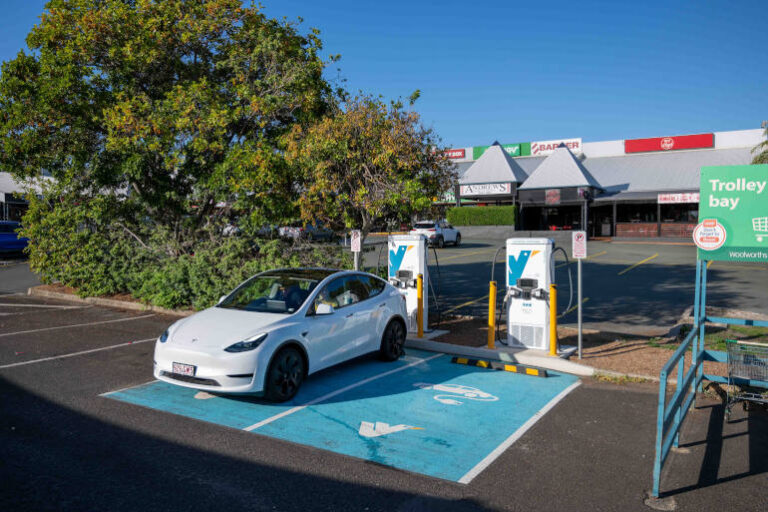
Ampol’s proposed $225 million acquisition of Evie Networks could prove to be a significant milestone for Australia’s EV charging sector, putting a substantial transaction value on a public charging network that was built well before electric vehicles became a mainstream consideration for Australian fleets.
Ampol Energy has entered into an agreement to acquire 100% of Fast Cities Australia Pty Ltd, which operates Evie Networks. Subject to ACCC clearance, the transaction is expected to be completed in the first half of 2027.
The deal would add more than 1,030 Evie charging bays to Ampol’s existing AmpCharge network, creating a combined network of approximately 1,425 bays across more than 400 locations.
While the increased scale is significant, the $225 million purchase price is perhaps the more interesting development for the EV charging industry.
It provides an indication of how established public charging networks are being valued as EV adoption and charger utilisation increase — and creates an exit for investors who committed capital when the commercial case for public charging was considerably less certain.

From early-stage investment to infrastructure asset
Evie Networks was founded in 2017, when Australia’s EV market and public charging network looked very different.
The business was initially supported by the St Baker Energy Innovation Fund, with $500,000 of seed funding followed by a further $7 million investment announced in 2018. Additional commitments followed as Evie began developing its national charging network.
Evie says StB Capital provided funding when there were only around 4,000 EVs on Australian roads and continued supporting the business while it established its network and business model.
Government funding also played a role. In 2019, ARENA committed $15 million towards a $50 million public-private project to establish 42 ultra-fast charging locations, helping provide the early intercity charging coverage needed to support longer-distance EV travel.
Further ARENA support helped Evie expand into metropolitan charging, while RACQ subsequently became a strategic investor.
That history makes the proposed Ampol transaction particularly noteworthy.
Capital was invested in charging infrastructure years before today’s EV volumes existed. Ampol is now proposing to pay $225 million for the resulting network, sites, grid connections, customer base and operating capability.
Ampol Managing Director and CEO Matt Halliday acknowledged the role of Evie’s early backing.
“Evie’s principal shareholder, Trevor St Baker AO, has been a genuine pioneer of Australia’s EV charging industry and his vision and capability have helped build Evie’s national platform and the foundations for broader EV adoption across Australia.”
Public charging becomes an infrastructure asset
The transaction follows another important development in Evie’s financing.
In 2025, Evie secured a $50 million senior debt facility from infrastructure investment manager Infradebt. Evie described it as the first non-recourse senior debt facility secured in Australia for public DC fast charging.
At the time, Evie Co-founder and Chief Strategy Officer Paul Fox explained that the company had initially needed venture capital because it was building charging infrastructure before significant demand existed.
“As an early mover, we had to build before there was any demand, so we used venture capital to prove the model,” Fox said.
The progression from venture funding, government support and strategic investment to infrastructure debt — and now a proposed $225 million acquisition by one of Australia’s largest fuel retailers — suggests public EV charging is moving into a different stage of development.
Charging locations are increasingly more than individual pieces of electrical equipment. Established networks can bring together valuable site agreements, grid connections, customers, operating systems, data and maintenance capability.
Ampol specifically highlighted Evie’s long-term site tenure and established grid connections, including locations with capacity for further expansion.
Utilisation is changing the investment case
The timing of the acquisition is also important.
Ampol said charging sessions across its AmpCharge network increased 116% year-on-year during the first half of 2026, while energy supplied increased 120%.
Halliday said Ampol had deliberately taken a measured approach to investment in charging infrastructure.
“For Ampol, EV charging is ultimately a question of disciplined investment at the right time. That means closely monitoring customer behaviour, EV uptake, site economics, grid connections and the broader charging network to ensure our capital is deployed where it can create the greatest value.”
The growth in utilisation appears to be strengthening that investment case.
“This gives us confidence in the strength of the business case that complements our traditional fuels business,” Halliday said.
For Ampol, acquiring an established network also offers a different route to scale compared with developing hundreds of sites individually.
“Evie’s high quality, attractive long-term tenure sites with established grid connections and some with expansion capacity, provides Ampol with an opportunity to grow its charging footprint at scale and at pace.”
Why it matters to fleets
For fleet operators, the consolidation of AmpCharge and Evie would create another large national charging platform at a time when public charging is becoming increasingly relevant to fleet electrification.
Public charging isn’t only for private motorists travelling between cities. It can provide an alternative for organisations that cannot install chargers at employees’ homes, have vehicles without reliable depot dwell time, or are beginning an EV transition before committing capital to their own charging infrastructure.
Evie has increasingly targeted this market through its fleet charging products, including consolidated billing and fleet management tools, while expanding its network across metropolitan and regional Australia.
Halliday also specifically identified fleets as part of the commercial opportunity.
“A substantial portion of Australian households have no practical means of charging at home, while public infrastructure is also critical for commercial fleets, rideshare operators and customers travelling longer distances.”
For Fleet Managers, the acquisition is therefore worth watching for more than the change of ownership.
A stronger commercial value being attached to established public charging infrastructure could encourage further investment, acquisitions and consolidation as charging utilisation increases.
It also demonstrates how quickly the charging market has evolved. Infrastructure that required patient early-stage capital and government assistance to establish is now attracting infrastructure debt and a $225 million acquisition proposal from one of Australia’s largest transport energy companies.
Ampol and Evie will continue operating independently while the proposed transaction is considered by the ACCC. Completion is anticipated in the first half of 2027.