

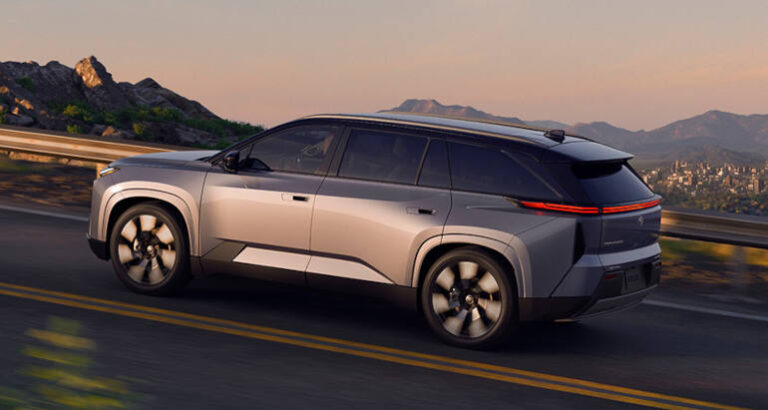
Toyota Motor Corporation has announced it will expand its battery electric vehicle (BEV) lineup in North America, adding an all-electric version of the Highlander as part of its multi-pathway approach to achieving a carbon-neutral society.
The new three-row SUV was unveiled by Toyota Motor North America in California, with sales expected to begin in late 2026.
Strengthening the multi-pathway strategy
Toyota continues to emphasise that carbon neutrality will require a range of technologies tailored to different markets. Alongside BEVs, the company is advancing hybrid, plug-in hybrid and hydrogen fuel cell vehicles to meet varying customer and regional requirements.
The decision to introduce a fully electric Highlander reflects Toyota’s product- and region-focused management approach, embedding electrification within established, high-volume nameplates rather than limiting BEVs to standalone models.
Production of the Highlander BEV will take place at Toyota’s Kentucky manufacturing facility, adding to its growing North American electric vehicle lineup.
A core SUV goes electric
The Highlander has long been positioned as a versatile three-row SUV suited to family use, urban driving and outdoor activities. Electrifying this model signals Toyota’s intent to bring zero-emission options into mainstream SUV segments that are widely used by both private buyers and fleets.
The new BEV version will offer multiple battery and driveline configurations, giving customers flexibility to align vehicle capability with driving needs and usage patterns.
Features such as battery preconditioning and improved eAxle efficiency are intended to support usability in a range of operating conditions, including colder climates and longer-distance travel.
Implications for fleet buyers
For Fleet Managers and Sustainability Managers, the expansion of BEV options into larger SUV categories is a practical development. Three-row SUVs are commonly used in executive transport, community services and operational support roles. An electric alternative within a familiar nameplate may simplify the transition process for organisations beginning to electrify these applications.
Finance Managers will need to consider acquisition costs, infrastructure planning and residual value assumptions as part of a broader whole-of-life assessment. As more mainstream SUVs move to electric platforms, fleet planning decisions can increasingly be based on operational suitability rather than limited product availability.
While the Highlander BEV has been confirmed for North America, it provides a clear indication of Toyota’s global direction. The company has reiterated that it will continue developing a variety of electrified powertrains to meet customer needs in each region as it works toward carbon neutrality.
For organisations developing medium-term fleet transition strategies, the key takeaway is that electrification is progressively extending into core fleet segments, reinforcing the need for structured planning and improved fleet management maturity.