


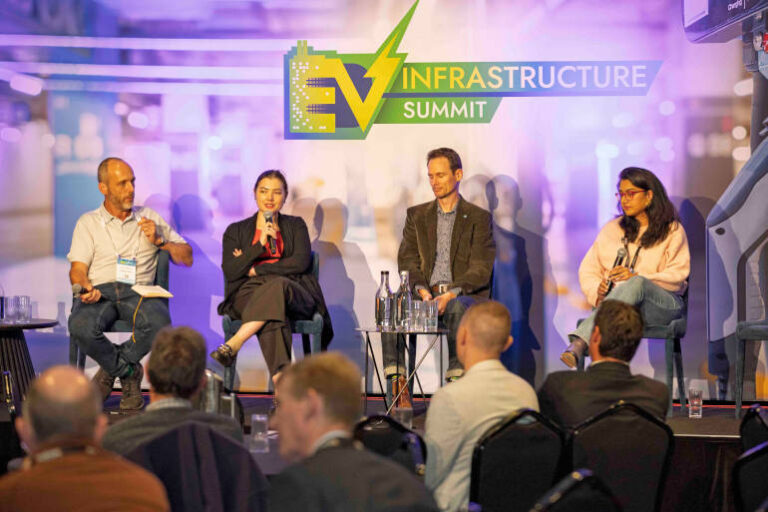
As Vehicle-to-Grid (V2G) technology edges closer to commercial reality, fleet managers and businesses are being urged to act now — not wait. A panel of industry experts at the 2025 EVI Summit explored what it will take to unlock the V2G opportunity in Australia, concluding that while V2G might be five years away, the time to prepare is now.
A Shift in Mindset
“You need to become an energy manager to become a V2G manager,” said Evan Beaver, Infrastructure Delivery Lead at Evenergi, who moderated the session.
Beaver drew on his experience with Tesla and Chargefox to outline the opportunity: V2G isn’t about trickle-feeding power from your home charger — it’s about making a commercial case that unlocks revenue. But that only happens if businesses understand their electricity use and vehicle movements.
The System Operator’s Perspective
Jonathon Dore, Manager – Distributed Energy Resource Technical Integration at AEMO, explained how the power system operator views V2G:
“There are a few times a year when you get the most value. Being able to push some energy back into the grid during a price spike can make someone a lot of bucks in a very short time.”
But he warned that V2G has to support, not destabilise, the grid.
“We apply very similar rules to V2G as we do to rooftop solar. It needs to ride through faults and not exacerbate a problem in the grid.”
AEMO is preparing now for flexible loads like EVs. “The big priority today is managing minimum system load,” Dore said, noting that energy prices are often negative in the middle of the day.
Thinking Like an Energy Asset
Kriti Nagrath, Research Principal at the Institute for Sustainable Futures, UTS, highlighted that V2G-ready EV drivers begin to see their vehicles not just as transport — but as energy assets.
“That mindset shift is really important,” she said. “Once people get an EV with V2G capability, they stop thinking of it as just a car.”
She urged fleet managers to gather three key data sets:
- Telematics – Understand when and where vehicles operate.
- Depot energy usage – Know the building or site consumption patterns.
- Driver behaviour – Understand and influence how drivers interact with charging infrastructure.
The Network Operator’s View
Naomi Wynn, Manager Net Zero Partnerships and Regulation – EV Charging at Ausgrid, outlined why fleets are so important to network operators:
“Fleets offer a far more coordinated opportunity to respond to events like excess solar during the day or peak demand at night.”
Wynn noted that Ausgrid is already working on smart tariffs and dynamic connections to help fleets charge when electricity is cheapest — and most abundant.
“You don’t have to build infrastructure for the one busiest day of the year. Dynamic connections mean cheaper and more efficient outcomes.”
She encouraged businesses to engage with their network early, especially if vehicles are taken home and need public curbside charging access.
So What Should Fleet Managers Do Now?
Here’s what the panel recommends you do today — to be ready for V2G tomorrow:
- Know your operations – Invest in telematics and charge management systems now. Even for petrol fleets, this builds your baseline.
- Engage with your DNSP – Start the conversation with your local network about charging connections and tariffs. Early collaboration unlocks future flexibility.
- Trial and learn – Start with managed charging. Don’t wait for V2G. Learn how to shift loads to low-cost periods and involve staff early in the change process.
- Treat the vehicle like an energy asset – Think in terms of total energy optimisation. A third of V2G value may come from exporting, but two-thirds comes from V2B (vehicle-to-building) or V2H (vehicle-to-home) savings.
- Expect different cohorts – Not everyone will embrace EVs or V2G the same way. Early adopters will drive progress, but your business needs to plan for broader staff engagement.
The Final Word: It’s Worth the Work
Beaver closed the session with a hopeful vision:
“Imagine a bus depot with solar, batteries, and a fleet of EVs plugged in. Buses do the morning run, then sit idle until the afternoon — that’s a huge opportunity to optimise your energy use, cut costs and support the grid.”
Wynn echoed the sentiment:
“Everyone is on a different journey. The important thing is to start. Start the conversation, start the data collection, and make your employees comfortable with the change.”
V2G is not science fiction — it’s the next evolution in fleet electrification. But it won’t happen by accident. The message from the 2025 EVI Summit was clear: If you want to profit from V2G in five years, start preparing today.