


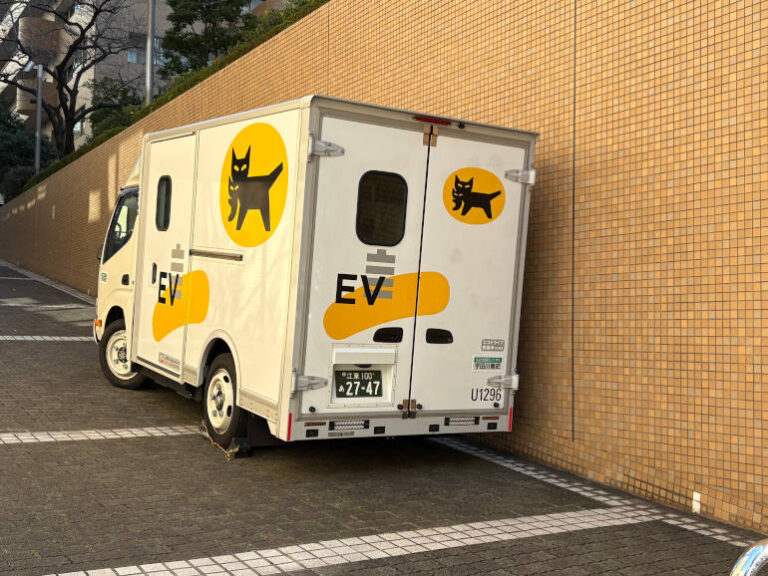
Electric vehicle adoption in Japan remains surprisingly modest for a country synonymous with automotive innovation.
Despite being home to some of the world’s largest vehicle manufacturers, battery electric vehicle penetration has hovered at low levels for several years.
“The EV penetration rate in Japan is constantly around two percent,” says Shuji Shiraki, Founder and CEO of eMotion Fleet. “Very, very low.”
While markets such as China, Norway and parts of Europe have accelerated rapidly, Japan’s transition has been more measured — shaped by infrastructure constraints, OEM strategy and practical fleet realities.
Infrastructure and Housing Constraints
One of the key barriers to EV adoption in Japan is charging access, particularly in dense urban centres.
“Particularly in Tokyo and other metropolitan cities, many people live in apartments,” Shiraki explains. “In many cases, the housing situation does not allow installing a charger.”
Mechanical parking systems common in Japanese cities add another layer of complexity. Even where companies want to push electrification for company cars, employees’ home charging capability can limit what is practical.
“Even if the company wants to push electric, the employee’s housing situation does not actually allow that,” he says.
Public charging networks remain limited in density, creating what Shiraki describes as a classic “chicken and egg” scenario.
“For those companies that have an EV agenda, with these dense networks still lacking, they are having challenges how to go about it,” he says.
OEM Strategy and Market Timing
Japan’s automotive industry has historically focused heavily on hybrid technology and hydrogen development. As a result, the rollout of competitive battery electric models has lagged behind some global competitors.
“Japanese auto makers are still very behind,” Shiraki says. “Toyota should be coming with more EV models maybe in the next two years.”
At the same time, Chinese brands such as BYD are beginning to enter the Japanese market more aggressively.
“BYD is becoming more relevant in the Japanese market,” he notes. “They even announced a k-car type model, which is very Japan specific.”
That level of localisation signals growing competitive pressure, which may accelerate domestic EV development.
Fleet Electrification: Starting with Data
For fleets, Shiraki believes electrification should begin with better data — not simply vehicle replacement.
“We have several steps in supporting customers through the journey,” he explains.
The first step focuses on what he calls “low carbonisation” — using telematics in diesel fleets to reduce idling, improve driver behaviour and optimise utilisation.
“Through the data we collect, we can reduce idling and improve efficiency,” he says. “That’s step one.”
The second step is fleet electrification consulting, where real-world vehicle usage data is used to determine which routes and vehicles are viable for EV replacement.
“We can say, this vehicle, this route, you can go electric with already the cars available in the market,” Shiraki says.
Rather than adopting EVs based on policy alone, this approach uses operational evidence to support decision-making.
Cold Climate Concerns
In northern regions such as Hokkaido, climate perceptions also affect adoption. “The perception is that core temperature and EV don’t really match,” Shiraki says.
To counter this, eMotion Fleet has been measuring EV data in cold climates to demonstrate what is achievable with the right charging and driving strategies.
“If you try to go to Hokkaido and talk with fleet operators, they say cold temperature and battery don’t match, so we don’t go electric,” he explains. “We want to prove them wrong.”
He argues that combining telematics data with smart charging and energy management software can improve range outcomes even in colder environments.
“It is a combination of different things,” he says. “Efficient driving, not charging to 100 percent every day, controlling charging speed at night — if you combine fleet management and energy management, there is a lot we can do.”
Telematics and the Data Gap
One of the structural challenges for EV fleets in Japan is limited access to granular vehicle data from OEM systems.
“When we try to go electric, pure GPS data is not enough,” Shiraki says. “You need state of charge, state of health, energy efficiency data.”
However, he notes that some manufacturers are reluctant to share that data openly. “They ask the OEM, can you share that? The answer is no,” he says.
As a result, OBD-based telematics platforms are beginning to gain attention among fleets seeking deeper insight.
“Once customers see the granularity of the data, they ask, can we not do the same thing with diesel?” Shiraki says. “The more granular the data, the more fuel saving cost you can achieve. There is definitely an ROI.”
Last Mile as the First Step
Shiraki expects electrification in Japan to be led by last-mile and municipal use cases rather than long-haul heavy trucks.
“In Japan, heavy duty truck electric will probably not come first,” he says. “Many automakers think hydrogen is more suited for long haul.”
Instead, urban logistics and short-range municipal fleets present the most immediate opportunity.
“I think it will be the last mile where electric will be moving on the demand,” he says.
A Market in Transition
Japan’s EV adoption story is not defined by hype or rapid policy shifts. It is defined by careful evaluation, structural constraints and a strong focus on safety and compliance.
Yet pressure is building — from global competition, carbon reporting expectations and operational cost management.
For Shiraki, the path forward is clear: electrification must be grounded in operational data.
“If customers see the data and understand the use case, then electrification becomes a business decision, not just a policy decision,” he says.
In that sense, Japan’s EV transition may be slower — but it may also be more methodical and data-driven as it gathers pace.