

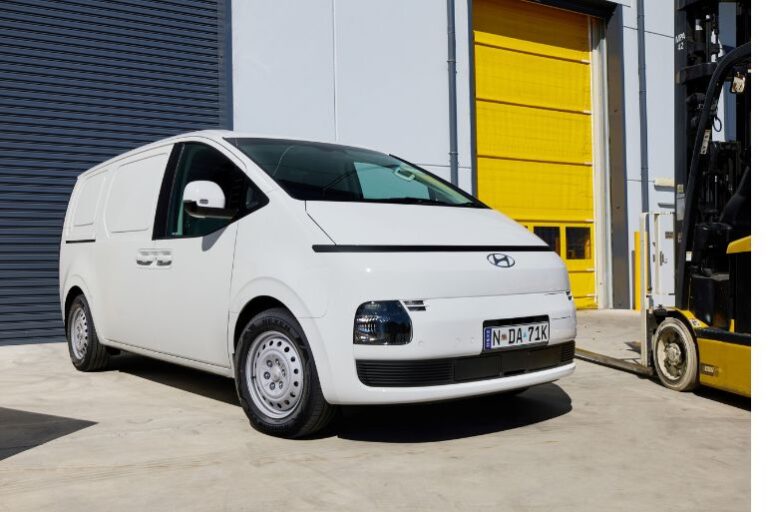
The arrival of the Hyundai STARIA Load Electric gives Fleet Managers something they rarely get when assessing an electric commercial vehicle: a genuine like-for-like comparison across diesel, hybrid and battery-electric powertrains.
All three versions offer essentially the same cargo space and around a one-tonne payload, making it possible to move beyond specification differences and ask the question that ultimately matters to a fleet — what does each powertrain cost over its working life?
Fleet News Group’s Whole of Life Cost (WOLC) model produces an interesting result.
Based on ownership over 48 months and 100,000 kilometres, the STARIA Load Hybrid records the lowest estimated annual WOLC at $15,115, narrowly ahead of the diesel at $15,225. The new STARIA Load Electric sits higher at $16,978 per year.
That means the Electric is still the most expensive of the three to own under the assumptions used in the model — but nowhere near by the margin suggested by its purchase price.
| STARIA Load | Diesel | Hybrid | Electric |
|---|---|---|---|
| Approx. NSW driveaway price | $53,000 | $56,000 | $74,000 |
| Consumption | 7.0L/100km | 6.2L/100km | 20.7kWh/100km |
| CO₂ | 183g/km | 147g/km | 0g/km tailpipe |
| Annual WOLC | $15,225 | $15,115 | $16,978 |
| Estimated WOLC over four years | $60,900 | $60,460 | $67,912 |
Fleet News Group WOLC estimate based on 48 months/100,000km. Driveaway pricing was calculated for NSW and rounded up.
Hybrid quietly comes out on top
Perhaps the first surprise is just how close the diesel and hybrid are.
The Hybrid costs approximately $3,000 more to put on the road, yet its estimated annual WOLC is $110 lower.
Across four years, that produces an estimated WOLC of $60,460 compared with $60,900 for the diesel — effectively making them lineball from a fleet budgeting perspective.
The Hybrid’s official combined fuel consumption of 6.2L/100km is lower than the diesel’s 7.0L/100km, while its quoted CO₂ figure falls from 183g/km for the diesel to 147g/km.
For fleets that aren’t ready to introduce charging infrastructure, that makes the Hybrid particularly interesting. It provides an emissions reduction without requiring drivers, depots or Fleet Managers to change how the vehicle is refuelled.
And according to the Fleet News Group WOLC model, there isn’t a financial penalty for doing it.
The Electric starts $21,000 behind
The biggest hurdle for the STARIA Load Electric is obvious before anyone opens a spreadsheet.
Fleet News Group calculated an approximate NSW driveaway price of $74,000, compared with $53,000 for the diesel and $56,000 for the Hybrid.
That puts the Electric around $21,000 above the diesel at acquisition.
But after 100,000km, the estimated difference in whole-of-life cost has fallen to approximately $7,012.
Against the Hybrid, the initial driveaway difference is around $18,000, while the estimated four-year WOLC gap is approximately $7,452.
That’s an important distinction for procurement teams.
Looking only at the purchase price makes the Electric approximately 40 per cent more expensive than the diesel. Looking at estimated WOLC over the nominated replacement cycle reduces the difference to around 11.5 per cent.
It doesn’t make the Electric the lowest-cost option in this scenario, but it changes the size of the financial hurdle considerably.
And unlike some electric vans, the numbers work operationally
Whole-of-life cost only matters if the vehicle can actually do the job.
This is where Hyundai’s specification for the STARIA Load Electric becomes important.
The 84kWh battery provides up to 450km of WLTP range, while its 1,005kg payload sits between the diesel’s 997kg and Hybrid’s 1,039kg. All three retain the same 4,935-litre cargo capacity.
The Electric also uses an 800V architecture capable of DC charging at up to 350kW, with Hyundai quoting a 10–80 per cent charging time of 20 minutes under suitable conditions. It can tow up to 2,000kg braked and includes Vehicle-to-Load capability for powering tools or other equipment from the traction battery.
That makes the WOLC comparison more relevant because Fleet Managers aren’t being asked to accept a dramatically smaller payload or cargo area simply to access an electric powertrain.
For the right operating profile, the three vans can potentially perform the same task.
WOLC makes the fleet decision more interesting
At first glance, choosing between the STARIA Load powertrains looks straightforward.
The diesel is the cheapest to buy. The Hybrid costs slightly more. The Electric costs substantially more.
Once whole-of-life cost is included, the picture changes.
The Hybrid becomes marginally the lowest-cost vehicle in the Fleet News Group model. The diesel remains extremely close. And while the Electric remains more expensive, lower ownership costs over the replacement cycle claw back a significant portion of its upfront premium.
For Fleet Managers, that’s why an EV assessment shouldn’t begin and end with the purchase order.
The next step is to run the numbers using the fleet’s actual kilometres, electricity tariffs, charging arrangements, fuel costs and replacement cycle. Residual values will also have a major influence on the final result as the used electric commercial vehicle market develops.
And there is another value that won’t appear directly in the dollar comparison: the STARIA Load Electric records zero tailpipe CO₂ emissions, compared with 147g/km for the Hybrid and 183g/km for the diesel.
For organisations with fleet emissions targets, that may be part of the business case rather than simply an environmental bonus.
The STARIA Load range therefore demonstrates why WOLC is becoming increasingly important as fleets compare different powertrains.
The Electric still asks Fleet Managers to pay more. The interesting part is that, over 100,000 kilometres, the gap becomes much smaller than the showroom price suggests.