


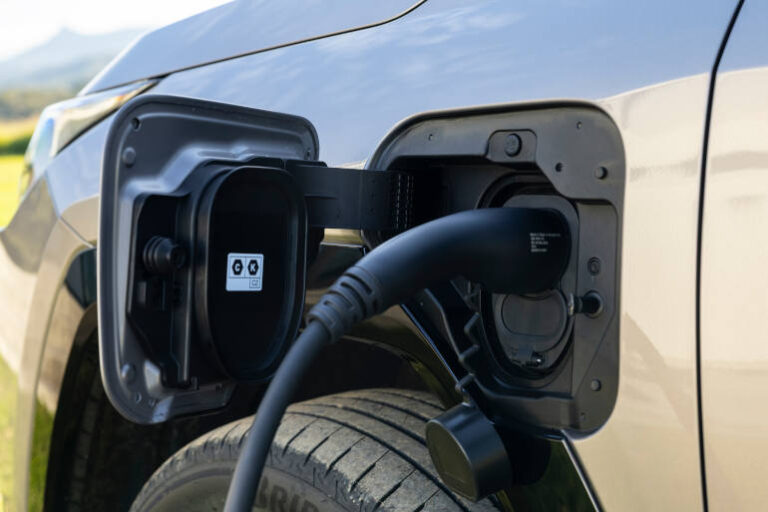
Toyota’s new RAV4 Plug-in Hybrid brings an important capability to the Australian fleet market: DC fast charging.
While many plug-in hybrids are designed primarily around home or workplace AC charging, the RAV4 PHEV can use both 11kW AC charging and up to 50kW DC charging. Toyota says the 22.7kWh battery can be charged from 10 to 80 per cent in around 28 minutes on a suitable DC charger, or from 10 to 100 per cent in approximately 2.5 hours using 11kW AC charging.
That gives fleet drivers more options to keep the vehicle operating in EV mode, whether it is charged overnight at home, plugged in at a depot during the day, or topped up at a public fast-charging site between appointments.
The significance is clear when considering the RAV4 PHEV’s electric-only range. Toyota claims up to 154km on the NEDC cycle for the front-wheel-drive XSE, while all-wheel-drive versions are rated at up to 144km. On the WLTP cycle, Toyota quotes 121km for the 2WD and 113km for the AWD.
For many fleet applications, that range could cover a full day of metropolitan or regional service work without the petrol engine needing to run. But it will only happen when the vehicle is charged consistently.

A plug-in hybrid is only as effective as its charging behaviour
A PHEV can offer a useful stepping stone for fleets that want to reduce fuel use and tailpipe emissions without committing every driver to a full battery-electric vehicle. It retains a petrol engine for long-distance work, while offering the potential for local driving to be completed electrically.
However, the operational outcome depends on driver behaviour and fleet controls.
A RAV4 PHEV that is charged regularly can complete a large share of daily travel in EV mode. A vehicle that is rarely plugged in becomes a heavier petrol SUV carrying a depleted battery, limiting the emissions and fuel-saving benefits that justified the purchase.
That makes a charging policy essential for any organisation introducing PHEVs.
Fleet policies should set out where drivers are expected to charge, when charging is required, who pays for home charging, how public charging is approved, and what happens when a vehicle is regularly returned without adequate battery charge.
The policy should also distinguish between charging for business use and charging that is simply convenient. Depot and home charging will generally provide the most predictable and manageable charging model, while public charging can provide an important operational back-up for drivers with longer or variable daily routes.
AC for routine charging, DC for operational flexibility
The ability to use AC and DC charging allows organisations to build a more flexible transition pathway.
Home charging can support employees who take vehicles home and start each day with a full battery. Depot charging can suit pool vehicles, operational teams and organisations with predictable return-to-base operations. AC charging is likely to do most of the routine work because vehicles are commonly parked for several hours or overnight.
DC charging adds another layer of flexibility. A driver who has used most of the battery during a busy day can regain useful electric range during a short break or while travelling between sites. It can also support vehicles that are unable to return to a depot or home charger before their next work period.
For fleets, this means charging infrastructure does not need to be limited to a single location or a single operating model. The RAV4 PHEV can work across depot, home and public charging environments.
Toyota notes that frequent DC fast charging can affect battery performance and durability, and recommends minimising its use. That reinforces the role of DC charging as an operational tool rather than a substitute for planned AC charging.
Monitoring is needed to prove the benefit
Fleet Managers will need data to ensure PHEVs are delivering the expected outcome.
At a minimum, organisations should monitor fuel purchases, electricity use, EV-mode kilometres where available, charging frequency and the share of trips completed with a charged battery. This can identify drivers or vehicle groups that are not charging consistently and help determine whether the assigned vehicle is suitable for the role.
The data can also support more informed conversations with drivers. A low charging rate may point to a lack of access to workplace infrastructure, uncertainty about reimbursement for home charging, poor awareness of vehicle settings, or an operating pattern that is not well suited to a plug-in hybrid.
The RAV4 PHEV’s combination of long claimed EV range, 11kW AC charging and 50kW DC capability creates a broader operating envelope than many plug-in hybrids. But the real fleet benefit will not come from the charging specification alone.
It will come from matching the vehicle to the right use case, providing drivers with simple charging access, setting clear expectations and monitoring whether the petrol engine is being avoided as often as the business case intended.