


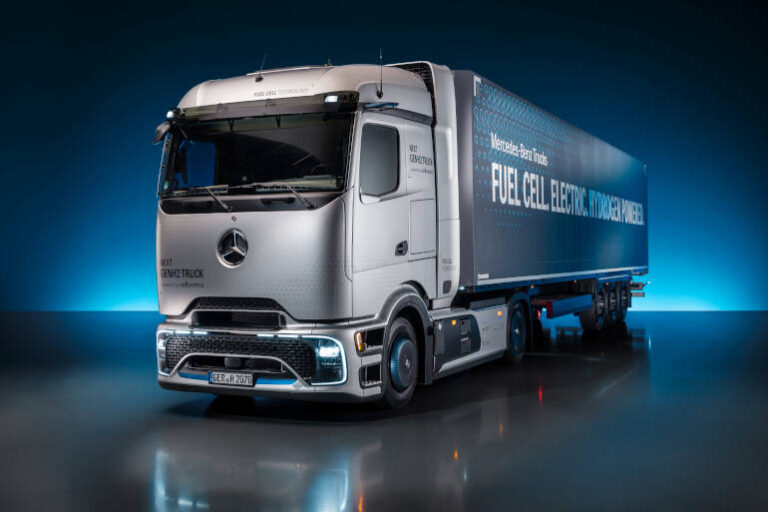
Daimler Truck has revealed the next step in its hydrogen trucking strategy, unveiling the Mercedes-Benz NextGenH2 Truck with small-series production planned to begin in Europe from the end of 2026.
The NextGenH2 Truck builds on the learnings from the first-generation GenH2 prototypes and is intended to demonstrate near-production-ready fuel cell technology in real-world long-haul operations. As part of the program, 100 trucks will be manufactured at the Mercedes-Benz plant in Wörth and deployed with selected European customers from late 2026.
According to Daimler Truck, the NextGenH2 Truck is designed for demanding long-distance transport tasks, combining hydrogen fuel cell technology with a battery-electric drivetrain. The truck uses liquid hydrogen, which offers higher energy density than gaseous hydrogen, enabling ranges of well over 1,000 kilometres on a single fill under full load conditions.
At the core of the drivetrain is the BZA150 fuel cell developed by cellcentric, the fuel cell joint venture between Daimler Truck and Volvo Group. Two fuel cell units operate as a twin system with a combined output of 300 kW, supported by a high-voltage buffer battery. Power is delivered through the same integrated electric axle used in the battery-electric Mercedes-Benz eActros 600.
Daimler Truck has also carried over a number of series-production components from its battery-electric trucks. These include the aerodynamically optimised ProCabin, the latest Multimedia Cockpit Interactive 2, and a full suite of advanced safety systems such as Active Brake Assist 6 and Active Sideguard Assist 2. The company says this approach helps accelerate development while improving reliability and driver familiarity.
From an operational perspective, the NextGenH2 Truck has been engineered to align closely with existing diesel long-haul workflows. Refuelling liquid hydrogen using the sLH2 standard can reportedly be completed in around 10–15 minutes, while payload capability and vehicle performance are intended to be comparable to conventional diesel prime movers.
Australian perspective
For Australia, Daimler Truck Australia Pacific is watching developments closely, but there are no immediate plans for local introduction.
Daimler Truck Australia Pacific Vice President Sales, Marketing and Operations, Andrew Assimo, said the European milestone was an important signal for the future of heavy transport.
“The start of the Mercedes-Benz NextGenH2 production for European markets represents a major milestone for sustainable trucking,” Mr Assimo said.
“We have no immediate plans for its introduction in Australia, but that is certainly something we will consider as we watch its roll-out across Europe,” he added.
While hydrogen refuelling infrastructure remains limited in Australia, Daimler Truck has consistently stated that hydrogen will play a role alongside battery-electric solutions in the long-term decarbonisation of heavy transport, particularly for applications requiring long range, high utilisation and fast refuelling.
Daimler Truck has indicated that series production of hydrogen fuel cell trucks is targeted for the early 2030s, subject to technology readiness, infrastructure development and market conditions.