


Toyota New Zealand has been steadily laying the groundwork for hydrogen mobility, with a strategy that prioritises collaboration, infrastructure alignment and long-term decarbonisation outcomes.
Rodger Spillane, Manager – Hydrogen Programme at Toyota New Zealand, says the company’s involvement dates back several years and has focused on practical projects rather than announcements.
“Toyota New Zealand have had active hydrogen projects since around 2021,” Spillane explained. He noted that the broader ecosystem began forming after “a 2018 Memorandum of cooperation between New Zealand and Japan.”
Early projects: buses, car share and marine
Toyota’s initial involvement has spanned multiple applications.
In 2021, partners converted a hydrogen bus for Auckland Transport. “They built a converted hydrogen bus for Auckland Transport, and that’s in operation even today,” Spillane said. “It does the school run in the morning and uses the Hiringa Energy refuelling station.”
Toyota also established a Mirai-based car share trial in Auckland, involving major corporates. “We established a car share scheme based in Auckland, around the refuelling facility that Halcyon Energy have in Auckland,” Spillane said. “That was around a group of connected companies… that would share a pool of five Mirai vehicles.”
The project was run through Toyota Finance’s Cityhop business and, according to Spillane, was “very much around that connected mobility project”.
One of the higher-profile initiatives was hydrogen-powered chase boats used during the America’s Cup. “One of the most successful projects we’ve been involved in is the hydrogen chase boats… used for the America’s Cup in Barcelona,” he said.
Heavy freight focus
While hydrogen passenger vehicles remain part of Toyota’s global strategy, New Zealand’s near-term opportunity is concentrated in heavy transport.
Spillane described collaboration with GBV Technology, TR Group and hydrogen producer Hiringa Energy to deploy converted 50-tonne fuel cell trucks powered by Toyota systems.
“GBV are delivering 12 of those which are powered by the Toyota fuel cell,” he said. “So the same fuel cell that you’ve got in Mirai… that’s enough motive power for a 50-ton GVM truck.”
Spillane emphasised that progress depends on coordinated investment.
“You can’t have the trucks without the infrastructure, but you can’t build the infrastructure if you don’t know that you’ve got customers lined up to make use of them,” he said.
Government support through the Energy Efficiency and Conservation Authority (EECA) has helped fund both refuelling infrastructure and truck deployment. At the same time, policy settings such as staged increases in diesel costs under the Emissions Trading Scheme are shaping the commercial outlook.
“We can see and understand very clearly where diesel is going to be, say by 2030,” Spillane said, noting that parity between diesel and hydrogen operating costs is expected toward the end of the decade.
Green hydrogen advantage
A key factor in Toyota’s New Zealand strategy is access to renewable electricity.
“You’ve got a very high proportion of renewable energy generating electricity… up to 85 per cent,” Spillane said. “That means that the hydrogen that we’re using to refuel the Mirai or the trucks is green hydrogen.”
For fleets with decarbonisation targets, that distinction matters. “The use of green hydrogen is really important to us, and we know to our customers as well,” he added.
Multi-powertrain future
Spillane was clear that hydrogen is not positioned as a single solution.
“We’d expect to see a range of powertrains serving the market,” he said, listing hybrid, plug-in hybrid, battery electric and hydrogen fuel cell vehicles as part of the mix.
In the near term, “our opportunity in New Zealand is skewed towards that heavy freight,” he said, reflecting infrastructure capability and operator demand.
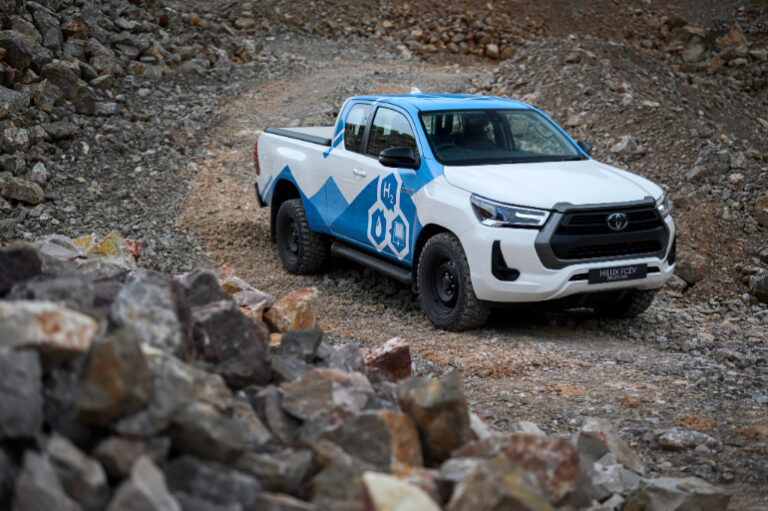
Hydrogen Hilux signalled for 2028
Looking ahead, Toyota has flagged the arrival of a hydrogen-powered Hilux.
“We announced with the new model Hilux that there’ll be a 2028 hydrogen Hilux,” Spillane confirmed.
He said the vehicle has been “signalled for some time”, with overseas concepts demonstrating how it could work. In markets such as Australia and New Zealand, Spillane suggested it could find application in mining and other commercial environments, while also appealing to broader customer segments.
“Hilux speaks to so many different parts of not just business, but the private market,” he said.
Collaboration at the core
For Spillane, the defining feature of Toyota’s hydrogen strategy is partnership.
“The key thing I’d emphasise is the collaborative nature of the hydrogen ecosystem in New Zealand,” he said.
Toyota’s objective, he explained, is “to collaboratively grow the hydrogen ecosystem”, with a focus on long-term decarbonisation outcomes.
For fleet buyers watching hydrogen’s progress, the message is that Toyota is building capability step by step — infrastructure, heavy vehicle applications and policy alignment first — before broader model expansion later in the decade.