


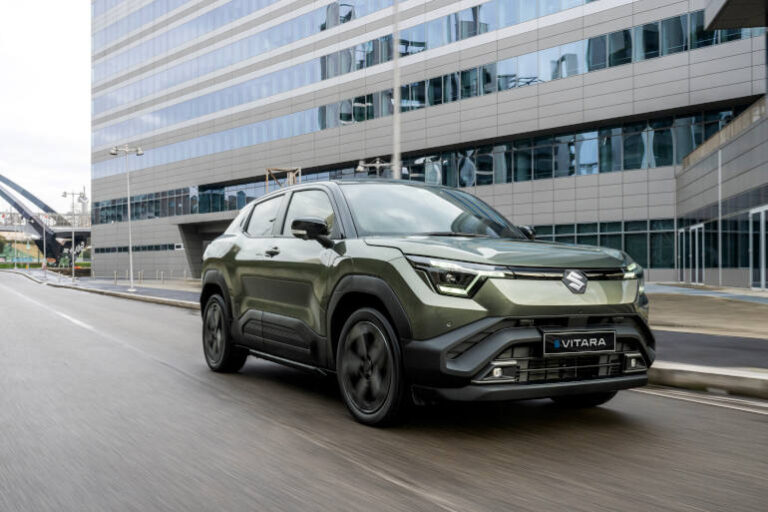
Suzuki has confirmed Australian specifications for its first fully electric vehicle, the Suzuki e Vitara, with local arrivals expected from June 2026 .
For fleet buyers and novated lease customers, the e Vitara represents a significant shift for the brand. It carries one of Suzuki’s most recognisable nameplates into the battery electric era, while aiming to retain the practicality and efficiency that have traditionally underpinned its appeal.
Michael Pachota, General Manager – Automobile at Suzuki Australia, described the launch as a milestone for the brand.
“The e VITARA marks a defining moment for Suzuki, it’s our first battery electric vehicle and a clear signal of how we’re evolving as a brand, whilst remaining true to the values that have always defined Suzuki – efficiency, reliability and everyday usability,” he said .
Two variants: Motion and Ultra
The Australian line-up will consist of two variants:
- Motion – 49kWh, 2WD
- Ultra – 61kWh, ALLGRIP-e 4WD
The Motion delivers a claimed driving range of 344km, while the Ultra extends that to 395km . For urban fleets, pool vehicles and salary-packaged commuters, that range bracket places the e Vitara squarely in the daily-use category.
Power outputs differ between the two models. The Motion produces 106kW and 193Nm, while the Ultra increases output to 135kW and 307Nm, thanks to dual motor front and rear eAxles .
ALLGRIP-e: Electric AWD for varied conditions
The Ultra variant introduces ALLGRIP-e, Suzuki’s electric four-wheel-drive system using independent front and rear motors. Torque distribution is managed electronically to improve traction and stability across sealed and unsealed surfaces .
For regional councils, utilities and businesses operating beyond metro areas, this could be a differentiator. Electric SUVs with genuine AWD capability remain limited in the compact segment, particularly at more accessible price points.
Built on the new HEARTECT-e platform
The e Vitara is underpinned by Suzuki’s dedicated HEARTECT-e battery electric platform. According to Suzuki, the architecture is designed to optimise cabin space, rigidity and battery integration while maintaining the brand’s lightweight engineering philosophy .
Dimensionally, the vehicle measures 4,275mm long with a 2,700mm wheelbase and 180mm ground clearance , positioning it competitively within the compact SUV segment.
Battery chemistry is lithium iron phosphate (LFP), a choice increasingly favoured for durability and thermal stability in fleet applications.
Charging and heat pump as standard
Both variants support AC and DC charging. Indicative charging times include:
- DC rapid charging (10–80%): 45 minutes
- 11kW AC (10–100%): approximately 5.5 hours
- 7kW AC (10–100%): approximately 9 hours
Importantly, a heat pump is standard across the range . For fleets operating in varying climates, this can improve efficiency and help stabilise range performance during colder conditions.
Interior: physical controls remain
Inside, Suzuki has taken a pragmatic approach. While the e Vitara features a 10.1-inch centre display and 10.25-inch digital instrument cluster , it retains physical climate control switches.
For Fleet Managers managing mixed-driver environments, tactile controls often reduce distraction and training requirements compared to fully touchscreen-dependent systems.
The Ultra adds premium touches including a glass roof, Infinity sound system, heated front seats and an electrically adjustable driver’s seat .
Safety as standard
Suzuki has confirmed a comprehensive safety suite across the range, including:
- Adaptive Cruise Control
- Autonomous Emergency Braking
- Lane Keeping Assist
- Blind Spot Monitor
- 7 airbags
For corporate policy alignment and ANCAP-conscious procurement teams, this standardised safety offering simplifies specification decisions.
Early global recognition
Ahead of its Australian launch, the e Vitara has attracted international attention, including recognition from the Automotive Researchers’ & Journalists’ Conference of Japan (RJC) .
Pachota noted the global reception provides confidence heading into the Australian market.
“Strong interest across international markets gives us real confidence as we prepare to introduce this vehicle to Australian drivers,” he said .
What it means for fleets
For fleet buyers, the e Vitara enters a segment where demand is accelerating but price sensitivity remains high. Compact electric SUVs are increasingly being considered for:
- Urban pool fleets
- Field service operations
- Salary-packaged employee vehicles
- Regional council light-duty roles
The availability of a 4WD electric option broadens its potential use cases beyond purely metropolitan deployments.
For Suzuki, the e Vitara is more than a new model. It signals the brand’s transition into electrification while attempting to maintain the practical, no-nonsense positioning that has long defined it in Australia. For fleets balancing emissions targets with operational realism, that balance will be closely watched.