


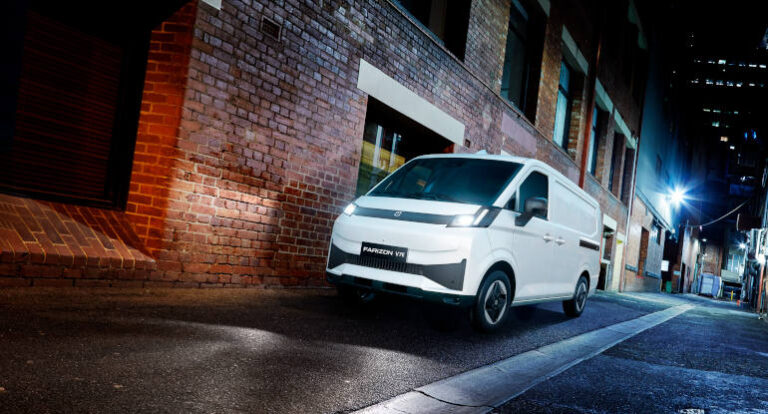
Farizon has announced the arrival of its all-new V7E electric van in Australia, positioning the model as a practical, work-focused alternative for fleets looking to reduce operating costs without compromising on capability.
Developed in partnership with Jameel Motors Australia, the V7E expands Farizon’s local commercial vehicle lineup and is expected to be available from May 2026, with full specifications and pricing to be confirmed in April.
Built for fleet fundamentals, not just electrification
The V7E enters the market with a clear message: electric power is an advantage, but it’s not the starting point. Instead, Farizon has focused on delivering the fundamentals fleet operators expect from a light commercial vehicle.
Adam Lawson, Country General Manager at Jameel Motors Australia, said the vehicle reflects a shift in buyer priorities.
“The arrival of V7E reflects a clear shift in how businesses are thinking about their next commercial vehicle. Operators want capability, usability and value first,” he said.
With a payload of more than 1,300kg and cargo volume of 6.95m³, the V7E is designed to compete directly with internal combustion engine (ICE) vans on practical performance.
For Fleet Managers, this signals an important trend: OEMs are now designing electric vans to integrate into existing operations, rather than requiring operational changes.
Designed for urban fleet operations
The V7E has been engineered around the realities of high-utilisation urban fleets, including courier services, trade vehicles and service fleets.
Key design features include:
- Narrow body and tight turning circle for urban access
- Low rear loading height for frequent loading cycles
- Generous internal load length for practical cargo use
- Agile footprint suited to congested metro environments
With a claimed driving range of up to 330km, supported by CATL LFP battery technology, the V7E is targeted at stop-start duty cycles typical of last-mile delivery and service operations.
This aligns with a growing trend where fleet electrification is being led by use cases with predictable routes and daily mileage.
Lower operating costs without changing fleet operations
A key positioning for the V7E is its ability to reduce operating costs without requiring significant changes to fleet processes.
By eliminating fuel dependency and reducing mechanical complexity, the vehicle offers:
- Lower servicing requirements
- Reduced fuel costs
- Simplified ownership model
- Depot or home charging flexibility
Lawson reinforced that the value proposition is centred on total cost of ownership rather than environmental messaging alone.
“Many operators are reassessing the true cost of running traditional ICE vans and looking for alternatives that do not require a change in how they work,” he said.
For Finance Managers, this reflects a broader shift towards evaluating EVs through whole-of-life cost modelling rather than upfront purchase price.
Supporting fleet maturity in EV adoption
The launch of the V7E highlights an important step in fleet electrification maturity.
Rather than focusing on early adopters or pilot programs, vehicles like the V7E are designed for mainstream fleet deployment. This means:
- Comparable payload and usability to existing assets
- Fit-for-purpose design for operational requirements
- Reduced barriers to adoption through familiar workflows
For organisations still developing their fleet strategy, this type of vehicle supports a gradual transition by enabling EV adoption within existing policies and operational frameworks.
Timing aligns with rising cost pressures
The V7E arrives at a time when many Australian fleets are reassessing cost structures due to rising fuel prices, maintenance costs and broader operational pressures.
Farizon’s positioning is clear: electric vehicles need to compete on economics and usability first.




