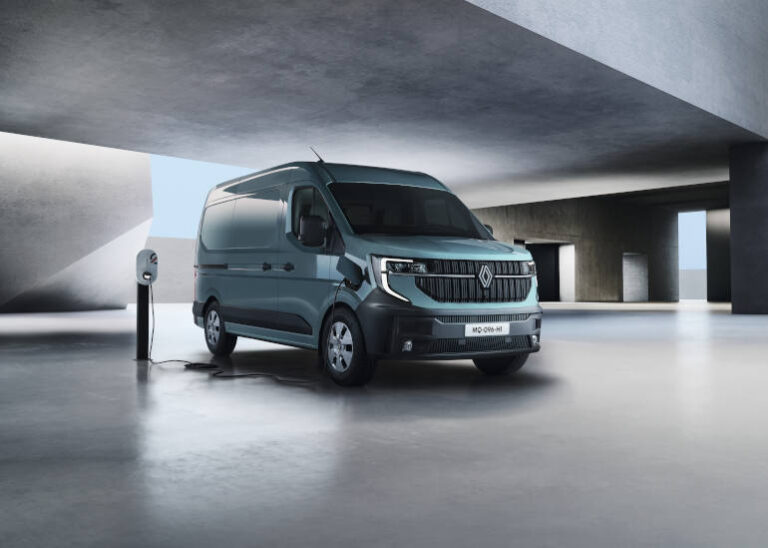
Renault has confirmed the arrival of an all-electric version of its flagship large van, signalling a clear intent to compete more aggressively in one of the most important segments for Australian fleets.
Due in local showrooms from June 2026, the electric Renault Master E-Tech will sit alongside diesel variants in the new-generation range, giving buyers a direct choice between traditional and zero-emission powertrains in the same vehicle platform.
For fleet operators looking to reduce emissions without downsizing vehicle capability, that positioning is significant. The large van segment has historically been dominated by diesel models, but electrification is starting to gain momentum as more OEMs bring purpose-built electric vans to market.

A serious contender for urban freight and service fleets
The electric Master is powered by an 87kWh battery pack delivering a claimed driving range of more than 400km on the WLTP test cycle. That range places it squarely in the operating window for metropolitan delivery, trade and service fleets that typically return to base each day.
Fast charging capability of up to 130kW means the vehicle is compatible with the most widely available DC charging infrastructure in Australia, supporting overnight depot charging or rapid top-ups during busy operating schedules.
From a fleet planning perspective, those specifications are increasingly becoming the baseline expectation rather than a premium feature.
The introduction of a large electric van with this level of range and charging capability also reflects a broader shift in the market. Fleet managers are under pressure to reduce emissions while maintaining productivity, and large vans are often among the most heavily utilised assets in urban operations.
Designed to compete on capability, not just emissions
One of the challenges for electric vans entering the Australian market has been payload and durability. Renault appears to be addressing that directly, with the electric Master offering payload of up to 1164kg and Gross Vehicle Mass (GVM) of up to 3500kg depending on specification.
That keeps the vehicle within the critical licence threshold for standard car drivers while still delivering meaningful load capacity.
The new-generation Master platform also focuses on operational practicality. The side loading door is sized to accommodate a standard forklift pallet, and a flat bulkhead behind the front seats maximises usable cargo space—features that matter more to fleet buyers than headline technology.
Renault has also introduced a redesigned cabin with improved ergonomics and connectivity, while retaining physical buttons and controls to reduce driver distraction. A fold-down centre seat can be configured as a mobile workstation, providing a practical solution for drivers completing paperwork or managing job schedules on the road.
Competition intensifies in the large electric van market
The arrival of the electric Renault Master adds another credible option to a segment that is rapidly evolving as fleets begin transitioning away from diesel.
Large vans are often the backbone of logistics, maintenance and service operations, and they are typically among the first vehicles targeted for electrification because of predictable routes and centralised depots.
For Fleet Managers, the growing number of electric large vans creates genuine procurement choice for the first time. Instead of trialling smaller vehicles or adapting passenger models, organisations can now assess purpose-built electric vans designed for commercial workloads.
That competition is expected to drive improvements in range, payload, charging performance and total cost of ownership over the next few years.
Part of a broader model rollout
Renault says the new-generation Master—available in both diesel and electric form—is a key part of its product renewal strategy in Australia.
Renault Australia General Manager Glen Sealey said the brand is focused on strengthening its position in the commercial vehicle market.
“The new-generation Renault Master is a key part of Renault Australia’s model revitalisation,” said Sealey.
“Last year Renault Australia promised six new models in the next 18 months and the new-generation Renault Master shows we are delivering. Plus there is more to come.”
Full pricing and detailed specifications for the electric Renault Master will be announced closer to the June 2026 launch.
For fleet buyers, the timing is notable. With emissions targets tightening and operating costs under scrutiny, the arrival of another large electric van option provides a practical pathway to decarbonise high-utilisation vehicles without compromising on size, capability or productivity.
- Parramatta found a simple way to tackle EV resistance
 Range anxiety isn’t always solved with another spreadsheet. Sometimes you need to hand someone the keys. That’s one of the lessons from City of Parramatta’s fleet electrification program, where an EV drive week has become an important tool for building employee support for the transition. Speaking at Everything Electric Sydney during a panel featuring finalists
 - Ausgrid’s charging strategy goes well beyond the depotInstalling chargers at the depot might be the obvious starting point for fleet electrification. For Ausgrid, it wasn’t going to be enough. As the electricity network continues electrifying passenger vehicles, vans and trucks, it has developed a charging strategy designed around how employees actually use fleet vehicles. Speaking during the Fleet News Group Awards finalists
- For Allianz, EVs are now business as usualFor many organisations, fleet electrification still means pilots, trials and discussions about what might happen next. At Allianz, the conversation has moved on. After starting its transition with a small pilot of 12 vehicles two years ago, the insurer has reached the point where electric vehicles are becoming part of its normal fleet replacement process.
- A Charger That Powers Up Isn’t Finished: Why Commissioning Matters for Fleet EV ChargingAn EV charger can be installed, connected and apparently operating — and the charging system can still be wrong. That is one of the more important lessons from the Local Council EV Integration Project involving Wyndham, Brimbank and Moonee Valley councils. As fleet charging installations become larger, depots are adding not only chargers but load
- How to Install EV Charging Without Shutting Down the DepotBuying electric vehicles may be the visible part of fleet electrification, but much of the hard work can happen underground. Trenching, conduits, electrical upgrades, switchboards, charger foundations, communications, traffic management and electrical shutdowns all need to be completed while the depot continues doing its normal job. Experience from the Local Council EV Integration Project involving