


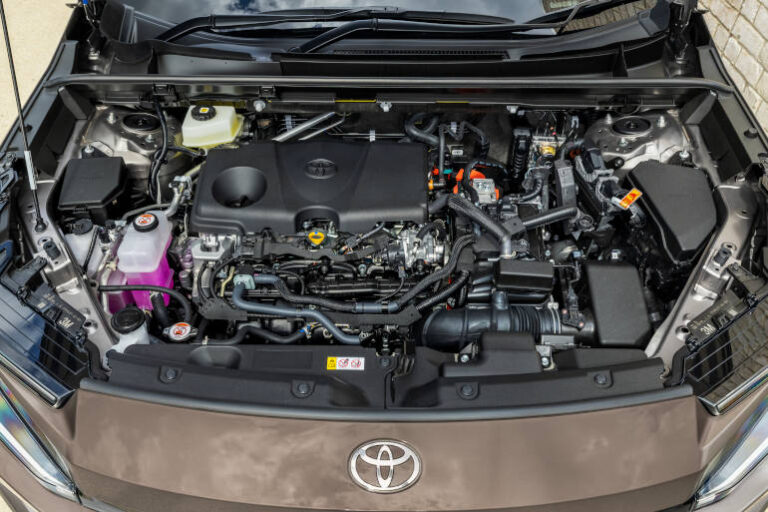
The sixth-generation Toyota RAV4 continues Toyota’s commitment to hybrid technology, but this latest update goes beyond incremental refinement. The new powertrain introduces meaningful engineering changes aimed at improving acceleration, efficiency, durability and overall driving feel — all critical factors for fleet buyers focused on Whole-of-Life Cost (WOLC) and emissions performance.
For many organisations, the hybrid system is the defining feature of the RAV4. It was the previous generation that enabled fleets to transition from sedans such as the Toyota Camry into SUVs without sacrificing fuel efficiency. The new model builds on that foundation with a redesigned fifth-generation hybrid system that is lighter, more powerful and more efficient than before.

A refined 2.5-litre hybrid system at the core
At the heart of the new RAV4 is Toyota’s updated 2.5-litre petrol-electric hybrid system, built around the A25A-FXS naturally aspirated engine paired with electric motor generators and an electronically controlled continuously variable transmission (e-CVT).
The petrol engine produces:
- 105 kW of power
- 221 Nm of torque
- Stronger low-speed torque delivery than the previous model
This improved torque response is particularly noticeable during everyday driving — accelerating from traffic lights, merging onto highways, or climbing steep grades. Engineers have recalibrated the engine to reduce reliance on high-rpm operation, resulting in smoother and quieter performance under load.
The combined system output for both two-wheel-drive and all-wheel-drive variants is:
- 143 kW total system power
That figure positions the RAV4 competitively within the medium SUV segment while maintaining its reputation for fuel efficiency.
New electric motor delivers stronger acceleration
One of the most significant changes in the new hybrid system is the upgraded electric motor generator.
Toyota engineers have redesigned the motor to increase output while reducing overall size and weight. The new design doubles the number of magnets inside the rotor and uses a revised coil winding method to improve efficiency.
The result is:
- 12 kW increase in front motor output
- Maximum motor output of 100 kW
- 208 Nm of torque from the electric motor
For drivers, this translates into:
- Faster initial acceleration
- Stronger response at low speeds
- More confident overtaking performance
These improvements are particularly valuable for fleet vehicles operating in urban environments, where stop-start driving dominates daily use.
New lithium-ion battery improves performance and efficiency
The previous RAV4 used a nickel-metal hydride battery in most variants. The new generation replaces that system with a lithium-ion battery across the range.
Key specifications include:
- 68-cell lithium-ion battery
- 4.4 Ah capacity
- Improved energy input and output capability
The battery is located beneath the rear seat and uses an air-cooled structure that channels cabin air through the system to maintain optimal operating temperature.
This design delivers several practical benefits:
- Improved fuel efficiency
- Reduced system weight
- Enhanced durability
- Better performance during sustained driving
From a fleet perspective, battery reliability and cooling efficiency are critical factors in long-term operating costs.
New hybrid transaxle reduces friction and improves efficiency
Toyota has also redesigned the hybrid transaxle — the component responsible for transferring power from the engine and electric motors to the wheels.
The new unit introduces several technical changes:
- Smaller, lighter internal gears
- Revised gear tooth design for improved strength
- New lubrication system
- Low-viscosity oil with 50 per cent lower resistance
These updates reduce mechanical losses and improve energy efficiency throughout the drivetrain.
In practical terms, this means:
- Better fuel economy
- Smoother acceleration
- Reduced drivetrain noise and vibration
The addition of a dry sump lubrication system further improves cooling and reliability during sustained operation.
Fuel efficiency and emissions improvements
Fuel efficiency remains the defining advantage of the RAV4 hybrid.
Official combined fuel consumption figures for the new model are:
Two-wheel drive
- 4.5 L/100 km combined
- 4.2 L/100 km urban
- 4.7 L/100 km extra-urban
All-wheel drive
- 4.6 L/100 km combined
- 4.4 L/100 km urban
- 4.8 L/100 km extra-urban
Combined carbon dioxide emissions are:
- 102 g/km for 2WD models
- 105 g/km for AWD models
These figures reinforce the RAV4’s position as one of the most efficient vehicles in its class.
For fleets operating under emissions reduction targets or sustainability reporting frameworks, the lower CO₂ output provides measurable progress toward compliance goals.
Improved drivability in real-world conditions
The updated hybrid system is designed to deliver more consistent performance across a wider range of driving conditions.
Key improvements include:
- Better sustained acceleration at higher speeds
- Reduced engine noise during normal driving
- Improved responsiveness when climbing hills
- Enhanced traction on low-grip surfaces
All-wheel-drive variants use a rear electric motor to distribute torque automatically between the front and rear wheels, improving stability and control in challenging conditions.
This system continuously monitors:
- Wheel speed
- Steering angle
- Vehicle motion
The result is improved traction and reduced risk of wheel slip, particularly on wet or gravel roads.
Why the hybrid system matters for fleets
The hybrid powertrain is not just a technology upgrade — it is a cost management tool.
Fuel remains one of the largest operating expenses in any fleet, and even small improvements in efficiency can produce significant savings over the life of a vehicle.
For example:
- A 4 per cent reduction in fuel consumption across a high-utilisation fleet can deliver substantial cost savings
- Lower emissions support corporate sustainability targets
- Reduced engine load can extend component life
These factors directly influence Whole-of-Life Cost calculations and vehicle replacement planning.
The bigger picture — evolution, not revolution
The new hybrid system in the Toyota RAV4 represents a careful evolution of proven technology rather than a radical redesign.
Toyota has focused on improving efficiency, durability and drivability while maintaining the reliability that has made the RAV4 a staple of fleet operations.
For fleet buyers, the message is clear:
The new hybrid powertrain is more capable, more efficient and better suited to modern operating conditions — but it remains grounded in the same dependable architecture that has defined the RAV4’s success in the Australian fleet market.