

Australia’s Treasury review of the Electric Car Discount has quietly quantified something Fleet Managers rarely factor into their total cost of ownership: the substantial public health savings generated every time a battery EV replaces a petrol or diesel vehicle.
When Australians weigh up the cost of switching to an electric vehicle, the conversation almost always lands on the same numbers: sticker price, fuel savings, charging costs. What rarely enters the calculation is the health bill that ICE vehicles quietly run up on every street, in every suburb, every single day.
The Federal Government’s statutory review of the Electric Car Discount — released in May 2026 — has put a dollar figure on that hidden cost for the first time in a comprehensive policy context. And the numbers are significant enough to fundamentally reframe how fleet operators think about the upfront premium of going electric.

What ICE vehicle are actually costing us
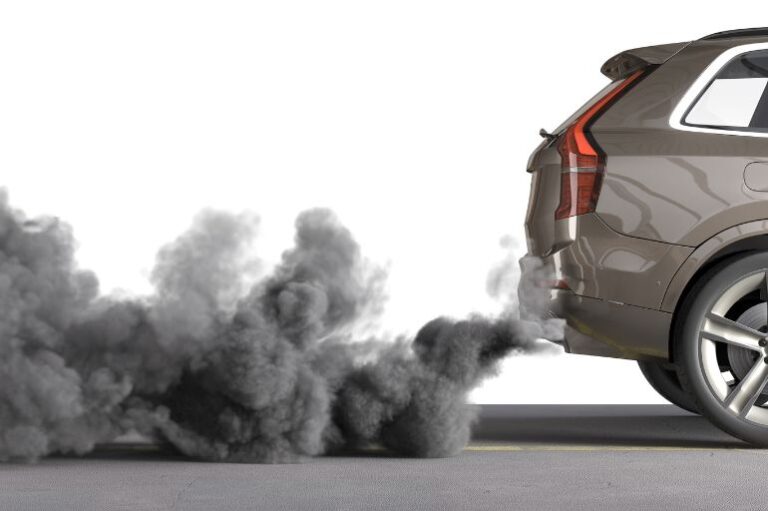
Internal combustion engine vehicles are a major source of carbon monoxide, nitrogen oxides, particulate matter and volatile organic compounds — particularly in densely populated urban areas. These aren’t abstract pollutants. They cause smog, contribute to heart and lung disease, and are linked to cancer. Vulnerable groups — children, people with asthma, the elderly — bear a disproportionate share of that burden.
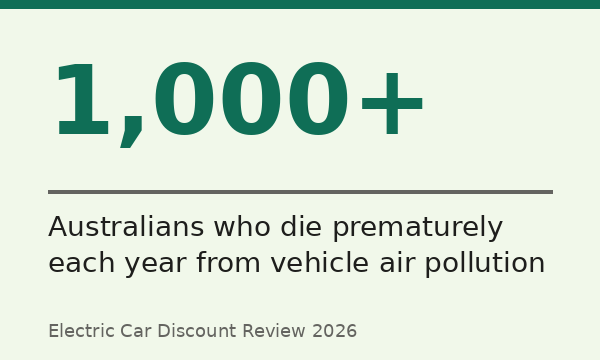
The review drew on research linking vehicle emissions to more than 1,000 premature deaths in Australia every year — a figure researchers note is likely a significant underestimate, as it captures only particulate matter smaller than 10 micrometres (PM10) and excludes other harmful compounds entirely.
Battery EVs produce zero tailpipe emissions. Every one that displaces a petrol or diesel vehicle generates a measurable, lasting improvement in local air quality — and a corresponding reduction in the healthcare costs borne by individuals, insurers and the public health system.
“Battery EVs do not produce any tailpipe pollution, contributing to the preservation of cleaner and healthier air in urban areas. A consistent and broad uptake of EVs should contribute to reduced rates of illnesses and fewer premature deaths.”
Statutory Review of the Electric Car Discount, Treasury & DCCEEW, May 2026
Putting a number on the benefit
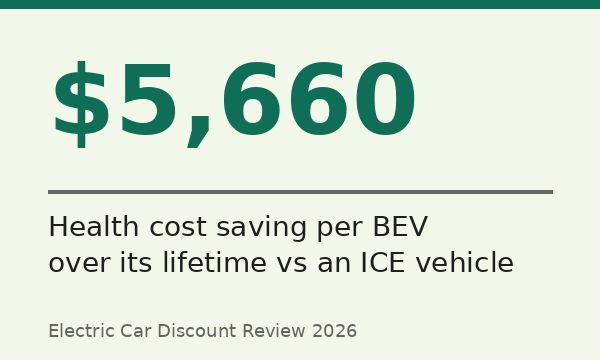
The review estimated that each battery EV delivers a health cost saving of approximately $5,660 relative to an ICE vehicle over its lifetime — based on reduced PM10 pollution alone, and adjusted for an 18-year vehicle life. That figure rises when the broader portfolio of harmful emissions — nitrogen oxides, carbon monoxide, volatile organic compounds — is brought into the equation, though the review did not attempt to quantify those additional benefits.
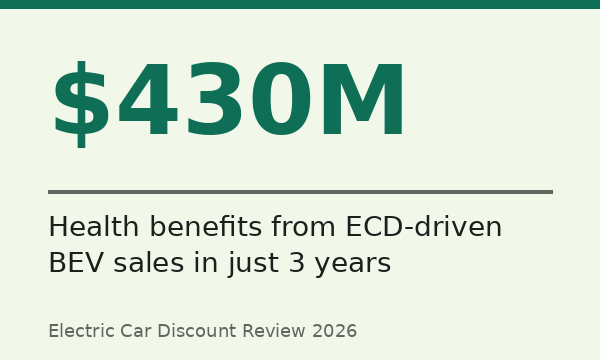
Applied across the estimated 64,000 additional BEV sales attributable to the Electric Car Discount in its first three years, the cumulative health benefit reaches approximately $430 million. Include the additional plug-in hybrid sales in that period and the figure climbs to around $500 million — with an upper bound estimate of $630 million.
These are not future projections or modelled scenarios. They represent health value already being generated by EVs currently on Australian roads — vehicles that in many cases were put there by employees accessing salary sacrifice and novated leasing arrangements through the ECD.
The upfront cost is an investment in future savings
This is where the fleet calculus shifts. The median battery EV still carries a price premium over a comparable ICE vehicle — the review put the median BEV sticker price at around $59,000 against a $47,000 median across all fuel types in 2024–25. That gap is real, and it’s the figure most procurement conversations start and end with.
But the review frames that premium differently when the full picture is in view. Each additional BEV sold generates not only fuel cost savings of around $26,500 over its life, but also a $5,660 health dividend and a 34-tonne reduction in lifetime carbon emissions. Importantly, the fuel savings figure was calculated using average pump prices of $1.90 per litre — before the Middle East conflict drove fuel costs sharply higher in early 2026. The real-world savings for vehicles purchased today will be materially larger.
For fleet operators running vehicles across suburban and regional routes — where commuting distances are longer and exposure to exhaust in congested corridors is higher — the health argument for electrification is particularly acute. The review found that outer-suburban residents tend to have greater commuting distances, meaning both their fuel savings and their contribution to local air quality improvements are amplified.
“Increased uptake of EVs helps to reduce Australia’s reliance on imported fuels, diminishing the impact of global oil price fluctuations and potentially easing pressure associated with maintaining national fuel reserves.”
— Statutory Review of the Electric Car Discount, Treasury & DCCEEW, May 2026
A benefit that compounds over time
Unlike fuel savings — which accrue to the individual vehicle owner — health benefits from reduced vehicle emissions are a public good that scale with the total number of EVs on the road. The more fleet operators electrify, the greater the aggregate reduction in urban air pollution, and the larger the downstream savings in healthcare, productivity and quality of life for the communities through which their fleets operate.
The review noted that this dynamic creates a compelling case for maintaining demand-side incentives at a pace that avoids market shocks. The ECD has been extended unchanged until April 2027, with a phased transition to follow — providing fleet operators a clear window to structure novated leasing arrangements under the current framework.
The bottom line is straightforward: the upfront premium of a battery EV is not simply a cost. It is, in significant part, an advance payment on cleaner air, fewer sick days, lower healthcare burden and a public health system under less pressure — benefits that accumulate across every year of the vehicle’s 18-year life and extend well beyond the employee who drives it.
Health benefits summary
- Each BEV generates an estimated $5,660 health saving over its lifetime versus an ICE vehicle (PM10 pollution only; other pollutants not included).
- Total health benefits from ECD-additional BEV sales in the first 3 years: approximately $430 million.
- Including plug-in hybrid sales: approximately $500 million, with an upper bound of $630 million.
- Air pollution from vehicles is linked to more than 1,000 premature deaths in Australia annually — likely a significant underestimate.
- Vulnerable groups — children, people with asthma, the elderly — are disproportionately affected by vehicle exhaust pollution.
- Health benefits are in addition to, not instead of, fuel cost savings of ~$26,500 per BEV over its life and carbon abatement valued at ~$400 million across ECD-additional sales.
Source: Statutory Review of the Electric Car Discount, Treasury & DCCEEW, May 2026.