
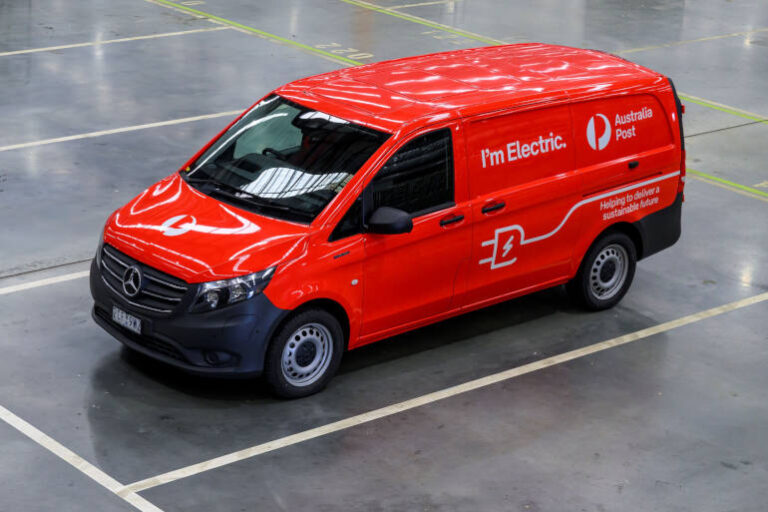
Australia Post plans to add around 100 electric vehicles to its fleet as it tackles the more difficult end of fleet electrification — moving beyond last-mile delivery vehicles and into vans, rigid trucks and prime movers.
The additional vehicles will be supported by the Federal Government’s $40.5 million investment announced in July, with Australia Post Executive General Manager of Network Operations Shane Plant confirming the program will span several vehicle classes.
“We expect to add around 100 electric vehicles to our fleet under the $40.5 million funding investment,” Plant said.
“The roll out will include a broad range of vehicles, from vans to light and heavy rigid trucks, as well as prime movers.”
The investment is significant because Australia Post has already made substantial progress electrifying last-mile delivery. The next challenge is applying the same approach to larger vehicles and more demanding routes.
“The Government’s investment enables us to accelerate the next stage of fleet electrification, supporting the evaluation and deployment of electric vans, trucks and associated charging infrastructure, particularly in vehicle classes where the technology is still emerging and large-scale adoption remains challenging,” Plant said.

Cutting diesel use
Australia Post estimates the expanded electric fleet could reduce diesel consumption by almost one million litres annually.
Plant put that figure into perspective, saying it represented approximately 2.3 per cent of Australia Post’s current diesel consumption.
“Investing in electric vehicles and supporting infrastructure strengthens the resilience of Australia Post’s national delivery network, reducing our reliance on diesel and supporting our long-term emissions reduction targets,” he said.
The fleet transition sits within Australia Post’s broader 2030 Sustainability Framework and its longer-term goal of achieving net zero emissions by 2050.
“Our 2030 Sustainability Framework sets out clear targets to support our journey towards Net Zero by 2050,” Plant said.
“I’m proud to say we’ve made a great start. We beat our 2025 targets, cutting carbon emissions by 20% against our FY19 baseline and getting 100% of our electricity at operational sites from renewable-matched sources.”
EVs aren’t the only answer
Vehicle replacement is only one part of the emissions strategy.
Australia Post is also examining how vehicles are routed and utilised across the network, including development of a new Transport Management System covering both Australia Post and StarTrack operations.
“As part of our Sustainability Framework, we continue to review and model optimum delivery routes,” Plant said.
“We are currently developing a Transport Management System (TMS) that when completed will operate across our Australia Post and Startrack business units improving fleet utilisation and efficiency.”
The organisation’s decade-long focus on last-mile delivery has already changed how much of the network operates.
“Part of this includes a focussed transition across last mile over the last ten years, three quarters of letters and mail delivery rounds are now delivered by foot or electric delivery vehicles,” Plant said.
For large fleets, that illustrates an important point about decarbonisation: the lowest-emission vehicle can sometimes be no vehicle at all, while improving routes and utilisation can reduce emissions from the vehicles that remain.
Long-haul trucks remain the big challenge
The difficult part comes when Australia Post moves into medium and heavy trucks operating over greater distances.
“Electrifying medium and heavy trucks on long-haul routes remains the biggest challenge in reducing our vehicle emissions,” Plant said.
“The distance between destinations on long routes make range and regional charging access key considerations.”
Vehicle availability is another barrier.
“Purpose-built electric trucks that meet the requirements of Australian delivery routes are quite new to the market,” Plant said.
That means the transition will depend not only on Australia Post’s appetite to buy electric trucks, but also on suitable models becoming available and the charging network being capable of supporting them.
“We’re committed to our drivers’ safety and our customers’ experience, so we’re working to bring these heavier freight vehicles into our fleet as quickly as possible,” Plant said.
“As suitable vehicles become available, the next stage of investment will be focused on light-vehicle electrification, depot charging infrastructure and new vehicle technology. This will be key to pushing electrification across our delivery network.”
Diesel isn’t disappearing tomorrow
Australia Post also acknowledges there are fleet applications where battery-electric vehicles are not yet practical.
That is particularly relevant for regional and rural operations where vehicles can travel significant distances and access to high-capacity charging remains limited.
“It’s important to recognise that electrification is a gradual process,” Plant said.
“While we intend to roll it out across our network, running efficient diesel vehicles will allow us to continue servicing communities around Australia, particularly those in regional or rural areas where charging infrastructure is less readily available.”
Rather than betting exclusively on batteries, Australia Post is keeping an eye on several alternatives for these harder-to-decarbonise applications.
“We’re watching developments in renewable diesel, hybrid and hydrogen technology closely, and we’ll continue reviewing our vehicle mix and operating patterns to find the right solution for every part of our network as new options become available,” Plant said.
For Fleet Managers facing the same transition, Australia Post’s approach provides a useful example of how fleet electrification is likely to unfold at scale. Start with applications where the technology already works, improve utilisation and routing at the same time, invest in charging infrastructure, and progressively tackle the harder vehicle classes as technology and infrastructure catch up.
The next 100 EVs may therefore be more significant than the number suggests. They will take Australia Post further into the parts of the fleet where electrification becomes much more complicated — and potentially provide valuable lessons for other Australian fleets trying to do the same.