

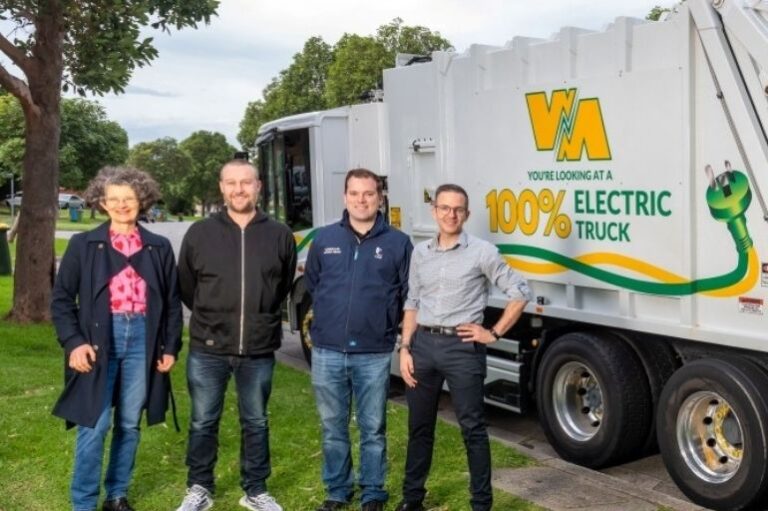
The City of Casey is expanding the use of electric trucks across its hard waste operations, with six fully electric compactor trucks set to begin servicing the municipality from 1 July 2026.
The new fleet will collect hard waste and dumped rubbish across Casey and will be supported by electric tray trucks. Diesel vehicles will remain available as backup during periods of peak demand.
The move builds on Casey’s experience with electric waste vehicles, with Council first introducing EVs into its hard waste service in 2019. The existing operation uses three electric compactor trucks.

City of Casey Mayor Cr Stefan Koomen said the expanded electric fleet could provide greater certainty around future operating costs at a time of volatility in diesel prices.
“With the conflict in the Middle East continuing and the uncertainty around fuel, the EV option offers greater financial certainty in the future,” Cr Koomen said.
“We have already seen increases to running costs of diesel-based fleet, and as a result some councils are considering reductions to their waste collection services. Having a full fleet of EV hard waste trucks will enable Council to continue its hard waste service without interruption.”
Fleet transition driven by cost and emissions
For fleet managers, the Casey rollout highlights how electric heavy vehicles are increasingly being considered not only for emissions reduction, but also for operating-cost stability and continuity of essential services.
Waste collection can be well suited to electrification because vehicles generally operate predictable routes, return to a depot and spend much of their working day travelling at relatively low speeds with frequent stopping and starting.
Casey said the transition will reduce diesel consumption and vehicle emissions while also lowering noise levels in residential areas.
“This initiative is a major step forward in reducing our environmental footprint while continuing to deliver essential services to our community,” Cr Koomen said.
“By transitioning to electric vehicles, we are significantly cutting diesel use and lowering carbon emissions, which aligns with our Council Plan and our community’s expectations for climate action. Not only that, but the EV trucks are much quieter than diesel trucks and don’t emit pollutants into residential streets.”
Diesel remains part of the contingency plan
While Casey is moving to a fully electric primary hard waste fleet, diesel vehicles will remain on standby to provide additional capacity when demand increases.
That approach gives Council a degree of operational resilience while the larger electric fleet is introduced and allows the service to accommodate workload peaks without relying entirely on the EV fleet.
The electric vehicles are being supplied and operated through Council contractor WM Waste Management Services.
“We commend our contractor WM Waste Management Services for their investment in a more sustainable waste collection and continuing to partner with the City of Casey,” Cr Koomen said.
The rollout represents another example of councils moving electric trucks beyond small-scale trials and into regular operational roles where utilisation, charging, reliability and whole-of-life operating costs can be assessed over an extended period.