


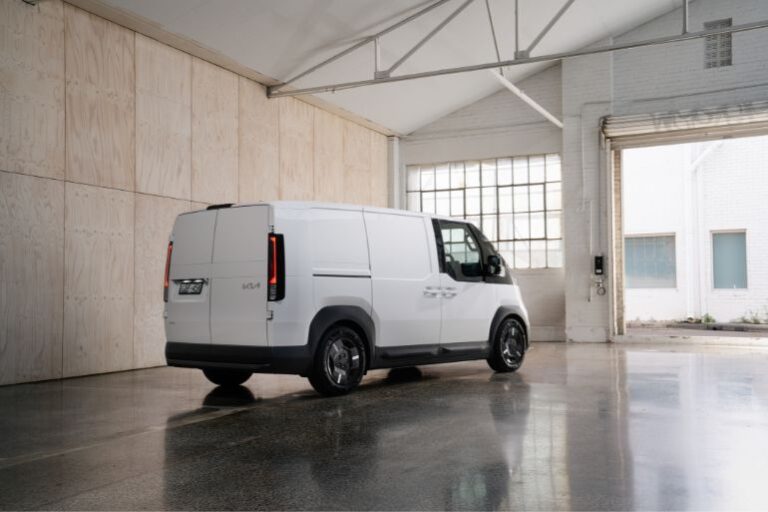
For Fleet Managers looking to electrify light commercial vehicles, the problem has rarely been a lack of enthusiasm for EVs. The harder question has been finding an electric van with enough range, cargo capacity and payload to do the job, backed by a dealer network capable of supporting it.
The Kia PV5 arrived in Australia attempting to address all of those issues at once.
Kia’s first dedicated battery-electric light commercial vehicle combines a claimed 416km WLTP driving range with 4.4 cubic metres of cargo space, a 740kg maximum payload and a launch price of $55,990 RRP. It also arrives from a brand that already has considerable experience selling and servicing electric passenger vehicles in Australia.
That combination could make the PV5 one of the more significant electric commercial vehicle launches for Australian fleets so far.
Electric vans are still a small part of the market
The challenge for Kia is that electric vans remain a niche within an otherwise very traditional market.
Kia’s launch data showed battery-electric vans accounted for just 2% of Australian van sales in 2025. But from January to May 2026 that had already increased to around 3.5%, suggesting the market is beginning to move as more products become available.
Kia Australia CEO Dennis Piccoli believes the PV5 can take advantage of that change.
At the Australian launch, Piccoli said Kia was initially working on sales of around 500 vehicles a year, subject to supply, but dealer and fleet interest was already stronger than expected.
“The early uptake, as I mentioned, from the network and early feedback from the fleet space has been very, very positive,” Piccoli said.
In a separate discussion at the launch, Piccoli said Kia had approached its dealer network several times for initial orders and believed more than 300 PV5s had already been committed by dealers before customer deliveries had begun.
That doesn’t guarantee fleet sales, but it suggests Kia dealers are confident there will be demand.
The numbers make sense for plenty of fleet applications
On paper, the PV5 avoids some of the compromises that have made previous electric vans difficult for fleets to introduce.
The 71.2kWh battery provides a claimed 416km WLTP range, while the front-mounted electric motor produces 120kW and 250Nm.
For charging, Kia quotes approximately six-and-a-half hours for a 10–100% charge using an 11kW AC charger. On a suitable DC charger, 10–80% takes approximately 30 minutes.
For many metropolitan fleets, however, the more important question is whether the vehicle can complete a normal day’s work and return to base for overnight charging.
That is where 416km of claimed range potentially changes the discussion. A Fleet Manager still needs to analyse actual routes, loads, charging availability and energy consumption, but the PV5’s specification gives organisations more room to work with than earlier generations of electric commercial vehicles.
Kia hasn’t forgotten the ‘van’ part
An electric powertrain is of little value if the vehicle can’t carry what the business needs.
The PV5 provides 4.4 cubic metres of cargo volume, with an internal cargo length of 2,255mm, width of 1,565mm and height of 1,520mm. Its maximum payload is 740kg.
One advantage of Kia’s dedicated E-GMP.S electric platform is packaging. The battery sits beneath the floor, helping Kia achieve a low loading height while retaining useful internal space.
The Cargo S also has dual sliding side doors, twin-swing rear doors, eight tie-down points and a solid partition between the cabin and cargo area.
For fleets carrying tools or running mobile operations, vehicle-to-load could be equally useful. The PV5 includes an internal V2L outlet in the cargo area and an external V2L adaptor, with output of up to 3.6kW discussed at the launch.
That makes the PV5 particularly interesting for trades and service fleets that could use the traction battery to power equipment at a worksite.
Kia sees fleets as a major part of the opportunity
Kia Australia General Manager of Fleet Chris Forbes made it clear at the launch that the company isn’t relying only on owner-drivers and small businesses.
While dealers had already seen interest from electricians and solar and battery installers, Forbes said Kia’s fleet team was looking further up the market.
“For us in the fleet teams [it is] probably more important to look at the larger organisations, the larger corporates, utility companies, governments,” Forbes said, pointing to applications including “last mile delivery” and conventional cargo work.
Those are exactly the fleets where electrification can make sense first.
Vehicles with predictable daily kilometres, regular overnight parking and depot-based charging are considerably easier to electrify than vehicles travelling long and unpredictable distances.
For government and corporate fleets with emissions-reduction targets, the PV5 also creates another option in a category where choice has been limited.
Driver acceptance matters too
Fleet electrification isn’t only a spreadsheet exercise. Drivers have to live with these vehicles every day.
Kia put the PV5 through an Australian ride and handling program, including testing laden and unladen, with development centred around approximately 300kg of load.
Kia’s local ride and handling engineer Graham Gambold said the objective was to avoid some of the compromises normally associated with commercial vans.
“It’s a confident, comfortable all-day drive,” Gambold said.
That was broadly reflected in the launch drive. The PV5 was quiet and smooth, with good forward visibility, comfortable seating and plenty of cabin storage.
There are details Fleet Managers should assess during a trial. The Cargo version has no rear glass, with the rear camera image displayed through the central infotainment screen rather than a digital rear-view mirror. For drivers accustomed to conventional vans, that may require some adjustment.
Cargo configuration also deserves a closer look where fleets use standardised pallets, shelving or racking. The headline 4.4m³ figure is useful, but operational fit should always be tested with the actual equipment the fleet intends to carry.
The aftersales piece could be just as important
Perhaps one of the more interesting comments from the launch had nothing to do with range or cargo capacity.
Piccoli said Kia would not wholesale an EV to a dealer unless that dealership had a qualified EV technician onsite, adding that Kia monitors the requirement monthly.
For fleet operators, particularly those running vehicles outside major metropolitan areas, that matters.
The transition to electric commercial vehicles is not simply about selecting an EV. Fleet Managers also need confidence that vehicles can be serviced, repaired and returned to operation without excessive downtime.
The PV5 has 24-month or 30,000km service intervals, a seven-year unlimited-kilometre vehicle warranty and an eight-year/160,000km warranty covering the high-voltage components. Kia also offered prepaid service plans at launch.
So, is this the electric van fleets have been waiting for?
For some fleets, potentially yes.
The PV5 won’t replace every diesel van. Payload requirements, regional travel, towing, charging infrastructure and vehicle utilisation will still rule it out for some applications.
But that isn’t the test an electric van needs to pass.
The more relevant question is whether the PV5 gives Fleet Managers enough range, cargo capacity, safety, driver comfort and aftersales support to electrify the vehicles that can be replaced.
With 416km of claimed range, 4.4m³ of cargo capacity, a 740kg payload and the backing of Kia’s established Australian network, the PV5 makes that conversation considerably easier.
And if Kia’s early dealer and fleet interest translates into orders, the bigger story may not be whether the PV5 can compete with other electric vans.
It may be whether vehicles like the PV5 finally begin moving electric vans out of the niche and into mainstream fleet procurement.