

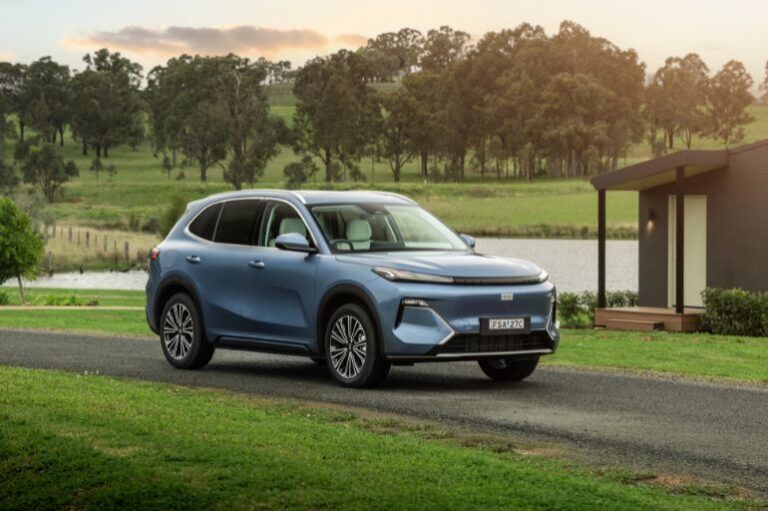
The Geely Starray EM-i is one of those vehicles that makes a strong first impression before you have even turned a wheel.
During my time with it, people stopped to look at it in car parks and took a second glance as we walked back towards it. That matters because for close to $40,000, the Starray Inspire manages to look and feel like a considerably more expensive SUV.
But styling is only part of the story.
The Starray EM-i is a plug-in hybrid that promises something increasingly attractive to Australian new-car buyers: electric driving for everyday trips without needing to rely completely on charging infrastructure when it is time to leave town.
And after spending time living with it around Sydney and taking it on a return trip to Canberra, that combination makes a lot of sense.
However, there is a twist for salary packaging buyers. When we compared a novated lease quote for the Starray EM-i Complete with a comparable quote for the fully electric Geely EX5 Complete, the more expensive EV was actually substantially cheaper each week.
That makes this an interesting comparison between what makes the best car for your lifestyle and what makes the best car for your wallet.

A lot of SUV for the money
At 4,740mm long and 1,905mm wide, the Starray EM-i is a decent-sized SUV, and you notice that most from inside rather than behind the wheel.
There’s generous passenger space front and rear, plenty of storage through the centre console and 428 litres of luggage capacity with the second row in position. Fold those seats and capacity expands to 2,065 litres.
Yet it doesn’t feel cumbersome on the road.
That’s important for somebody buying one as an everyday family vehicle. You get the space of a substantial SUV without constantly feeling as though you’re manoeuvring something enormous through shopping centres and suburban streets.
The cabin also punches above its price point.
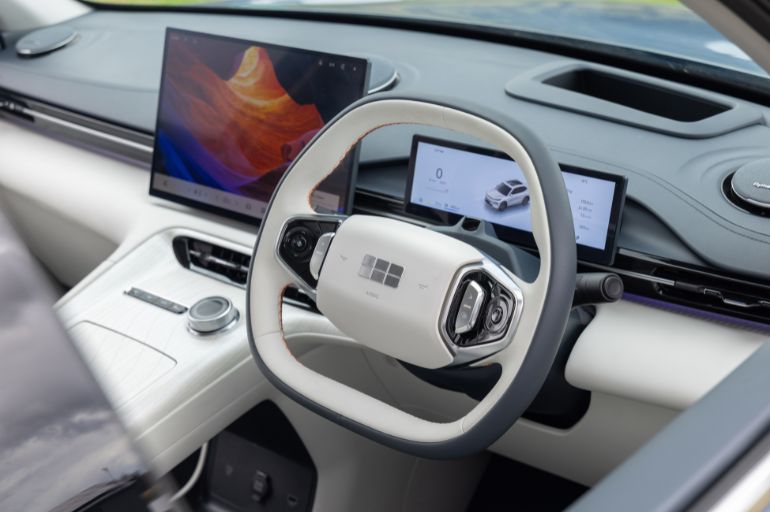
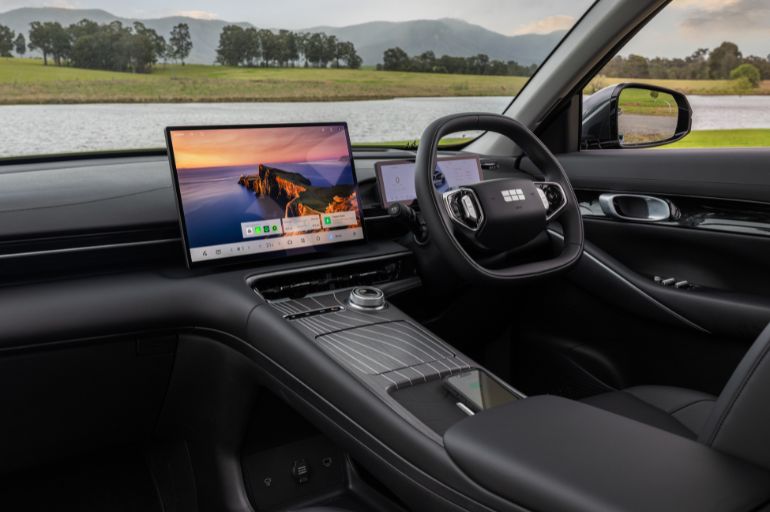
There’s a 15.4-inch central touchscreen, a 10.2-inch instrument display, wireless Apple CarPlay and Android Auto, climate control and plenty of connectivity. The Complete also gets heated front seats, while the higher-grade Inspire adds items including ventilated and massage front seats, a head-up display, panoramic sunroof and 16-speaker audio system.
Importantly, Geely hasn’t completely eliminated physical controls. There are still some useful climate-control buttons and a large volume dial.
That’s good, because our biggest interior criticism is that some frequently used functions still require a trip through the touchscreen. Turning the heated seats on during a cold morning shouldn’t feel like opening an app.
The cupholders could also be larger, and the unusually shaped steering wheel won’t suit everybody.
They’re relatively small criticisms in an otherwise spacious and well-presented interior.
The advantage of driving electric without owning a pure EV
The Complete uses an 18.4kWh LFP battery and offers an official WLTP electric range of 83km. The Inspire Extended Range increases battery capacity to 29.8kWh and electric range to 136km. Official combined range is 943km for the Complete and 996km for the Inspire.
That creates the Starray’s biggest ownership advantage.
Charge it regularly and many owners could complete a large proportion of their normal commuting using electricity. Around town it delivers much of the smoothness and quietness people appreciate about an EV.
Then you can head from Sydney to Canberra—or much further—without thinking about where the next charger is.
On our Sydney-to-Canberra drive, once the electricity had been depleted and the Starray was effectively operating as a hybrid, we recorded approximately 5.2L/100km. For a large SUV travelling at motorway speeds, that’s respectable.
The transition between petrol and electric propulsion is also relatively seamless. You know there’s an engine somewhere under the bonnet, but most of the time the powertrain isn’t constantly reminding you about it.
That’s exactly what a good PHEV should do.
Technology that can improve after you buy it
There’s another ownership feature worth mentioning: over-the-air software updates.
Geely’s first Starray EM-i OTA update added wireless Android Auto, a one-touch Drive Setup function and revised Intelligent Cruise Control logic designed to provide smoother deceleration through curves. The update could be installed at home without visiting a dealership.
Drive Setup is particularly useful because owners can create quick access to preferred settings covering drive mode, regenerative braking, lane-keeping systems, fatigue detection, speed alerts and battery-hold functions.
That’s significant because software is increasingly becoming part of the ownership experience.
Rather than accepting every characteristic of the car on delivery day, manufacturers can continue refining functions after the vehicle is sitting in your driveway.
And the Starray could benefit from that.
Our experience with the adaptive cruise control was generally positive, but its speed adjustments could sometimes be overly assertive. When moving from a 110km/h zone into an 80km/h zone, for example, it could brake harder than necessary rather than progressively allowing the vehicle to slow.
OTA capability gives Geely an opportunity to keep refining systems like these.
Starray EM-i versus EX5: novated leasing changes the equation
Here’s where the decision gets particularly interesting.
Summit Fleet Leasing and Management supplied the novated lease quotations for a Starray EM-i Complete PHEV and EX5 Complete Extended Range EV.
Both quotations use the same assumptions: an $80,000 salary, NSW registration, a 48-month lease and 60,000 contracted kilometres. That gives us a useful side-by-side comparison.
| Starray EM-i Complete | EX5 Complete | |
|---|---|---|
| Total on-road price | $40,877 | $45,500 |
| Amount financed | $37,364.33 | $41,579.24 |
| Weekly net cost | $242.07 | $188.08 |
| Fortnightly net cost | $484.15 | $376.16 |
| Monthly net cost | $1,048.99 | $815.01 |
| Estimated total saving over lease | $12,216.41 | $24,162.57 |
| Term | 48 months | 48 months |
| Contract distance | 60,000km | 60,000km |
The numbers create a fascinating result.
The Starray is $4,623 cheaper to buy, yet under these particular novated lease quotations the EX5 costs $53.99 less per week from net salary.
That’s around $234 a month.
And Summit estimates total savings over the four-year lease of $24,162.57 for the EX5 compared with $12,216.41 for the Starray—a difference of almost $12,000.
Why? Look more closely at the packaging structure.
The EX5 quotation shows the full $14,382.48 annual leasing cost being packaged pre-tax, with no post-tax employee contribution.
The Starray quotation is very different. It shows $7,271.67 as the annual pre-tax employee contribution and another $7,643.16 as the annual post-tax employee contribution.
That difference overwhelms the Starray’s lower purchase price.
There’s another detail worth noting. The Starray quotation budgets $125 per month for fuel and does not include an electricity-charging budget, while the EX5 budgets $68.38 per month for charging. Actual Starray running costs will therefore depend heavily on how often an owner plugs it in and how much of their driving can be completed electrically.
So which Geely should you choose?
This is where ownership priorities matter.
If you’re buying privately and want to experience electric driving without committing completely to an EV, the Starray EM-i makes a compelling argument.
It’s spacious, comfortable, well equipped and surprisingly premium for its price. Its electric range could handle plenty of normal weekday driving, while the petrol engine takes charging infrastructure almost completely out of the equation when it’s time for a long road trip.
For regional drivers, people without guaranteed charging at every destination, or families that regularly travel long distances, that flexibility has genuine value.
But novated leasing changes the calculation.
Based on the two Summit quotes we’ve compared, someone choosing between these particular Geely models on an $80,000 salary would pay considerably less from their net salary to drive the more expensive EX5 EV.
That’s the important lesson. Don’t simply compare drive-away prices when you’re considering a novated lease.
A $45,500 EV can potentially cost you less each pay cycle than a $40,877 PHEV.
For the Starray EM-i, the argument is therefore about flexibility. For the EX5, it’s increasingly about economics.
And depending on where you live, how far you drive and whether you can charge at home, either one could be the more sensible Geely to own.