

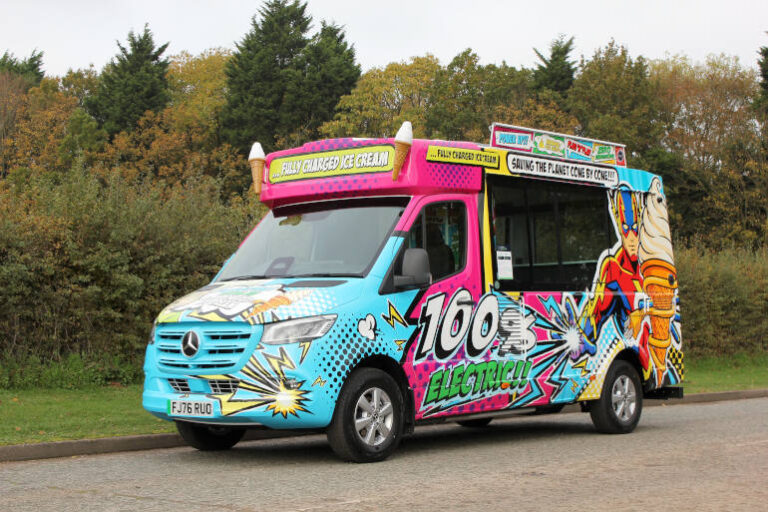
An electric ice cream van has completed its first summer of trading in the UK, demonstrating how battery-powered commercial vehicles can handle demanding daily operations while running equipment that would traditionally rely on a diesel engine.
Built by British manufacturer Whitby Morrison on the Mercedes-Benz eSprinter chassis, the fully electric ice cream van has been operating in North Devon since July, travelling more than 160 kilometres a day and serving customers for up to 12 hours.
The results provide an interesting example for Australian fleet operators considering electric commercial vehicles, particularly those that need to power specialist equipment throughout the working day.
Unlike a conventional ice cream van, the vehicle doesn’t need a diesel engine running to operate its refrigeration and serving equipment. Both the vehicle and the ice cream equipment are powered by batteries using Whitby Morrison’s ePower system.
The manufacturer says the vehicle is the world’s first fully certified electric ice cream van, having received UK Individual Vehicle Approval from the Vehicle Certification Agency.
A full day’s work without diesel
The electric van was delivered to Hocking’s of North Devon in July and has now completed its first trading season.
During that time, it has demonstrated that electric propulsion and battery-powered equipment can support the daily requirements of a commercial ice cream business.
The vehicle has been charged overnight, allowing it to return to service the following day without requiring charging stops during its reported operating schedule.
Christian Hocking, from Hocking’s, said the electric vehicle had attracted considerable interest from customers.
“Our customers have loved it. When they find out the van is fully electric, they’re genuinely interested, and lots of them come over just to ask how it works. People like knowing their ice cream has come from a van with zero emissions.”
For fleet managers, the more significant result is that the vehicle has completed its daily work while powering the specialist equipment needed to operate the business.
This is an important consideration for organisations investigating electric service vehicles, mobile workshops and other specialist fleet applications where energy consumption extends beyond simply driving between locations.
Built on the Mercedes-Benz eSprinter
The electric ice cream van uses the Mercedes-Benz eSprinter Chassis Cab with an 81 kWh battery and a gross vehicle mass (GVM) of 4.25 tonnes.
Mercedes-Benz quotes a driving range of up to approximately 440 kilometres under WLTP testing, depending on specification, although actual range will vary according to the vehicle body, operating conditions and equipment usage.
DC fast charging can replenish the battery from 10 to 80 per cent in as little as 34 minutes, according to Mercedes-Benz.
The 4.25-tonne GVM also makes the vehicle relevant to Australian operators because it falls within the 4.5-tonne GVM limit for a standard Australian C class driver’s licence.
This provides additional flexibility for businesses wanting to introduce electric commercial vehicles without requiring drivers to obtain a heavy vehicle licence.
Electric vehicles offer more than lower emissions
For local councils, event organisers and commercial operators, the benefits of an electric ice cream van extend beyond eliminating tailpipe emissions.
Traditional ice cream vans often operate in locations where pedestrians gather, including parks, beaches, schools, sporting grounds and public events.
An electric vehicle can operate with significantly less noise and without exhaust emissions at the point of use.
This creates opportunities for councils seeking to reduce emissions and noise in public spaces while continuing to support mobile businesses.
It also demonstrates how electrification could change the way specialist commercial vehicles are designed and operated.
Rather than simply replacing a diesel engine with an electric motor, manufacturers can reconsider how auxiliary equipment is powered and how energy is managed throughout the working day.
For fleet operators, this raises important questions about battery capacity, daily operating hours, charging arrangements and the additional energy required by equipment fitted to the vehicle.
The UK trial demonstrates that these requirements can be accommodated in at least one real-world application.
Australian operators could be next
Whitby Morrison is now seeking interest from Australian operators as the country approaches its summer trading season.
The manufacturer recently hosted an event in Crewe, England, attended by more than 200 ice cream van operators, and reported receiving a significant number of orders.
Ed Whitby, Operations Director at Whitby Morrison, said the successful trading season represented an important milestone for the business.
“Every so often a vehicle comes along that feels like a real turning point, and this is one of them. Hocking’s have now put it through a proper British summer, and it has done exactly what an operator needs.”
Australian pricing and availability have not yet been announced, with the manufacturer providing details on request.
For Australian fleet managers, the electric ice cream van is another example of how electric commercial vehicles are moving beyond conventional delivery and passenger transport applications.
The lesson isn’t necessarily about selling ice cream. It’s about understanding the complete duty cycle of a vehicle, including the equipment it operates, and identifying where electric power can replace diesel without compromising the work that needs to be done.
And if an electric van can spend 12 hours serving ice cream while covering more than 160 kilometres a day, it might encourage fleet managers to reconsider some of the other specialist vehicles in their fleet.