
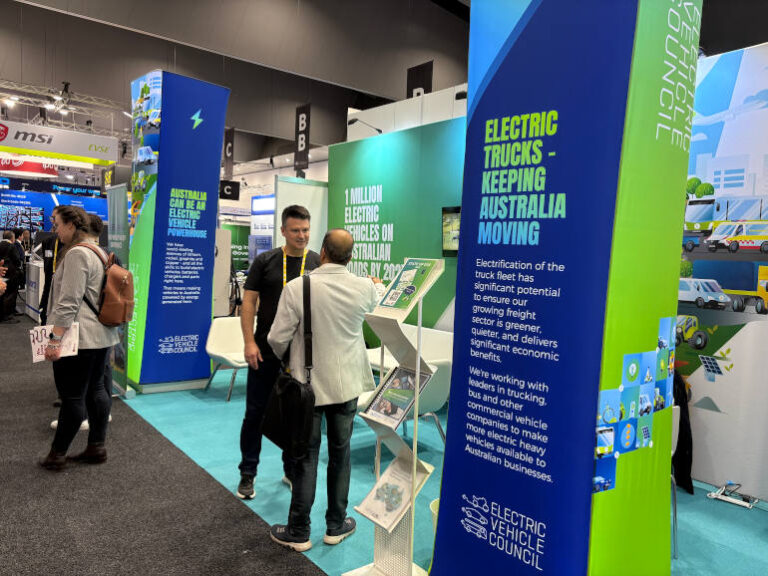
At the opening of All Energy Australia 2025 in Melbourne, Electric Vehicle Council CEO Julie Delvecchio declared that the conditions have finally aligned to create a “perfect storm” for the rapid transition to electric vehicles across all asset types — from passenger cars to heavy trucks.
In a powerful address, Delvecchio said that Australia is entering a decisive phase where political stability, ambitious targets, and strong consumer demand are converging to make electrification inevitable.
“The transition is no longer a gamble. It’s guaranteed by political and policy stability, and that really counts for something in a period of change,” she told the packed plenary.
Delvecchio highlighted that the Federal Government’s second term has already delivered major reforms, including the 2035 emissions reduction target, new vehicle efficiency standards, and a $2.3 billion battery program. Together, these policies provide the framework the industry needs to invest with confidence and accelerate momentum.
The burning platform for change
Delvecchio described the road ahead as both ambitious and achievable, noting that the new targets create a “burning platform” for collaboration across transport and energy sectors.
“We need five million electric vehicles on our roads by 2035 — and that doesn’t include the electric trucks we’re going to need,” she said. “It’s going to require every bit of nous and every bit of grit we have.”
For fleet operators, logistics providers, and councils, this represents not just a challenge but a defining opportunity to reshape transport systems. With targets set and the direction clear, Delvecchio emphasised that government now expects industry unity to deliver the shared vision.
The products — and the proof
Perhaps the most important driver of change, Delvecchio said, is that the EV industry now has “better products” than its fossil fuel competitors.
EVs are cheaper to run, easier to charge, and increasingly diverse. “Drivers are saving around $3,000 a year on fuel and maintenance,” she noted. “And for those with solar, batteries, and home electrification, the benefits are even greater.”
That reality is reflected in Australia’s sales data: 72,000 Australians bought an EV in the first six months of 2025, lifting EVs to 12% of all new car sales. More strikingly, growth is now strongest in outer suburbs and regional areas, showing that the technology is reaching mainstream buyers.
“EVs aren’t niche anymore,” Delvecchio said. “Tradies are snapping up electric utes — the BYD Shark is one of the top five-selling utes in Australia of any fuel type.”
Building the movement together
With 153 electric models now available — up from 94 just a year earlier — and new bi-directional charging products appearing on the market, Delvecchio said the industry is entering a new stage of capability.
But technology alone won’t deliver the transition. Her message to delegates was simple: work together.
“What we need now is coordinated industry momentum, and there’s no better way to do that than by working with the people sitting right beside you,” she urged.
She encouraged attendees to turn off their phones, meet someone new, and start a conversation about shared challenges and solutions — a symbolic gesture that captured the spirit of collaboration underpinning the event.
As Delvecchio concluded, the message was clear: the EV transition is happening now. Australia has the policy settings, the products, and the proof. What’s needed next is collective action to make the most of this “perfect storm” of opportunity.