


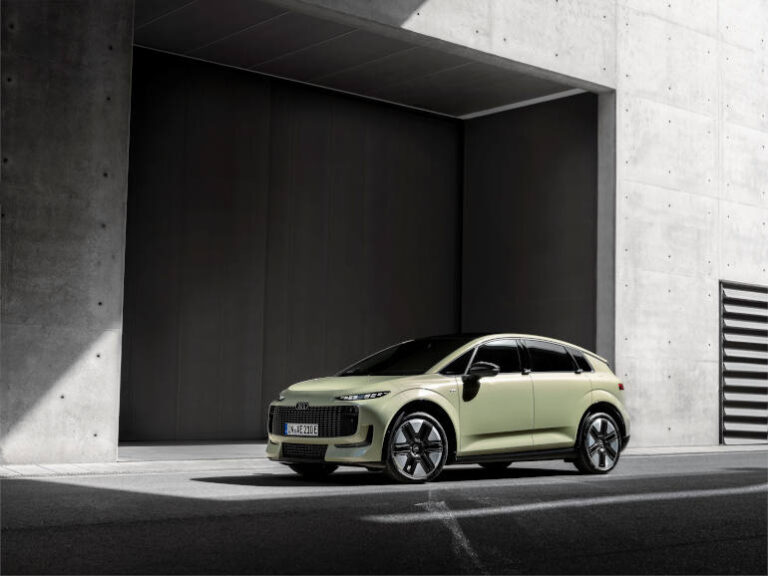
Audi has unveiled the A2 e-tron, a compact electric model that combines low energy consumption, a choice of three battery sizes and up to 646km of WLTP driving range as the brand looks to broaden its EV offering.
The new Audi A2 e-tron has been developed around a simple proposition: improve electric vehicle efficiency rather than relying solely on larger batteries and higher power outputs.
Audi says the most efficient version of the A2 e-tron consumes just 12.8kWh/100km under WLTP testing, making it the lowest energy consumption figure achieved by a series-production Audi. Depending on specification, driving range extends to 646km.
For fleet operators considering the next generation of electric passenger vehicles, the approach is significant. Lower energy consumption has the potential to reduce charging requirements and electricity costs, while giving organisations greater flexibility to select a battery size that matches the vehicle’s operational profile.
Audi will offer four power outputs — 125kW, 140kW, 170kW and 240kW — matched with 52kWh, 61kWh or 84kWh gross-capacity batteries. The two smaller batteries use lithium iron phosphate chemistry, while the 84kWh battery uses nickel manganese cobalt cells.
The 125kW model offers up to 423km of WLTP range, while the 140kW version extends that to 515km. The 170kW model provides the longest claimed range at 646km, with the 240kW flagship rated at up to 630km. Maximum DC charging capability ranges from 100kW to 183kW, with quoted 10 to 80 per cent charging times between 24 and 29 minutes depending on battery.
Efficiency becomes part of the fleet equation
Much of the A2 e-tron’s efficiency comes from reducing the amount of energy required to move the vehicle rather than simply increasing available battery capacity.
A drag coefficient of 0.24 is the best figure in Audi’s compact range, supported by an enclosed underbody, controllable cooling-air intake, aerodynamic wheels and measures designed to reduce turbulence around the wheel arches.
The 140kW model with Audi’s optional efficiency package achieves the headline 12.8kWh/100km consumption figure.
That focus could become increasingly relevant for fleets as EV procurement matures. Battery capacity and headline range remain important, but energy efficiency can have a direct influence on operating costs, charging infrastructure utilisation and the amount of downtime required for charging.
Audi CEO Gernot Döllner said the vehicle reflects a broader rethink of the company’s approach to electric mobility.
“It shows how we are rethinking premium for Europe: using resources more intelligently without compromising on quality, technology, or customer experience.”
Vehicle-to-Load and Vehicle-to-Home
The A2 e-tron also introduces bidirectional charging capability.
Vehicle-to-Load allows the high-voltage battery to power external equipment, while Vehicle-to-Home enables compatible vehicles to supply stored electricity back to a household electrical system through a suitable DC wallbox.
Audi says V2H will initially be available in Germany, Austria and Switzerland, where the vehicle can effectively operate as additional storage for household solar generation.
While the initial application is focused on residential energy, the inclusion of bidirectional capability continues a broader trend that fleet operators will be watching closely as EVs become increasingly integrated with workplace and energy-management systems.
Compact footprint, practical interior
Audi has also focused on making the A2 e-tron practical enough for everyday business and private use.
Boot capacity is 396 litres, expanding to 1,336 litres with the rear seats folded, while some versions also receive a 13-litre front storage compartment.
Standard technology includes an 11.9-inch Audi virtual cockpit plus and 12.8-inch MMI touchscreen, while the e-tron route planner can calculate charging stops based on traffic, topography and charger availability.
Audi has also incorporated Microsoft Outlook and Teams functionality through its connected work offering, allowing occupants to access selected work functions using voice commands.
Safety and driver assistance equipment includes adaptive cruise control, emergency brake assist, evasive assistance, parking sensors and a reversing camera as standard, with additional assistance systems available depending on specification.
Sustainability extends beyond the powertrain
Audi says more than 300 components in some A2 e-tron configurations are made using recycled materials, with more than 100 containing post-consumer recycled material.
The company is also reducing the variety of materials used within individual components to make them easier to separate and recycle at the end of the vehicle’s life.
Production efficiency has also been part of the project. Audi says the A2 e-tron reached production 21 months faster than comparable previous models, with the Ingolstadt factory reusing more than 1,200 existing manufacturing assets and around 250 robots previously used for other models.
For fleets, that broader efficiency message may ultimately be as important as the headline range. The A2 e-tron demonstrates how manufacturers are beginning to address EV efficiency across the complete vehicle — from energy consumption and battery sizing to aerodynamics, materials and manufacturing.