

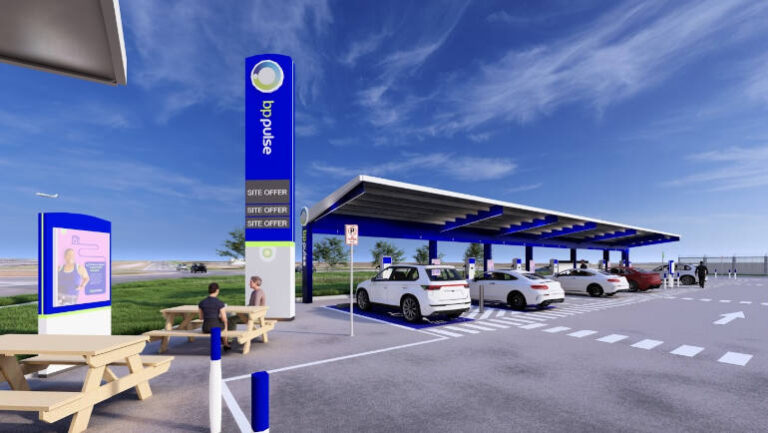
Bp pulse has broken ground on its first large-scale electric vehicle (EV) charging hub in Australia, with a 24-bay site at Melbourne Airport planned for completion in 2026.
Set within the Melbourne Airport precinct, the new charging hub will feature a mix of 150kW and 300kW chargers, two accessible bays, drive-through bays for larger vehicles, a bathroom and a canopy. The design reflects the growing demand for public charging infrastructure that can support commercial operations as well as private motorists.
For Fleet Managers and Sustainability Managers, the project highlights the continued expansion of high-capacity charging infrastructure in locations that support high vehicle utilisation. Airport precincts are critical transport hubs for rideshare operators, rental companies, shuttle services and field-based teams, making them practical locations for public fast-charging facilities.
Antoine Denis, General Manager, bp pulse Australia, said the charging hub is a key step in building a national network to support electrification.
“Since 2022 we’ve been building a network of EV charging sites around the country to support our customers on the road to electrification,” said Denis.
“Now, with the backing of over 41,000 bp pulse charging bays across the world, we’re leveraging our global EV charging expertise to bring bp pulse’s first large-scale charging hub to Australia.
“Conveniently positioned in the Melbourne Airport precinct, we want to ensure this charging hub offers a quick and seamless way for drivers to recharge and get back on the road.”
With around 34,000 vehicles visiting Melbourne Airport each day, the charging hub is expected to support professional drivers, businesses, travellers and local EV users who require reliable access to fast charging. The site will also enable Uber drivers who have transitioned to electric vehicles to access bp pulse’s existing EV charging discount.
Melbourne Airport Chief of Ground Transport, Property and Retail, Jai McDermott, said the airport was pleased to support infrastructure that benefits both the precinct and the wider community.
“bp pulse’s new Melbourne Airport charging hub will give better charging access for commercial passenger vehicle drivers, workers across the precinct and the broader community,” said McDermott.
“Not only will this be the first of its scale at an Australian airport, but we’re proud that bp pulse has chosen to power the hub with 100% renewable electricity generated from Melbourne Airport’s two onsite solar farms.”
Since launching in 2022, bp pulse has installed more than 290 EV charging bays across Queensland, New South Wales, Victoria, Tasmania, South Australia, Western Australia and the Australian Capital Territory.
For organisations developing fleet decarbonisation plans, the continued rollout of high-power public charging infrastructure provides greater confidence that EVs can be integrated into operational fleets. As fleet management maturity improves, organisations will be better positioned to align vehicle selection, charging strategies and operational requirements with the expanding charging network.