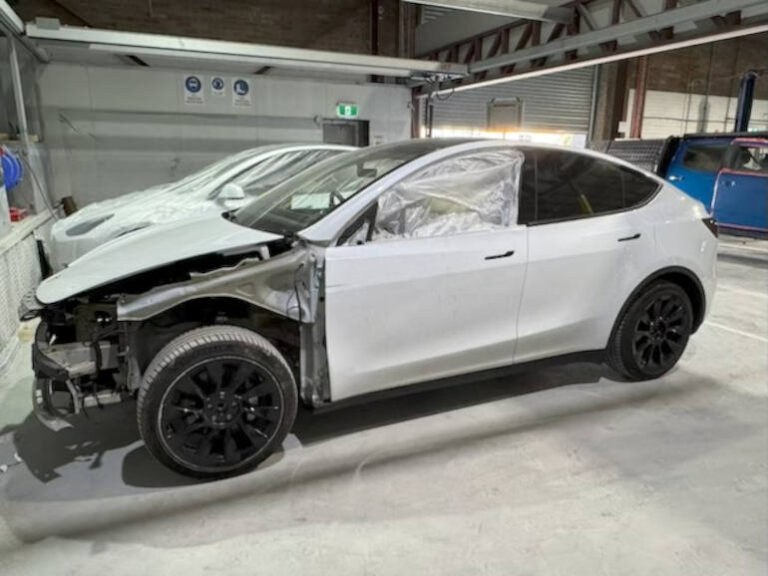
Electric vehicles are not only changing the way fleets power their vehicles – they are also reshaping the panel repair industry. New safety requirements, longer repair times, and higher costs mean Fleet Managers need to think differently about accident management as EV adoption grows.
Safety is non-negotiable
According to Shaun Janks, Co-Founder and Chief DingGo at DingGo, the biggest change is safety.
“If you put your hand in the wrong place before you’ve powered down the battery, you’re dead,” Mr Janks said. “Repairers have to learn the process of making an EV safe before pulling panels or removing linings. It’s life or death.”
To manage the risk, many repairers have created EV-only bays and trained specific staff to handle high-voltage vehicles. “The first bit of training everyone went through was safety – knowing how to power down the car before anything else,” he explained.
Repairs take longer
Even when damage is only cosmetic, the repair process takes more time with EVs.
“It’s about 20 per cent longer to repair an EV,” Mr Janks said. “That extra time comes from powering down, recalibrating ADAS systems afterwards, and even things like lifting the car onto hoists because of the extra battery weight.”
For Fleet Managers, that means factoring longer downtime into replacement planning and service level agreements with repairers.
Higher repair costs
The added labour translates into higher costs. DingGo’s data shows EV repairs are around 20 per cent more expensive on average than ICE vehicles.
“EVs are usually involved in less severe accidents, more cosmetic in nature,” Mr Janks said. “But even then, the average cost is higher. I’d hate to think what happens when an EV is involved in a major accident – the costs would be significantly higher than a comparable ICE vehicle.”
Parts supply challenges
While established brands like Toyota have well-developed parts networks, many EV brands are still building their supply chains in Australia. That creates extra delays.
“Some of the new OEMs are dumping cars into the market faster than they’re building aftermarket support,” Mr Janks said. “Panel shops struggle to get certain parts, particularly battery housings and structural components. Even simple things like pillars can be hard to source.”
For Fleet Managers, this means asking OEMs about local parts supply and factoring in the risk of longer vehicle downtime.
Common damage types remain the same
Although the repair process differs, the types of accidents are familiar. DingGo’s data shows front-end damage accounts for 26 per cent of incidents, doors for 17 per cent, and rear-end hits 13 per cent.
“Most repairs are still the usual bumpers, headlights and panels,” Mr Janks said. “It’s just that when it’s an EV, the safety and repair process around it is very different.”
Safer vehicles, but pricier repairs
The positive news is that EVs appear to be safer on the road. “We’re seeing a 19 per cent lower incident rate for EVs compared with ICE vehicles,” Mr Janks said. “They also tend to be involved in lower-severity accidents. The ADAS technology built into EVs is clearly playing a role.”
That means fleets may see fewer repairs overall, but when they do happen, they are likely to cost more and take longer.
What Fleet Managers should do
Mr Janks advised Fleet Managers to look beyond the purchase price when planning EV adoption.
“Fleets need to think about the support behind the vehicle – who can repair it, how quickly parts can be sourced, and how safe the repair process is,” he said.
For Fleet Managers, the key steps are:
- Check repairer capability – ensure your network is EV-certified.
- Plan for longer downtime – EVs take more time to repair.
- Factor in higher costs – include repair costs in whole-of-life models.
- Reduce accidents – invest in driver training, ADAS awareness, and telematics.
The shift to EVs is unavoidable, but with the right preparation, fleets can manage the risks. As Mr Janks summed up: “EVs are safer and involved in fewer accidents, but when they are damaged, repairs take longer and cost more. Fleet Managers need to plan for that balance.”
- Origin Hits EV Milestone as Corporate Demand Accelerates
 Origin has surpassed 2,000 electric vehicles (EVs) under management, a milestone that highlights growing demand from organisations seeking practical ways to introduce EVs into their fleets and employee benefit programs. The energy company says it is now Australia’s largest dedicated EV subscription and fleet provider, working with major organisations including AON, AustralianSuper, Gilbert + Tobin,
 - TCO Parity: Where the Gap Has Actually Closed for EVsFor years, electric vehicles have been framed as an environmental decision first and a financial decision second. That equation is now shifting. According to Kristian Handberg, General Manager – Future Business and Origination at JET Charge, the total cost of ownership (TCO) case for EVs in many light vehicle segments has materially strengthened. “We’re waving
- XPENG Distributor Collapse Reinforces the Value of Patience in Fleet ElectrificationThe Australian distributor of XPENG electric vehicles, TrueEV, has entered administration, marking one of the first visible signs of consolidation in the rapidly expanding electric vehicle market. Over the past two years, dozens of new brands and models have entered Australia, encouraged by growing demand for low- and zero-emission vehicles and policy settings designed to
- BOSSCAP collapse raises questions about non-OEM vehicle supply modelsThe collapse of BOSSCAP Group into receivership on 17 March 2026 has sent a ripple through Australia’s emerging electric commercial vehicle sector, particularly among fleets exploring alternatives to traditional OEM supply. BOSSCAP had positioned itself as a specialist engineering and advanced manufacturing business, delivering right-hand-drive conversions of the Ford F-150 Lightning and supporting early fleet
- Suzuki eyes fleet growth with new hybrid and EV modelsSuzuki Australia says the introduction of new hybrid and electric vehicles will broaden its appeal to fleet buyers, even though the brand has historically focused on private customers. In an interview with Fleet News Group, Michael Pachota, General Manager at Suzuki Australia, explained that the company is not traditionally a large fleet supplier but sees new