

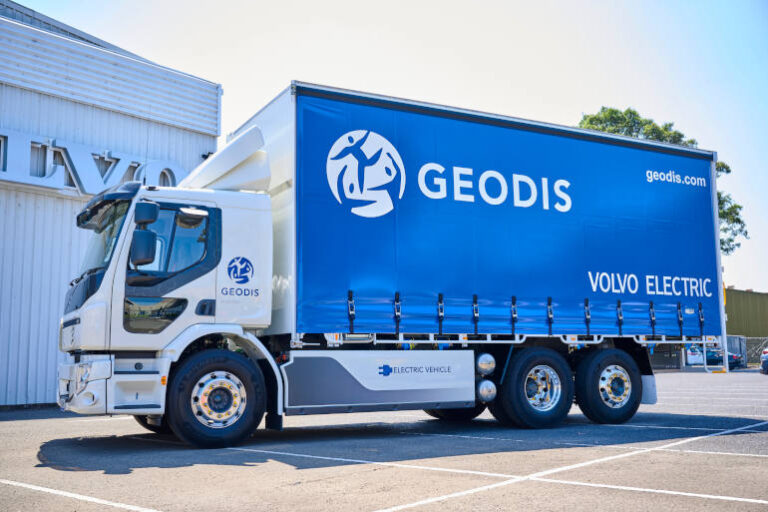
Geodis has taken another step toward fleet decarbonisation with the delivery of its second Volvo electric truck, marking a milestone in the logistics provider’s long-standing partnership with Volvo Group Australia. The announcement was made during the 2025 Brisbane Truck Show and reinforces a shared ambition to lower emissions and transform supply chain operations.
The new electric vehicle is a Volvo FE, powered by advanced battery technology and supported by an energy-efficient charging system that integrates solar power. This latest addition builds on the success of GEODIS’ first electric FE truck, launched in early 2023, which has been operating in New South Wales between Matraville and Volvo’s Minto Parts Distribution Centre.
Now, the second FE truck will be deployed in Brisbane, transporting truck components and sub-assemblies from Brisbane Airport to Volvo’s Wacol manufacturing facility. The fully electric vehicle can carry payloads up to 11,000kg over a range of 200km, making it ideal for metropolitan freight applications.
Fleet transformation driven by collaboration
Geodis’ Sub-Regional Managing Director for the Pacific, Japan, and Korea, Stuart Asplet, emphasised the strategic importance of the partnership:
“At Geodis, our commitment to reducing the supply chain carbon footprint is strengthened through partnerships with like-minded companies such as Volvo Australia… Sustainability is not just a responsibility in the supply chain sector; it is a strategic imperative that drives innovation, efficiency, and resilience in global operations.”
This delivery reflects a broader strategy at Geodis to embed sustainability into every part of its operations. The company has publicly committed to a 40% improvement in energy efficiency at its sites by 2030 and aims to power 90% of operations with low-carbon energy sources. New facility developments are now assessed against stringent environmental benchmarks.
Building a cleaner heavy vehicle ecosystem
Volvo Group Australia continues to advance electromobility in the heavy vehicle sector, with a strong focus on local manufacturing and energy-efficient logistics solutions. Tim Camilleri, Director of Electromobility Solutions, highlighted the momentum:
“Our partnership with Geodis continues to drive forward our commitment to developing lower-emission and safer transport solutions… By consistently advancing our electromobility technology, we have significantly enhanced the range, efficiency and performance of our FE trucks.”
With EV performance improvements and growth in adoption across Australia, Volvo says the push toward a cleaner transport ecosystem is well underway.
Emission reductions and real-world results
According to Volvo, the FE electric trucks are expected to deliver up to a 95% reduction in direct carbon emissions compared to equivalent diesel vehicles performing the same tasks. The use of existing solar infrastructure for charging also helps eliminate fine particle and nitrogen oxide emissions, improving local air quality in dense urban environments.
For Geodis, the investment goes beyond vehicle technology. The company is adopting digital tools to optimise vehicle routing and loading, ensuring maximum efficiency from every trip. Awareness campaigns and climate-related training are also part of the cultural shift within the organisation.
Long-term partnership, local manufacturing
Geodis and Volvo Australia share a relationship spanning more than 40 years. This latest milestone builds on decades of logistics collaboration, but now with a firm focus on sustainability and innovation. The Volvo FE trucks used by Geodis are built locally at Volvo Group’s Wacol facility, which proudly bears the Australian Made certification.
His Excellency Pontus Melander, Swedish Ambassador to Australia, joined Volvo and Geodis executives at the handover ceremony at the Brisbane Truck Show, underscoring the international significance of the partnership and the global push for low-emission transport.
What this means for Fleet Managers
For Fleet Managers, the delivery of another electric heavy vehicle into commercial service sends a clear signal: electric trucks are now viable for urban operations. With a 200km range and 11-tonne payload capacity, these vehicles offer a practical, clean alternative to diesel for metropolitan logistics tasks.
Importantly, Geodis and Volvo’s approach demonstrates how to integrate electric vehicles into the supply chain without compromising operational requirements. By leveraging solar infrastructure and local manufacturing, and prioritising technology partnerships, they’ve created a blueprint that other fleets can follow.
As Geodis and Volvo continue to scale their sustainability efforts, the electric truck transition in Australia is gaining ground—one delivery at a time.