Scroll through social media whenever hydrogen fuel cell vehicles are mentioned and you’ll usually find the same chorus in the comments section: “Hydrogen is dead.” Or the slightly more technical version: “It’s inefficient compared to batteries.”
The irony is delicious.
Many of the loudest critics appear to have missed one small but important engineering detail: a hydrogen fuel cell vehicle is, quite literally, an electric vehicle.
Yes — it has an electric motor. Yes — it has a battery. Yes — it drives exactly like a battery electric vehicle (BEV).
The difference is simply how the electricity is produced and stored.
Rather than plugging into a charger and storing energy in a large battery pack, a hydrogen fuel cell vehicle generates electricity on board using hydrogen. Think of it as carrying your own power station under the bonnet.
And once you understand how it works, the technology starts to look less like a rival to battery EVs and more like a different flavour of the same electric drivetrain.
The Basic Idea: Hydrogen Makes Electricity
At the heart of a hydrogen fuel cell vehicle is the fuel cell stack. This device performs a chemical reaction between hydrogen and oxygen. Unlike combustion engines, nothing is burned. Instead, the reaction produces three outputs:
- Electricity
- Heat
- Water vapour
The electricity powers the vehicle’s electric motor and charges a small battery. The only emission from the tailpipe is water. No CO₂. No particulates. No exhaust gases. Just steam.
For those who like a simple analogy: a fuel cell is basically a battery that never goes flat as long as you keep supplying hydrogen.
The Main Components of a Hydrogen Vehicle
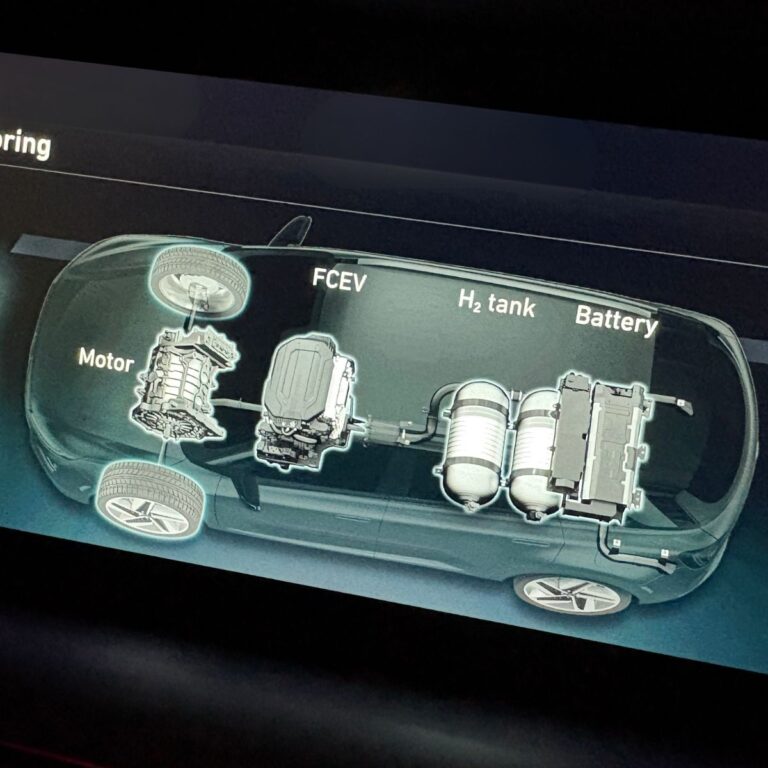
A hydrogen fuel cell vehicle shares most of its hardware with a battery EV. The main components include:
Hydrogen Storage Tanks – Hydrogen gas is stored in high-pressure tanks, typically at 700 bar. These tanks are incredibly strong carbon-fibre structures designed to withstand impacts and extreme conditions.
Fuel Cell Stack – The stack combines hydrogen from the tanks with oxygen from the air. Through an electrochemical process, this produces electricity.
Battery Pack – Just like a battery EV, hydrogen vehicles have a lithium-ion battery. It’s usually much smaller because it only stores short bursts of energy rather than powering the entire vehicle.
Electric Motor – The motor drives the wheels. From a driver’s perspective, it behaves exactly like any EV: instant torque, quiet operation and smooth acceleration.
Power Electronics – These systems manage the flow of electricity between the fuel cell, battery and motor.
So while hydrogen might sound exotic, the majority of the drivetrain is shared with battery electric vehicles.
Why There’s a Battery at All
This is another detail that often surprises people. If the fuel cell is generating electricity, why does the vehicle need a battery? The answer is efficiency.
Electric motors occasionally demand large bursts of power — during acceleration or climbing hills. Rather than oversizing the fuel cell to handle these spikes, engineers use a battery to supply short bursts of energy.
The battery also stores energy captured through regenerative braking, exactly like a battery EV. This hybrid approach improves overall efficiency and responsiveness. In other words, hydrogen vehicles combine a generator (the fuel cell) with a battery buffer.
The Energy Journey
Let’s walk through what happens when you drive a hydrogen fuel cell vehicle.
- Hydrogen gas flows from the storage tanks into the fuel cell stack.
- Oxygen from the air enters the stack through an intake system.
- Inside the fuel cell, hydrogen molecules split into protons and electrons.
- The electrons flow through an external circuit, generating electricity.
- This electricity powers the electric motor and charges the battery.
- The protons combine with oxygen to form water, which exits as vapour.
That’s the entire process. No pistons. No explosions. No gear changes. Just chemistry generating electricity.
Where Hydrogen Makes Sense
Battery EVs are excellent for many applications — particularly passenger vehicles and urban driving. But the challenge becomes more complex when vehicles grow larger or operate continuously. This is where hydrogen is attracting attention. For heavy transport, hydrogen offers several advantages:
Fast Refuelling – Hydrogen vehicles can refuel in roughly the same time as diesel trucks.
Long Range – Hydrogen contains far more energy per kilogram than batteries.
Payload Efficiency – Large battery packs can weigh several tonnes. Hydrogen systems are often lighter for long-distance heavy vehicles.
Cold Weather Performance – Hydrogen fuel cells are less sensitive to extreme cold compared with large battery packs.
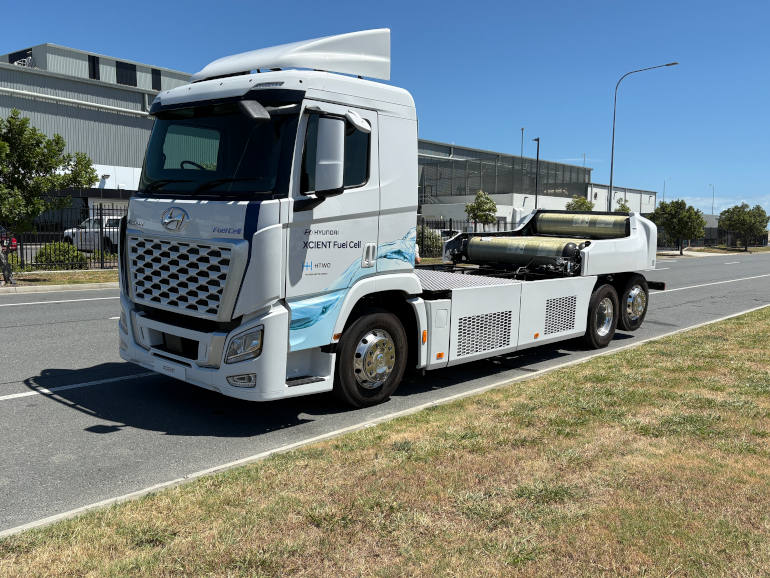
These characteristics are why hydrogen trucks, buses and industrial vehicles are being trialled around the world. Australia is beginning to explore the technology as well, including projects involving hydrogen trucks such as the Hyundai XCIENT Fuel Cell.
The Real Debate: Efficiency
Critics often point to the efficiency of the hydrogen pathway. They’re not wrong — converting electricity to hydrogen and back into electricity involves energy losses. A battery EV is generally more efficient if you can plug it directly into the grid.
But the debate becomes more nuanced when considering real-world logistics.
Hydrogen can be stored, transported and produced using renewable energy when supply exceeds demand. It also provides a way to decarbonise sectors that are difficult to electrify directly.
Energy systems are rarely about one perfect solution. They are about using the right tool for the right job.
The Hidden Benefit: Shared Technology
Here’s where the one-eyed technology debates start to look a little silly. Hydrogen fuel cell vehicles rely heavily on the same technologies driving improvements in battery EVs:
- Electric motors
- Power electronics
- Battery chemistry
- Thermal management systems
- Energy management software
Advances in these areas benefit both technologies. If engineers develop a more efficient electric motor, it improves:
- Battery EVs
- Hydrogen fuel cell vehicles
- Hybrid vehicles
Likewise, improvements in battery durability or regenerative braking systems flow across the entire electric drivetrain ecosystem. Innovation rarely respects the tribal boundaries of internet comment sections.
The Future Is Likely a Mix
For fleets and transport operators, the question isn’t whether hydrogen will replace battery EVs or vice versa. The more realistic scenario is a mixed technology landscape.
Passenger cars and urban fleets may lean heavily toward battery electric vehicles. Heavy transport, mining equipment, buses and long-distance freight may adopt hydrogen or other zero-emission fuels where batteries become impractical.
Both technologies share the same fundamental shift: replacing combustion engines with electric drivetrains. And once you remove the internal combustion engine from the equation, the engineering conversation changes entirely.
The Takeaway
Hydrogen fuel cell vehicles are not the opposite of electric vehicles. They are electric vehicles. They simply generate their electricity differently.
So the next time someone declares hydrogen a “dud technology” online, it may be worth pointing out — gently, of course — that the vehicle they’re criticising is powered by the very same electric motor technology they’re cheering for.
Sometimes the future of transport isn’t a battle between competing technologies. It’s just different ways of plugging electricity into the wheels.