


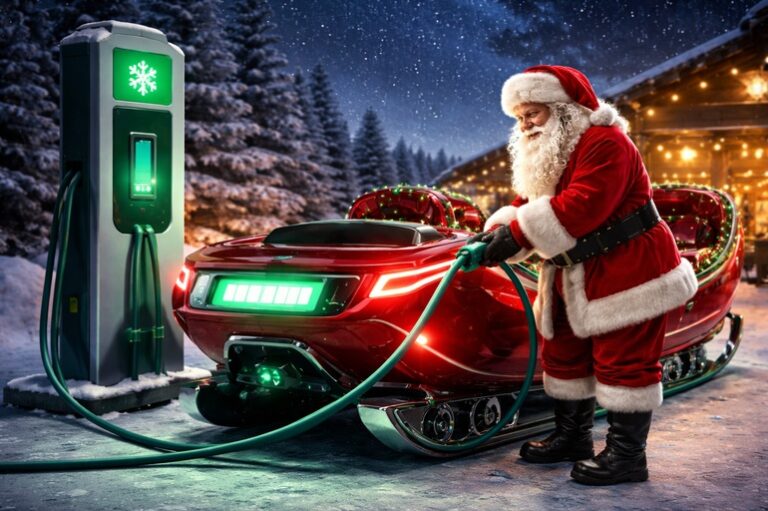
This Christmas, Santa’s sleigh has quietly joined the electric transition — and not because it’s fashionable, but because the numbers finally make sense.
After years of monitoring technology, infrastructure and operating costs, Santa made the call to move to an electric-powered sleigh for peak season delivery. Like any experienced fleet decision-maker, the choice wasn’t driven by hype. It was driven by whole-of-life cost, operational suitability and risk reduction.
Charging was once the biggest constraint. Not anymore. EV charging technology has taken a meaningful leap forward in the past year, with faster charging times and a growing network of destination charging locations across Australia. For Santa, that means predictable dwell times, less range anxiety, and greater confidence in route planning — especially when deliveries stretch from capital cities to regional and remote rooftops.
Battery technology has also moved the dial. Compared to last Christmas, a sleigh sized battery pack delivers more range with less weight, improving overall efficiency and payload capability. Reduced mass means less energy per kilometre, lower wear on components, and smoother performance during long overnight runs. It’s the kind of incremental improvement Fleet Managers love — not revolutionary, but quietly transformative.
Santa doesn’t need megawatt charging just yet. Current dwell times align well with existing fast-charging infrastructure, and destination charging remains fit for purpose. But with payloads increasing year-on-year and expectations only rising, Santa can already see the future value of ultra-fast charging. As delivery density grows and time windows tighten, reduced charging dwell time will become a competitive advantage — even at the North Pole.
Like many fleets, Santa hasn’t limited his assessment to battery electric alone. Hydrogen fuel cells and HVO have both been on the table as potential decarbonisation pathways. They offer promise, particularly for heavier loads and longer distances. However, when assessed through a strict whole-of-life cost lens — factoring in infrastructure, supply certainty, residual risk and operational complexity — the business case simply doesn’t stack up today.
That doesn’t mean those technologies are off the roadmap forever. It just means that, right now, battery electric delivers the best balance of cost, capability and carbon reduction for Santa’s operation.
As fleets across Australia continue their EV transition journeys, Santa’s experience will feel familiar: better batteries, faster charging, improving infrastructure, and technology choices guided by data — not ideology.
This Christmas, the sleigh is still magical. It’s just quieter, cleaner, and a little more future-ready.
Happy Holidays from the team at Fleet News Group!




