For many fleet operators, electric vans are still being trialled, tested and debated. For Melbourne-based charity Big Group Hug, an electric van is already part of the daily workload — moving essential goods, supporting vulnerable families and quietly proving where EVs work best.
Big Group Hug is a volunteer-driven, not-for-profit organisation supporting disadvantaged Victorian families by providing new and pre-loved items for children aged from newborn to 16 years old. From clothing and toiletries to cots, prams and car seats, every item is cleaned, checked, packed and delivered free of charge.
Behind the scenes, it’s a highly coordinated logistics operation — and transport is critical.
A logistics operation hiding in plain sight
“People don’t always realise it, but we’re essentially running a logistics, refurbishment and circular-economy business,” said Bernadene Voss, CEO of Big Group Hug since 2022.
Donations arrive from across Melbourne and regional Victoria. Items are triaged, cleaned, repaired where needed, stored, then packed based on individual family requests before being delivered or collected by caseworkers.
“No two items are the same,” Voss said. “It’s not Amazon. But quality and dignity matter — everything has to be safe, clean and presented beautifully.”
That complexity creates constant vehicle movement between warehouses, donation points and delivery locations — making fleet capacity and efficiency essential.
Why the Ford E-Transit made sense
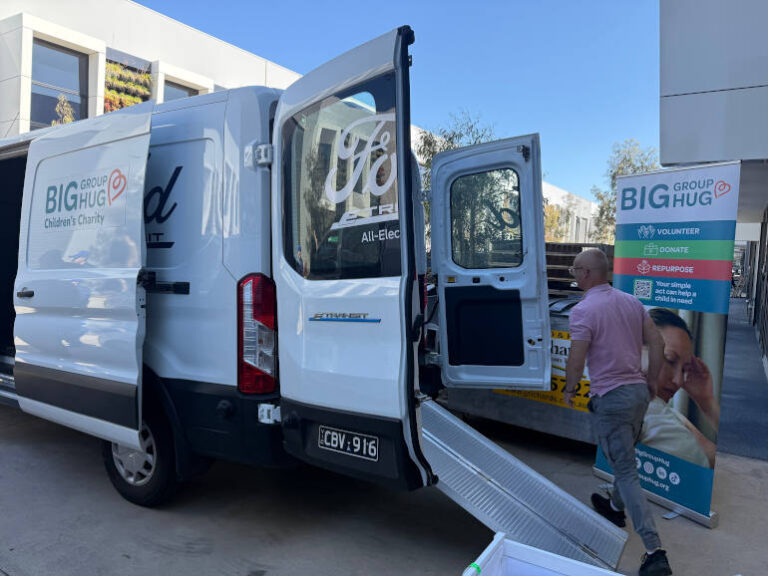
With demand increasing, Big Group Hug added a Ford E-Transit to its fleet, supported by Ford Australia. The electric van is now the largest vehicle in the charity’s fleet and has quickly proven its value.
“It fits significantly more than our other vans,” Voss said. “What used to take two trips can often be done in one.”
For a fleet running multiple daily routes, fewer trips mean lower operating pressure — even before considering fuel or emissions savings.
The high-roof design has also delivered unexpected benefits.
“Most people can stand up in the back of the van,” she said. “For volunteers loading and unloading all day, that makes a huge difference ergonomically.”
Where EVs shine — and where they don’t (yet)
From a Fleet EV News perspective, Big Group Hug’s experience highlights both the strengths and limitations of electric vans in real-world operations. On the plus side, the E-Transit aligns strongly with the charity’s sustainability goals.
“Keeping things out of landfill is a key priority for me,” Voss said. “Going electric is part of trying to be as sustainable as possible.”
Volunteer drivers have also embraced the EV.
“We had a couple of volunteers who only wanted to drive that van,” she said. “They loved it.”
However, charging infrastructure remains the biggest constraint.
“We don’t have fast chargers at all our warehouses,” Voss said. “If you run out of petrol, you refill in minutes. If you run out of electricity, you’ve got to find a charger and sit there — and volunteer time is very valuable.”
To manage this, the fleet relies on careful planning.
“We just make sure it’s charged every night,” she said. “That way our volunteers aren’t stuck charging during the day.”
EVs and social equity
For Big Group Hug, the conversation around EVs extends beyond emissions.
“Safe mobility shouldn’t depend on income,” Voss said. “Transport is a social equity issue.”
That philosophy is reflected in the organisation’s car-seat program, which redistributes safe, compliant seats to families who urgently need them. Around half of all requests currently can’t be met due to supply shortages.
In this context, the E-Transit isn’t just an electric van — it’s an enabler. It supports safer transport, faster deliveries and a circular economy model that keeps quality items in use and out of landfill.
For fleets watching the electric van transition closely, Big Group Hug offers a grounded lesson: EVs already work exceptionally well in urban, planned-route operations — provided charging is managed. And when aligned with purpose-driven outcomes, the benefits go well beyond the balance sheet.
- Tesla sharpens Model 3 appeal for fleets and novated buyers
 Tesla has launched a new Model 3 RWD at a sharp entry price, putting the electric sedan into consideration for fleets and value-conscious novated lease buyers. Unveiled to the fleet community at an event in Sydney, the vehicle was introduced at an Australian price of $45,900 (plus inroad costs). Tesla described it as the most
 - REMONDIS Puts Electric Waste Collection to the TestREMONDIS Australia has trialled a Mercedes-Benz eEconic battery-electric waste collection truck in Brisbane, testing how the technology performs in local commercial operations. The trial marks another step in the company’s fleet decarbonisation program. With 600 waste collection trucks operating across Australia, REMONDIS sees significant potential to reduce emissions through alternative powertrains. The next phase will
- EVs are turning employees’ homes into fleet fuel stationsFor decades, fleet fuel management has been relatively straightforward. Give the driver a fuel card, let them visit a service station and receive an invoice detailing the transaction. Electric vehicles are changing that model because the organisation can suddenly be responsible for procuring the energy used to power its fleet — and some of that
- Ford Brings Range-Extender Bronco to AustraliaFord will add another form of electrification to its Australian line-up when the Bronco Basecamp arrives in the second half of 2027, combining electric drive with a petrol-powered range extender designed to support long-distance travel. Rather than using a conventional hybrid system where both the petrol engine and electric motors can drive the wheels, the
- Why Hyundai sees its dealer network as part of the EV propositionThe specifications of the new Hyundai STARIA Load Electric will attract plenty of attention from Fleet Managers: 450km of WLTP range, a payload of more than a tonne and 800V architecture capable of very fast DC charging. But Hyundai Australia Chief Operating Officer Gavin Donaldson argues that the commercial vehicle proposition extends well beyond what