
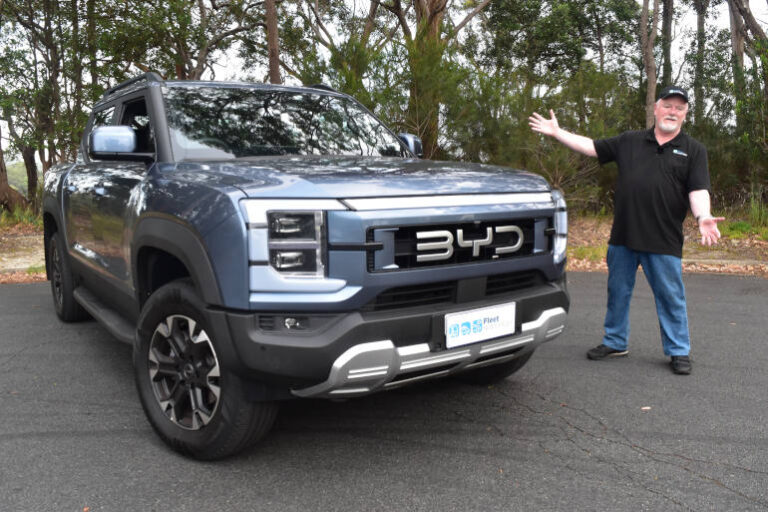
Spend a few kilometres behind the wheel of the BYD Shark 6 and it becomes obvious this ute hasn’t been tuned with the usual priorities. Instead of feeling like a tool first and a passenger vehicle second, the Shark 6 leans heavily toward comfort, refinement and effortless performance — and that makes it feel very different from most dual-cabs on the road.
On-Road Performance: Smooth, Silent and Surprisingly Quick
The Shark 6’s plug-in hybrid drivetrain transforms the driving experience. Around town and in low-speed driving, it operates quietly and smoothly, often pulling away under electric power alone. The instant torque from the electric motors means there’s no hesitation off the line, no hunting for gears, and no need to work the throttle to get moving.
Acceleration is a highlight. With a combined 321kW and 650Nm on tap, the Shark 6 feels genuinely quick for a ute, and overtaking on highways is effortless. There’s a seamless transition between electric and petrol power, and in Sport mode the response is immediate and confidence-inspiring without feeling aggressive or unruly.
Ride Comfort and Handling
Where the Shark 6 really separates itself is ride comfort. The suspension is tuned more like a large SUV than a traditional work ute, soaking up bumps and rough surfaces with ease. On broken urban roads, speed humps and patchy bitumen, it feels composed and settled, with far less rear-end hop than you’d expect from a dual-cab.
Steering is light and easy in town, making parking and tight manoeuvres stress-free, while remaining stable at highway speeds. It’s not a sports ute, but body control is well managed and the all-wheel-drive system gives the Shark 6 a planted, reassuring feel in wet conditions.
A Cabin Built for Comfort
Inside, the Shark 6 reinforces its comfort-first approach. The seats are well cushioned and supportive, with heating and ventilation adding to long-distance comfort. Road and wind noise are well suppressed, and the cabin feels calm even at freeway speeds.
The large rotating touchscreen, head-up display and digital instruments are easy to live with, while features like adaptive cruise control and lane assistance take the strain out of longer drives. It feels less like a commercial vehicle and more like a premium family SUV with a tray on the back.
Living With It Day to Day
For drivers who spend hours behind the wheel — whether commuting, travelling between sites or clocking up highway kilometres — the Shark 6 stands out for how easy it is to drive. Add in the ability to run short trips in EV mode and the convenience of vehicle-to-load power, and it becomes a genuinely versatile daily vehicle.
Verdict
The BYD Shark 6 may look like a traditional dual-cab ute, but from the driver’s seat it tells a very different story. It prioritises comfort, smoothness and refinement in a way few utes do. For buyers who value how a vehicle drives just as much as what it can carry, the Shark 6 is a refreshing change of pace.
- Why Hyundai says fleet EV buyers need to look beyond the sticker price
 As competition in Australia’s electric vehicle market intensifies, Fleet Managers have more choice than ever — and an increasingly wide spread of purchase prices. For Hyundai Australia, the challenge is convincing fleet buyers that vehicle selection should not stop at the upfront price. Akshat Ahuja, Senior Manager, Fleet at Hyundai Australia, says whole-of-life cost, servicing,
 - GAC Expands EMZOOM Line-Up with New PremiumGAC is expanding its Australian footprint with the launch of the new EMZOOM Premium, adding a more accessible specification to its compact SUV range while retaining a strong list of technology, safety and convenience features. The Premium joins the existing EMZOOM Luxury as GAC builds its presence in the Australian new-car market. Both variants are
- The PHEV that makes a strong case for itself — until you run the novated lease numbersThe Geely Starray EM-i is one of those vehicles that makes a strong first impression before you have even turned a wheel. During my time with it, people stopped to look at it in car parks and took a second glance as we walked back towards it. That matters because for close to $40,000, the
- Fleet of the Year finalists show why fleet strategy can’t be a set-and-forget documentA fleet strategy should provide long-term direction, but it also needs to change as technology, operational requirements and organisational priorities evolve. That balance is evident across the three finalists in the 2026 Fleet News Group Fleet of the Year Award — Blacktown City Council, Ausgrid and Parkes Shire Council. Each organisation has a documented framework
- Australia Post maps next phase of fleet electrificationAustralia Post plans to add around 100 electric vehicles to its fleet as it tackles the more difficult end of fleet electrification — moving beyond last-mile delivery vehicles and into vans, rigid trucks and prime movers. The additional vehicles will be supported by the Federal Government’s $40.5 million investment announced in July, with Australia Post