


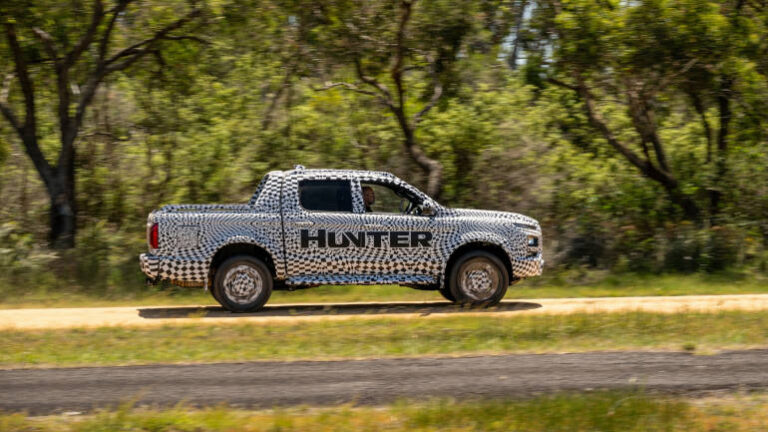
JAC Motors Australia has completed the initial local testing phase of the upcoming JAC Hunter plug-in hybrid Dual-Cab 4X4 ute at Victoria’s Lang Lang Proving Ground, marking a significant milestone ahead of its planned mid-2026 launch.
For Fleet Managers assessing future-ready utes, the announcement signals that JAC is investing heavily in local validation rather than relying solely on global development.
Local validation for Australian conditions
The Lang Lang program forms part of a broader engineering initiative that will see more than 50,000km of development completed on Australian roads and tracks.
JAC Motors Australia Managing Director Ahmed Mahmoud described the local program as the brand’s “most exhaustive and ambitious to date”, adding that by launch the Hunter will be “match-fit and ready for Australia.”
Testing at Lang Lang was conducted in partnership with Segula Technologies Australia, focusing on:
- Vehicle durability and dynamics
- Powertrain performance and calibration
- Towing and load-carrying capability
- On-road and off-road performance
- Acceleration and braking
- ADAS systems
For organisations operating across regional, mining, utilities or construction environments, this type of validation is particularly relevant. It suggests the vehicle is being tuned for Australia’s heat, road surfaces and high-load duty cycles rather than simply imported with minimal adaptation.
Strategic importance of Australia
JAC Motors Australia Technical Director Hongjian Jiang noted that the findings from the Australian program will also be reviewed by the global development team for other markets, highlighting the role of Australia as a proving ground.
For Sustainability Managers and Finance Managers, this global feedback loop can be significant. Vehicles validated under demanding local conditions may offer greater confidence around durability, residual value and whole-of-life cost performance.
Plug-in hybrid capability for operational flexibility
The Hunter features an all-new plug-in hybrid system combining two electric motors with a new-generation turbocharged petrol engine and a 31.2kWh lithium-iron phosphate battery.
In addition, the ute offers 3.3kW vehicle-to-load (V2L) capability, enabling it to power tools on site or provide backup electricity during outages. For fleets operating in remote locations or managing mobile work crews, this functionality may reduce reliance on standalone generators and support emissions reduction strategies.
As organisations work to lower fleet emissions without compromising operational performance, plug-in hybrid utes can provide a transitional pathway. They allow electric-only driving for short urban trips while retaining the flexibility of a combustion engine for longer regional travel or towing.
Launch timing and ownership package
The JAC Hunter is scheduled to launch in mid-2026. Pricing and final specifications will be announced closer to launch.
Like other JAC vehicles, the Hunter will be backed by the brand’s All Roads Assurance (JARA) package, including a seven-year unlimited kilometre warranty (including commercial use), roadside assistance for up to seven years, capped price servicing, and a warranty loan vehicle program.
For Fleet Managers developing an electrification roadmap, the key takeaway is that JAC is positioning the Hunter not just as a value offering, but as a locally engineered solution aimed at meeting Australia’s demanding fleet requirements.
The next phase will be to see how final specifications, real-world fuel and energy performance, and total cost of ownership stack up when closer to launch.