


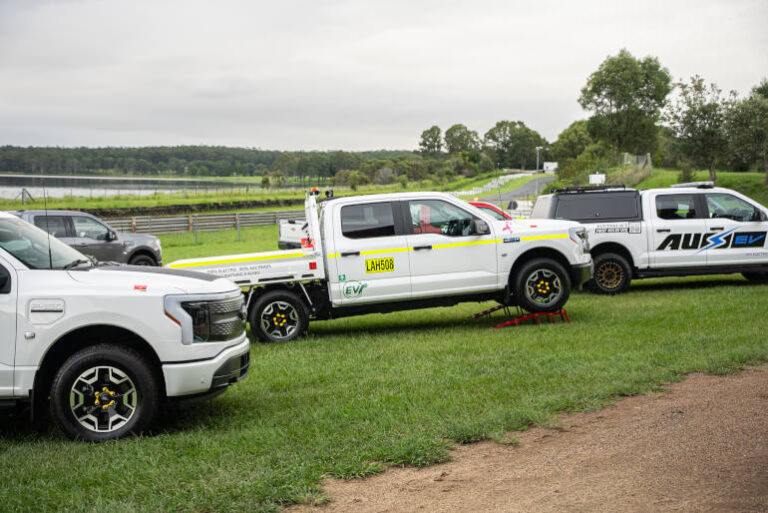
The collapse of BOSSCAP Group into receivership on 17 March 2026 has sent a ripple through Australia’s emerging electric commercial vehicle sector, particularly among fleets exploring alternatives to traditional OEM supply.
BOSSCAP had positioned itself as a specialist engineering and advanced manufacturing business, delivering right-hand-drive conversions of the Ford F-150 Lightning and supporting early fleet electrification projects. Through its AMQ and AUSEV operations, the company built capability in compliance, local manufacturing, and vehicle integration—areas that are often barriers for new vehicle platforms entering Australia.
However, the business model ultimately depended on access to an upstream OEM platform. According to the company’s media release, “a sudden change in global production strategy from Ford materially impacted the availability of the underlying platform the business relied on… removing the foundation of future supply.”
With that supply disrupted, BOSSCAP’s forward pipeline collapsed despite what it described as “strong market interest and growing sales momentum.”
Operations have now been suspended, and the company has confirmed it is unable to undertake warranty repairs while receivers assess the business.
Is the non-OEM model flawed?
The BOSSCAP situation doesn’t necessarily mean the concept of non-OEM vehicle supply is dead, but it does highlight the structural risks.
There are three key issues for fleet buyers to consider:
1. Supply chain dependency
Non-OEM providers—converters, second-stage manufacturers, or local engineering firms—typically rely on base vehicles from global OEMs. If that supply is interrupted, the downstream business has limited control.
In BOSSCAP’s case, the entire model was built around access to a specific platform. Once that changed, there was no immediate alternative.
2. Scale and capital intensity
Developing compliant, road-legal vehicles for the Australian market requires significant investment in engineering, testing, and certification. Without scale, it can be difficult to sustain operations if volumes or supply fluctuate.
OEMs absorb this risk across global platforms. Smaller players cannot.
3. Warranty and lifecycle support
Fleet buyers prioritise uptime and support. When a supplier fails, warranty, parts, and service continuity become immediate concerns—as BOSSCAP customers are now experiencing.
This is not unique to converters, but the risk profile is higher where there is no global support network behind the product.
Where converters still have a role
Despite the risks, the non-OEM model still fills important gaps.
- Early access to new technology: BOSSCAP brought the F-150 Lightning to Australia well before any official OEM program.
- Local adaptation: Mining, utilities, and infrastructure fleets often need modifications that OEMs do not provide.
- Niche applications: Low-volume or specialised use cases are often not viable for OEMs to address directly.
For some fleets, these benefits can outweigh the risks—provided they are understood and managed.
What about the influx of Chinese brands?
The second question raised by the BOSSCAP collapse is whether similar risks apply to the growing number of new vehicle brands entering Australia, particularly from China.
There are some parallels—but also important differences.
Similar risks
- Market entry uncertainty: Not all new brands will achieve long-term viability in Australia.
- Dealer and service network maturity: Early-stage networks may not provide consistent national support.
- Residual value risk: Unproven brands can impact whole-of-life cost modelling.
Key differences
- Direct OEM supply: Most Chinese brands are fully integrated OEMs, controlling production rather than relying on another manufacturer’s platform.
- Global scale: Many are backed by large industrial groups with significant manufacturing capacity.
- Strategic expansion: Entry into Australia is often part of a broader global growth strategy, not a single-market venture.
This reduces—but does not eliminate—the risk compared to a converter model dependent on a third-party OEM.
What it means for fleet buyers
The BOSSCAP collapse is less about one company and more about risk management in a changing supply landscape.
For Fleet Managers and Procurement Managers, the key considerations remain consistent:
- Supply certainty: Where does the vehicle come from, and who controls production?
- Support network: Is there a national service and parts capability?
- Financial stability: Does the supplier have the balance sheet to support long-term operations?
- Exit risk: What happens if the supplier withdraws or fails?
These questions apply equally to converters, new entrants, and even established OEMs launching new technologies.
A maturing market, not a closed door
The BOSSCAP story reflects a market still finding its structure as electrification accelerates.
It doesn’t signal the end of innovation outside traditional OEM channels. But it does reinforce a point fleet buyers already understand: new supply models come with different risk profiles, and those risks need to be assessed alongside the potential benefits.
In practical terms, fleets are unlikely to abandon non-OEM solutions entirely—but they may apply more scrutiny, particularly around supply security and long-term support.
That shift, more than the collapse itself, is likely to shape the next phase of the market.