


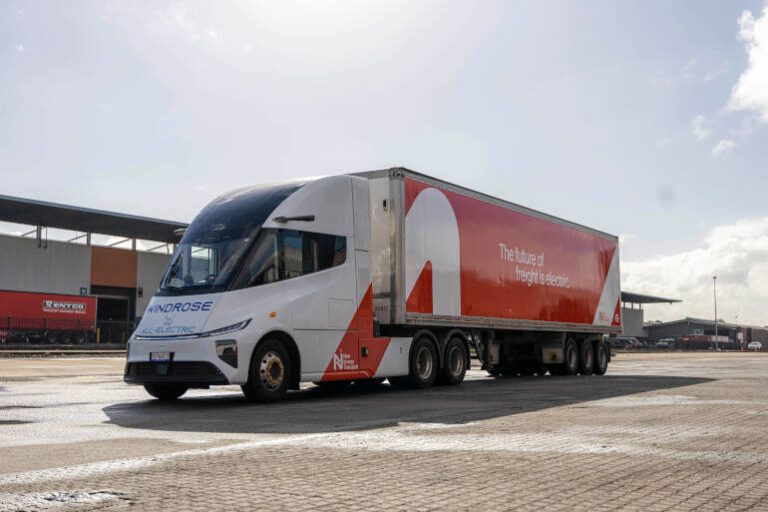
Australia’s heavy freight sector has reached a significant milestone, with the country’s first fully electric, end-to-end delivery completed between Sydney and Canberra—demonstrating that battery-electric trucks are ready for mainstream freight operations.
The project, led by New Energy Transport (NET) in partnership with ANC and Who Gives A Crap, saw a Windrose electric prime mover transport a bulk load of consumer goods from a Sydney distribution centre to Canberra, before the freight was transferred to electric last-mile delivery vehicles for final delivery to customers.
The fully electric journey covered approximately 460 kilometres and delivered measurable operational benefits, including lower energy costs and improved journey times compared to diesel.

A practical demonstration of electric freight capability
For many Fleet Managers and Logistics Managers, the key question has been whether electric trucks can handle real-world freight tasks without compromising productivity. This demonstration provided a clear operational case study rather than a theoretical discussion.
The electric prime mover completed the route on a single charge while maintaining performance across challenging terrain, including steep sections near Goulburn where diesel trucks typically slow significantly.
In addition to matching diesel performance, the electric truck delivered tangible efficiency gains.
- 84% reduction in energy costs compared to a diesel truck on the same route
- 25 minutes faster delivery time than the diesel equivalent
- Zero tailpipe emissions across the entire delivery journey
These outcomes are particularly relevant for organisations managing high-utilisation freight operations, where energy costs and asset productivity directly affect Whole-of-Life Cost (WOLC) calculations.
Daniel Bleakley, Co-CEO of New Energy Transport, said the delivery signals a turning point for the industry.
Daniel Bleakley, Co-CEO, New Energy Transport, said the delivery proves that zero-emission heavy freight is possible now: “This delivery ushers in a new era for Australian road freight where electric heavy trucks are not just cheaper and faster, they unshackle Australia from volatile global oil markets, dramatically strengthening our supply chain resilience.”
Range, charging and payload capability are reaching operational thresholds
One of the persistent barriers to heavy vehicle electrification has been concerns about range, payload and charging time. The Windrose electric truck used in the demonstration provides insight into how quickly these constraints are evolving.
According to the project partners, the vehicle offers:
- Up to 670 km driving range at 49-tonne combined mass
- One-hour fast charging capability
- B-double rated 1,400 horsepower performance
For fleet planners, these specifications move electric trucks beyond pilot programs and into mainstream operational consideration—particularly for linehaul and regional distribution routes where predictable daily distances are common.
The demonstration also builds on previous trials that showed productivity improvements, including a 12% reduction in journey time on long-distance freight operations.
Infrastructure planning remains the next critical step
While vehicle capability is advancing rapidly, infrastructure planning will determine how quickly organisations can scale electric freight operations.
New Energy Transport has announced plans to develop a major heavy-vehicle charging depot near Wilton in south-west Sydney, designed to support up to 50 electric trucks and anchor electrified freight corridors between Sydney, Wollongong and Canberra.
This type of infrastructure investment reflects a broader shift in fleet strategy—from evaluating individual vehicles to planning integrated operating models that include:
- Depot charging capacity
- Route planning and energy management
- Asset utilisation optimisation
- Risk management for fuel and energy supply
For organisations developing Fleet Asset Management Plans (FAMP) or decarbonisation strategies, these operational considerations are becoming as important as vehicle selection.
What this means for fleet and logistics leaders
For Fleet Managers, Sustainability Managers and Finance Managers, the demonstration highlights a shift from pilot projects to operational deployment.
1. Electric trucks are reaching commercial viability
The combination of lower energy costs and competitive delivery times strengthens the business case for electrification in suitable duty cycles.
2. Productivity is no longer the primary barrier
Performance on challenging terrain and long-distance routes suggests electric trucks can meet operational expectations for many freight applications.
3. Infrastructure and planning will drive adoption speed
Organisations with structured fleet planning processes will be better positioned to integrate electric heavy vehicles into existing operations.
As fleet management maturity increases—particularly in areas such as utilisation analysis, replacement planning and energy strategy—organisations will be able to evaluate electric freight solutions within a disciplined procurement and risk framework rather than as isolated technology trials.
The successful Sydney-to-Canberra delivery demonstrates that the transition to zero-emission freight is no longer a future concept. It is becoming an operational decision.




