

The NSW Government is positioning itself as one of the most active supporters of electric vehicle adoption in Australia, using a combination of funding, infrastructure rollout, fleet programs and industry engagement to accelerate the transition.
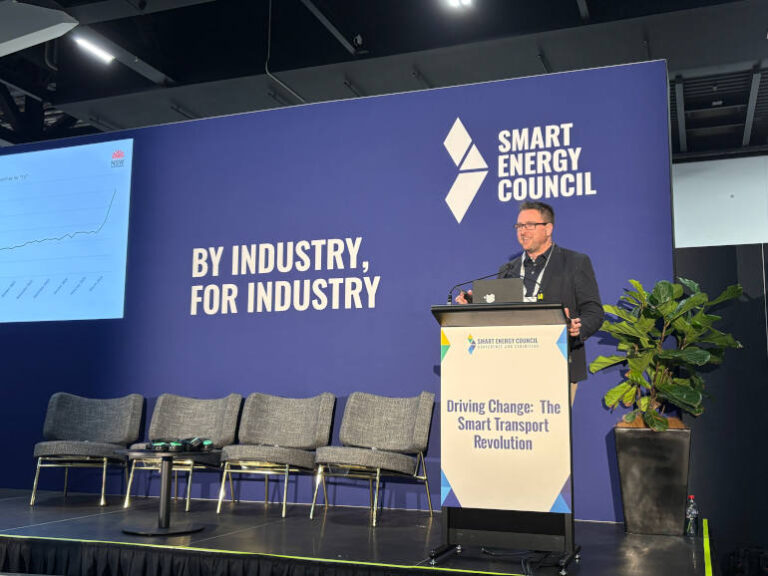
Speaking at the Smart Energy Conference and Exhibition in Sydney, Terry Niemeier, Director Transport Electrification & Safeguard at the NSW Government’s Department of Climate Change, Energy, the Environment and Water (DCCEEW), outlined how the state is trying to move EVs from an emerging technology to mainstream transport infrastructure.
Niemeier said the conversation around EVs has shifted dramatically over the last four years.
“It’s been really remarkable to see how much conferences like this and the conversations that we’ve been having have evolved so quickly from that early stage of any technology where it’s new, it’s talking about what we’re going to do tomorrow and what we need to do now to gear ourselves up,” he said.
“For passenger EVs, it’s no longer something for the future. It’s here, it’s now. And the momentum is really shifting.”
Niemeier pointed to growing public interest in EVs, saying Google search trends had effectively doubled in recent months as fuel prices and energy security concerns pushed more consumers and businesses to consider alternatives to petrol and diesel vehicles.
He said the NSW Government’s support for EVs is driven by more than emissions reduction targets.
“The last few months have really clearly shown us how much the transition to EVs provides cost of living relief and cost of living certainty and predictability,” Niemeier said.
“Importantly, sovereign security of being able to keep things moving when external factors can change that.”
Transport remains one of the largest emissions challenges for the state, accounting for around 20 per cent of total emissions in NSW, with passenger vehicles making up roughly half of that figure.
To address the challenge, the NSW Government recently refreshed its EV Strategy, committing more than $100 million over the next four years to continue supporting EV adoption.
According to Niemeier, the strategy is designed to support both vehicle demand and charging infrastructure simultaneously.
“We know people won’t make the transition to EVs without there being infrastructure to rely on,” he said.
“But we also know that investment in infrastructure is heavily reliant on there being EVs on the road in the first place to use it.”
One of the biggest focuses for NSW has been the development of a statewide charging network. The government has already supported more than 120 fast charging stations across the state through three funding rounds, with about half already operational. A fourth round recently closed and further announcements are expected later this year.
Niemeier said the goal is to ensure EV drivers are always within 100 kilometres of an ultra-fast charger on major highways and roads, and within five kilometres of one in metropolitan areas.
The strategy also includes support for kerbside charging in dense urban areas where residents may not have access to home charging.
“We’ve run two funding rounds of that program and supported over 1,000 charge plugs across metro areas,” he said.
Fleet electrification is another major pillar of the NSW approach.
Niemeier said fleets represent about half of all new vehicle sales and are critical to creating a healthy second-hand EV market in future years.
“We’ve got a program particularly designed to support businesses and local government fleets to procure electric vehicles by helping them to address the total cost of ownership gap,” he said.
“But excitingly, when we go through that process, you’ll find that depending on the kilometres travelled and the use type, there are many cases where it’s already cheaper in a total cost of ownership model structure to buy an EV now.”
The NSW Government has also established its own fleet targets, aiming for 100 per cent of new passenger vehicle procurement to be electric by 2030.
Importantly for commercial operators, Niemeier said the government is increasingly turning its attention toward heavier vehicles and urban freight.
“Our fleet program has been moving more and more into heavier commercial vehicles,” he said.
“We’re seeing more and more models become available every year as that happens. And we’re really keen to be working with more fleet operators of those, particularly last mile delivery size trucks, where the technology is already here and already available.”
Beyond infrastructure and vehicle funding, the NSW Government is also investing in education and training programs to support the transition.
That includes EV drive days, consumer information tools, mechanic training programs for regional workshops, and support for councils planning their own EV transition strategies.
Niemeier said councils play a critical role because they are often the first to hear both concerns and opportunities from local communities.
“Councils work in and interface with the communities right across New South Wales, and they’re the first people to hear of issues as well as opportunities in their community,” he said.
The NSW Government is also preparing for the next stage of EV adoption, including vehicle-to-grid (V2G) technology and further support for heavy vehicle electrification.
Despite the progress, Niemeier acknowledged the transition requires more than simply replacing petrol and diesel vehicles with EVs.
“We can’t just focus on EVs by themselves as a solution to decarbonising our transport sector,” he said.
“We need to be decarbonising the electricity grid that provides the energy for our EVs, but we also need to be looking at opportunities to reduce the number of vehicles on the road in the first place.”
Still, his overall message to industry was clear: the momentum behind EV adoption is building rapidly, and NSW intends to stay at the front of the transition.
“We have momentum really, really building up in EVs and becoming quite mainstream, but we just need to pick up the pace,” Niemeier said.
“The next big wave is going to be that freight piece, and we need to be having more of those conversations.”