


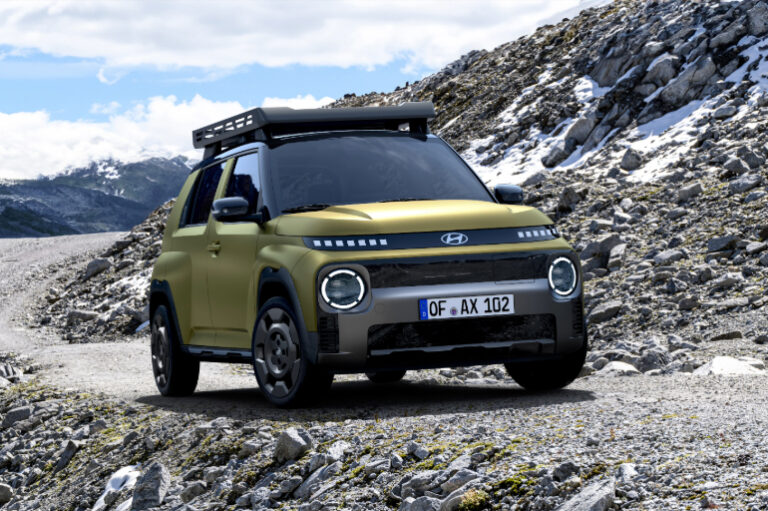
Hyundai Motor Company Australia is dramatically increasing electric vehicle supply to Australia in response to a sharp rise in consumer demand, with EV orders surging in March and April as fuel prices pushed more buyers to consider lower running costs.
The biggest growth story is the new INSTER compact EV, but Hyundai says strong demand is being experienced across the entire electric vehicle range including the KONA Electric, IONIQ 5 and the new ELEXIO.
Hyundai Motor Company Australia Director of Sales, David Rodda, said the brand experienced a major turning point in EV demand during March.
“In March, Hyundai saw a 355% increase month-on-month for EV orders, from 228 in February to 1,037 in March, with a similar level of strong performance across IONIQ 5, INSTER, ELEXIO and KONA EV,” Rodda said.
“The order rate for Hyundai EVs remains strong. EVs now account for 20% of our volume – previously we were at less than 3%. We are planning for a 70% increase in EV orders for the second quarter over Q1.”
To respond to the increase in demand, Hyundai has secured significantly more EV allocation from Korea for the second quarter of 2026.
KONA Electric supply will jump from 305 vehicles in Q1 to 1,265 units in Q2 — a 315% increase. INSTER supply will rise from 84 units to 255 vehicles, up 204%.
The new ELEXIO SUV will increase from 750 units in Q1 to 1,180 units in Q2, while IONIQ 5 supply grows from 96 vehicles to 150 units.
Hyundai said the supply increase reflects strong factory support and the ability to quickly redirect vehicles into the Australian market.
“Hyundai Australia has secured a 158% supply increase of EVs for quarter two to meet this unprecedented level of demand, with KONA EV supply increasing by 315%, for example,” Rodda said.
“These vehicles will start to arrive from May due to the fast supply chain out of Korea. We are confident in securing equally strong support from the factory for the rest of the year.”
The increase in supply closely mirrors rising customer demand.
Between January-February and March-April, Hyundai reported EV order growth of 205% for INSTER, 298% for KONA Electric, 187% for IONIQ 5 and an extraordinary 2,183% increase for ELEXIO orders.
The demand growth is not limited to EVs. Hyundai also experienced a major jump in hybrid demand during March.
“Hyundai also grew hybrid orders from 3,049 in February to 3,966 in March, a 30% increase,” Rodda said.
“In fact, 57% of Hyundai Australia’s orders in March were for hybrids – that’s the biggest percentage ever for us, and the highest in the Australian industry.”
The company believes the shift reflects changing consumer confidence towards electrified vehicles as cost-of-living pressures and fuel prices influence purchasing decisions.
“Anyone who was previously only considering an EV as a future purchase is now completely confident in making that decision, given the benefits of ownership,” Rodda said.
Hyundai also pointed to its broad EV product range and established dealer network as key advantages in the Australian market.
“Our existing EV lineup already covers 85% of the market, and with the introduction of the STARIA Commercial Van later this year and IONIQ 3 hatch early next year, we expect to reach 96% overall EV market coverage,” Rodda said.
“Across Hyundai’s established dealer network, we now have 166 EV certified dealer service departments nationwide, spanning all states and territories—providing customers with genuine peace of mind when it comes to EV ownership.”
Rodda added that Hyundai’s long-term EV investment is now paying dividends as mainstream consumers move into the market.
“Hyundai’s current model lineup is our second generation of electric vehicles in Australia. We’ve been delivering EVs to Australians for eight years – and globally, we’ve been developing EVs for 35 years,” he said.
“We have two World EV of the Year Award winners in our range in the form of INSTER and IONIQ 5 as well as local recognition.”
The latest figures reinforce how quickly Australia’s EV market is evolving in 2026, particularly as established brands with broad dealer networks and improving supply begin to capture growing mainstream demand.