


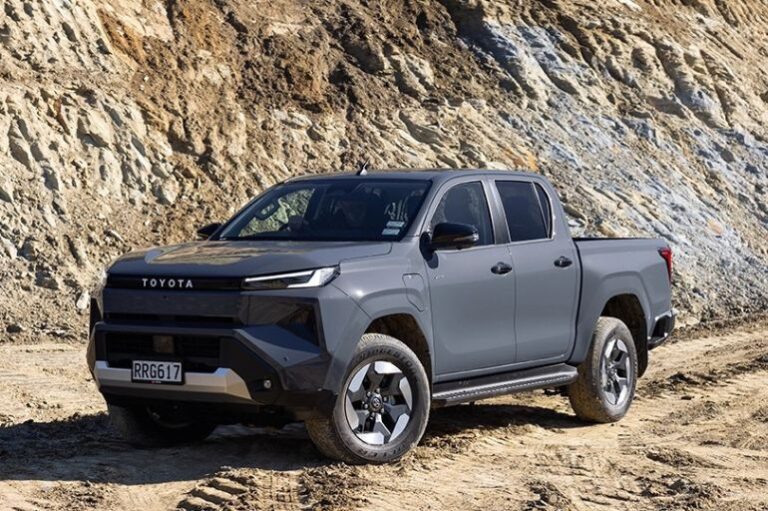
Toyota New Zealand will open pre-orders for the first-ever battery electric Hilux towards the end of May, giving Kiwi fleets, businesses and private buyers a new zero tailpipe emissions option in the ute market.
The Hilux BEV joins the newly launched ninth-generation Hilux range and represents a major step in Toyota’s multi-pathway approach to electrification. It has been designed for customers that want the familiar size, durability and flexibility of a Hilux, but with a battery electric powertrain suited to defined routes, depot charging and lower-emission operations.
Toyota New Zealand Chief Strategic Officer, Andrew Davis, said the arrival of the Hilux BEV is an important addition to the company’s electrified vehicle line-up.
“Offering both Kiwi businesses and private buyers the choice of a Hilux with zero tailpipe emissions is a crucial step forward in providing consumers the right powertrain for the right application, at the right time,” Andrew Davis, Chief Strategic Officer at Toyota New Zealand, said.
“This is an exciting time for Toyota; bringing in a fully electrified version of the much-loved Hilux finally gives businesses and fleets the option of low-emission motoring, supported by Toyota’s genuine parts and accessories programme, and our unrivalled servicing network.”
Toyota has secured both wellside and Cab Chassis variants of the Hilux BEV, giving customers flexibility to customise the vehicle for work or lifestyle applications. It will be launched exclusively as a double-cab model, available with either cab chassis or wellside body styles, dual-motor all-wheel drive, and in SR or SR5 grades.
For Fleet Managers, the key message is fit-for-purpose. Toyota says the Hilux BEV will be best suited to everyday operational roles, predictable routes and use cases where charging is available at a depot, base, farmyard or worksite. Davis said the vehicle would work well where daily travel distances are less than 200 kilometres.
“From patrolling airport runways, moving equipment around a vineyard or orchard, to regional highway inspections, the Hilux BEV would fit seamlessly into many working environments. But don’t underestimate its capability – it certainly holds its own on rugged terrain too,” Davis said.
The Hilux BEV is expected to appeal to infrastructure and construction companies, farmers, horticulture operators, trades, eco-tourism businesses and local government contractors operating within defined areas. Toyota also points to the benefits of quiet operation and zero tailpipe emissions when working around livestock, orchards or sensitive environments.
Under the skin, the Hilux BEV uses a newly developed 59.2kWh lithium-ion battery and dual-motor all-wheel-drive system producing a combined 144kW. Torque is distributed between the front and rear axles, while Toyota’s Multi-Terrain Select system provides six drive modes for low-traction and off-road conditions.
The Hilux BEV maintains the same 700mm wading depth as the standard Hilux. DC fast charging can take the battery from 10 to 80 percent in around 30 minutes, while 10kW three-phase AC charging can take it from 10 to 100 percent in approximately 5.5 hours.
Toyota lists driving range at 245km for the cab chassis variant and 315km for the wellside variants, both measured on the NEDC cycle. Towing capacity is rated at 2,000kg braked when fitted with a Toyota Genuine Accessories towbar, while unbraked towing capacity is 750kg.
Toyota says the Hilux BEV has been developed with durability in mind, including testing with Australian mining fleets in demanding conditions such as high temperatures, remote operations and off-road environments. Since arriving in New Zealand, Toyota says the vehicle has also been tested against its diesel equivalent in challenging off-road conditions.
Davis said the new model is not designed to replace diesel Hilux variants across every application, but to give organisations more choice when matching vehicles to the job.
Diesel will remain important for high-payload and heavy-towing roles, while the Hilux BEV creates a new option for organisations that need ute practicality, all-wheel-drive capability and lower emissions in roles where the duty cycle suits battery electric operation.
The Hilux BEV also receives its own suspension package, with frame reinforcements, MacPherson strut front suspension and a De-dion rear leaf spring setup designed to accommodate the rear electric motor while retaining the Hilux’s live axle layout.
Standard safety equipment includes Toyota Safety Sense features such as Pre-Collision System with motorcycle detection, Intersection Collision Avoidance, Road Sign Assist, Automatic High Beam and Lane Tracing Assist. SR Wellside and SR5 grades add features including a higher-definition Panoramic View Monitor, front and rear parking sensors and Parking Support Brake.
Externally, the Hilux BEV is identified by a closed-off upper front grille and aerodynamically enhanced 17-inch alloy wheels. Two exterior colours will be available: Glacier White and Ash.
Pricing for the Toyota Hilux BEV will be announced later this month.