


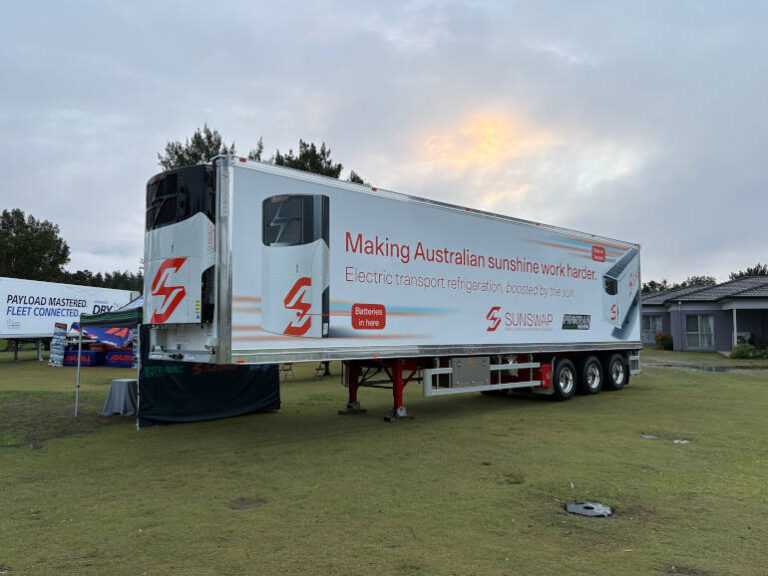
The Clean Energy Finance Corporation has committed up to $10 million to accelerate the introduction of low-emissions electric transport refrigeration across Australia’s cold chain logistics sector.
The investment will support the deployment of more than 100 Sunswap Endurance units across refrigerated retail and logistics fleets. The units are fully electric and solar-assisted, and are designed to replace the diesel-powered refrigeration systems commonly fitted to refrigerated trailers.
Transport refrigeration plays a critical role in Australia’s food and pharmaceutical supply chains, where temperature control is essential. However, diesel-powered refrigeration adds fuel use, maintenance requirements and emissions to fleet operations.

The CEFC investment is being made through the Powering Australia Technology Fund and is intended to address one of the key barriers to adoption: the upfront cost of manufacturing and importing advanced refrigeration units.
Sunswap’s Endurance technology is already being deployed locally through Australian distribution partner Protran Solutions. It has also been tested in Australian conditions, including a three-day, 1,671 kilometre route between Sydney and Brisbane without the need for en route charging. The unit completed the trip with 62 per cent battery remaining.
CEFC Head of Growth Capital Malcolm Thornton said transport refrigeration was an important part of the national supply chain.
“Transport refrigeration is critical to Australia’s food and pharmaceutical supply chains. Supporting proven electric alternatives enables emissions reductions, improved air quality and lower operating costs for Australian businesses,” Thornton said.
Sunswap CEO and Co-founder Michael Lowe said cold chain logistics had relied on diesel-powered refrigeration for decades.
“Cold chain logistics has relied on diesel powered refrigeration for decades. The load stays cold, but everything else – the fuel cost, high maintenance, limited operational insights – has been accepted as the price of doing business. We built Endurance to change that calculation,” Lowe said.
“Today, we are relied on by major fleets and retailers across Europe and South America. The CEFC investment puts more units on Australian roads, giving operators access to electric refrigeration that cuts operating costs, handles Australian distances, and comes with the service infrastructure to back it up.”
Protran Solutions General Manager Grant Turner said the Australian trial showed the technology could perform in local operating conditions.
“Australian refrigerated transport has put up with diesel’s costs and limitations for too long, not because operators wanted to, but because there simply wasn’t a credible alternative. Sunswap changes that,” Turner said.
“The Sydney to Brisbane trial run without recharging it’s shows the technology actually performed in Australian conditions. This investment puts more of that capability on Australian roads, and I genuinely believe it’s the beginning of a significant shift for this industry.”
For refrigerated transport fleets, electric refrigeration creates another pathway to reduce diesel use beyond the transition to lower-emission trucks and prime movers. Refrigeration units can be a major operating consideration in cold chain logistics, particularly where trailers spend long periods maintaining temperature at depots, distribution centres and customer sites.
The solar-assisted design may also be relevant for Australian fleets because of local climate conditions. Higher solar contribution has the potential to reduce electricity demand and operating costs, depending on route profile, dwell time, ambient temperature and charging arrangements.
Australia represents a significant opportunity for electric transport refrigeration, with the cold chain logistics market estimated at up to US$5 billion in 2025.
Transport remains Australia’s third-largest source of greenhouse gas emissions, accounting for around 22 per cent of national emissions. Heavy vehicles are a significant contributor and remain one of the more difficult transport segments to decarbonise.
The CEFC-backed deployment will give local operators more exposure to electric refrigeration technology and provide further evidence on how the systems perform across Australian distances, temperatures and duty cycles.




