

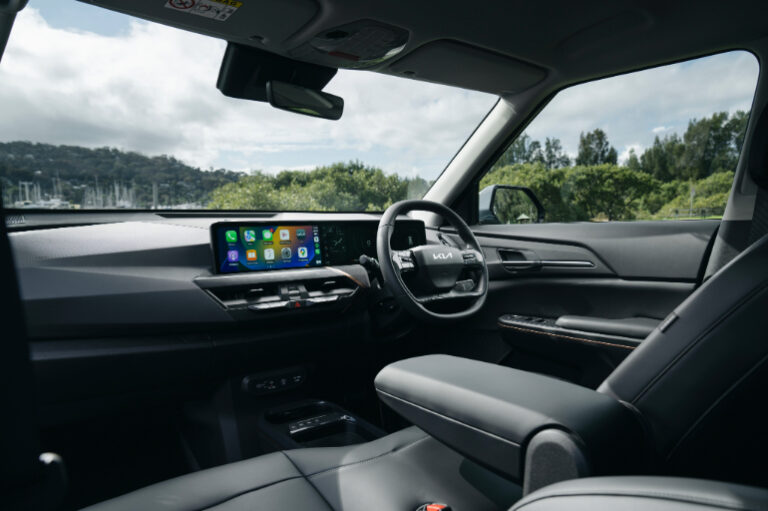
As vehicle interiors become increasingly dominated by touchscreens, Kia Australia is deliberately retaining physical buttons, toggles and dials in its EVs because it believes fleet vehicles need to work as mobile workplaces.
Roland Rivero, General Manager, Product Planning & Training at Kia Australia at the time of the interview, told Fleet News Group that vehicle ergonomics should be considered differently when employees spend hours behind the wheel every day.

The vehicle is part of the workplace
For Fleet Managers, comfort and usability are more than convenience features. A seat, dashboard or control system that works well during a short test drive may become much more important when the vehicle is being used for an entire working day.
Rivero said Kia approaches its interiors with this in mind.
“We’ve always you know looked at the the vehicle interior as as an office you know for mobile employees,” he said.
That starts with basics including lumbar support and sufficient adjustment to accommodate drivers with different body types.
Rivero said these features were intended to minimise fatigue for employees spending extended periods on the road.
Physical controls still have a role
The bigger design debate is taking place around the dashboard. Large touchscreens are now common across the industry, including Kia’s own vehicles, but Rivero said the company continues to see value in controls drivers can operate by touch.
“You know what we have retained is physical buttons, toggles and dials, and that’s all about tactility as much as possible,” Rivero said.
“You know you can argue that that buttons are old technology, but they they’re tactile technology, and from a safety perspective as well, it means that you can you can focus on the road and just feel your way through the buttons and the dials, and and have full focus and attention to to the road ahead and to the traffic ahead.”
It is an important consideration for fleet buyers as manufacturers increasingly move functions such as climate control, mirrors and vehicle settings into central screens.
The question for a Fleet Manager is not simply whether the technology looks modern, but how easily an employee can operate it repeatedly during a working day.
Digital systems still need to be simple
Rivero said retaining physical controls does not mean avoiding digital technology.
Kia uses dual-screen layouts for driver information and infotainment, but he said the objective was to make those systems intuitive enough that drivers did not need extensive instruction before using them.
“The the complex digital screens don’t have to be complex if you make a user interface that’s simple and easy to use and intuitive,” Rivero said.
He pointed to functions including Spotify, Android Auto and Apple CarPlay as examples of systems that need to be easily customised by the driver.
For organisations operating pool vehicles, that usability can be particularly important because employees may regularly move between different vehicles rather than becoming familiar with one assigned car.
PV5 takes the mobile workplace further
Kia’s new PV5 electric van provides another example of where vehicle technology could become more directly connected with the working day.
Rivero highlighted its Android-based in-vehicle infotainment system as an opportunity for greater customisation in future. He also pointed to vehicle packaging and storage as part of the same discussion.
“All of that adds up. You know, when you are running a fleet and you’re operating, you know, a fleet of vans, you know, every every bit of downtime counts, and the aim is to to create operational efficiency as much as possible,” Rivero said.
It is a useful reminder for Fleet Managers evaluating the next generation of EVs. Technology should not only be judged by screen size or the number of functions available.
For a vehicle being used as a workplace, the better measure may be how quickly and comfortably an employee can get in, understand it and get on with the job.