


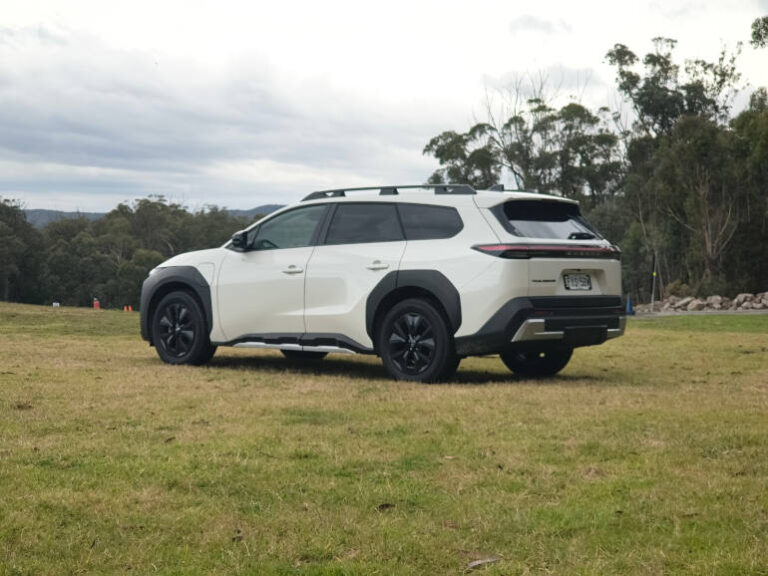
For Fleet Managers who still associate Subaru’s electric vehicle strategy primarily with the Solterra, it might be time for another look.
The arrival of the Trailseeker in June marked a significant expansion of Subaru’s battery-electric offering in Australia. Solterra has now been joined by the larger Trailseeker and the smaller Uncharted, giving Subaru electric SUVs across several vehicle sizes rather than relying on a single BEV to cover every customer requirement.
That matters for fleets because one of the challenges with transitioning to electric vehicles is finding alternatives that fit different roles without dramatically expanding the number of manufacturers on the fleet.
Subaru’s strategy appears to recognise that.
At the Trailseeker launch, Scott Lawrence, General Manager, Subaru Australia, was asked how Subaru expected sales to split between its three electric models.
“At this stage, we don’t have a target for sales split for the three BEVs,” Lawrence said. “The important part for us is offering consumers in those different segments options.”
Rather than nominating one EV as the volume model, Subaru is positioning its electric range around different applications and customer requirements.
The Solterra is positioned as the medium electric SUV role, Uncharted as the smaller EV and Trailseeker as the largest, most powerful and most adventure-focused model of the three.
For Fleet Managers, it creates a more useful conversation than simply asking whether an organisation should buy a Subaru EV.
The better question becomes: which Subaru EV is fit for purpose?
Trailseeker adds another type of EV
Trailseeker is the vehicle that broadens the Subaru EV proposition most obviously.
Its dual electric motors produce a combined 280kW, while the 74.7kWh CATL battery provides a WLTP driving range of up to 533km in the Trailseeker AWD. The AWD Touring is rated at up to 488km. Both have 211mm of ground clearance and Subaru’s Symmetrical All-Wheel Drive and X-Mode systems.
Those numbers allow it to address a different set of applications from an urban-focused electric SUV.
But Subaru is also careful not to position its new EVs as replacements for every petrol vehicle in the range.
Asked at the launch how Trailseeker fitted alongside the Outback, Lawrence said expanding the model range was about increasing customer choice.
“The expansion of the model range really puts a lot more choices to consumers, and the likes of a Trailseeker lives beside Outback for those that want that progressive EV choice for them,” he said.
That distinction should make sense to fleets.
Electrification does not necessarily mean replacing every combustion vehicle with an EV at once. A mixed fleet can allocate BEVs to applications where charging, range and operating requirements work, while retaining other powertrains where they remain better suited.
Existing Subaru customers are looking at EVs
Amanda Leaney, Marketing Director at Inchcape Australasia, said Subaru was already seeing interest from its traditional customer base as well as people who had not previously considered the brand.
“We have a very loyal customer base, and the first volume of sales always come from within the Subaru loyalty group,” Leaney said at the launch.
“We’ve got a huge following of Subaru owners who are looking for an electrification journey. And complementing that is we have a whole bunch of new people coming to discover what Subaru’s electric vehicle range will be.”
She said Subaru was seeing “a really good mix of both”.
That may be particularly relevant to organisations that already operate Forester, Outback or Crosstrek models.
Changing powertrain is already a significant change-management exercise for drivers. Being able to introduce an EV from a manufacturer drivers already know may remove one small part of the transition.
More choice is the important bit
Subaru isn’t suddenly an EV-only manufacturer, nor is it suggesting every application should be electrified.
What changed in 2026 is the breadth of the choice.
Two years ago, Subaru Australia effectively had one battery-electric option. It now has three EV nameplates alongside hybrids and familiar combustion models, part of what the company described at the launch as a deliberate expansion across multiple powertrains.
For a Fleet Manager developing an EV transition plan, that makes Subaru worth reconsidering. The brand is no longer asking fleets to make one electric SUV fit every job.