

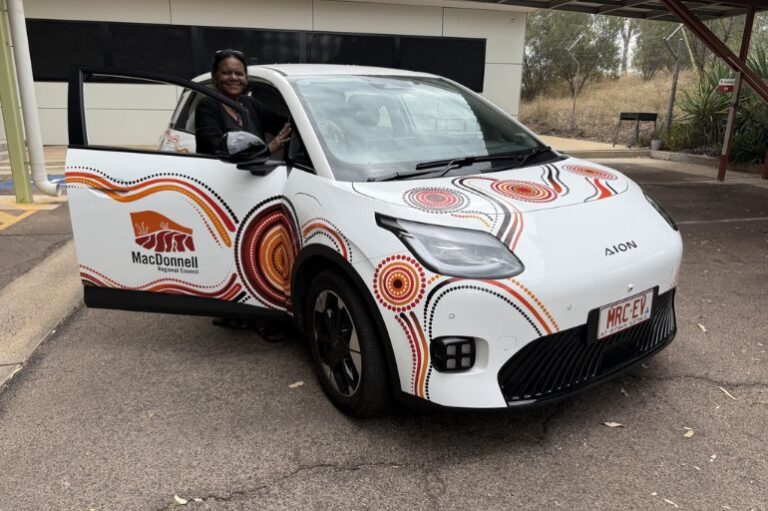
MacDonnell Regional Council has introduced its first fully electric vehicle, taking an initial step towards reducing the environmental impact of a fleet that supports essential services across remote Central Australia.
The vehicle features Indigenous artwork celebrating the culture, communities and landscapes of the MacDonnell Region, bringing a local identity to the council’s first EV.
For a council operating across a vast geographical area, introducing electric vehicles involves a different set of considerations to those facing metropolitan fleets. MacDonnell Regional Council relies on a large vehicle fleet, including many diesel vehicles, to deliver services to its communities.
The council has framed the purchase as a small, practical move towards more sustainable operations.
Council President Roxanne Kenny said the vehicle reflected a commitment to reducing environmental impacts wherever practical.
“We know that operating across such a vast region means we rely heavily on vehicles to deliver services to our communities. While this is only one vehicle, it’s an important first step and shows our commitment to reducing our environmental impact wherever we can.”
The announcement does not identify the vehicle model, its intended duties or charging arrangements. These details would help explain how the EV fits into the council’s operations and whether its application could be extended to other vehicles.
For fleet managers, the purchase highlights the opportunity to assess individual vehicle roles within a diverse fleet. Even where diesel vehicles continue to support remote service delivery, particular duties may offer a starting point for electrification, subject to range, charging access and operational requirements.
The EV joins a broader series of council sustainability initiatives, including chilled water refill stations to reduce reliance on single-use plastic bottles and efforts to reduce plastic use across council operations.
MacDonnell Regional Council says it will continue exploring practical ways to make service delivery across its communities more sustainable.