

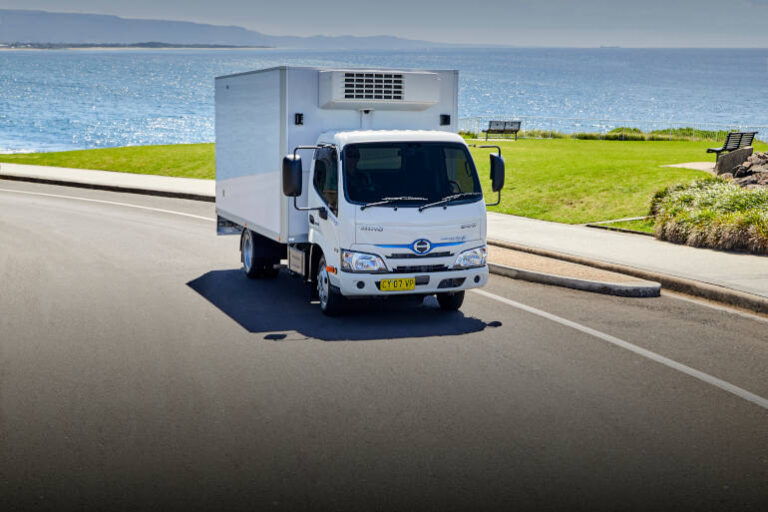
Hino has revised the gearing of its 300 Series Standard Cab Hybrid after vehicle data revealed customers were using the truck for more urban and regional travel than originally anticipated.
The change introduces a taller differential ratio, lowering engine speed at highway cruising speeds. Hino says it delivered a 5% fuel efficiency improvement in its assessment.
For fleet operators, the update demonstrates how understanding actual vehicle use can inform changes to an established product.
Daniel Petrovski, Department Manager of Product Strategy for Hino Australia, said the Standard Cab Hybrid had originally been targeted at city operations. Customer usage, however, showed a broader role for the truck.
“We’ve got a lot more customers who are now doing urban and regional type operation,” he said during the 300 Series product presentation.
Taller gearing matches changing workloads
Hino has brought the Standard Cab Hybrid’s differential ratio into line with the taller gearing already used in the Wide Cab Hybrid.
The change reduces engine speed at 100km/h, addressing the needs of operators whose work extends beyond low-speed metropolitan routes.
Petrovski said the adjustment might appear modest, but it produced a measurable benefit.
“That’s a 5% fuel improvement we got by changing that diff ratio to a taller diff ratio,” he said.
The figure relates to Hino’s assessment of the gearing change on the Standard Cab Hybrid. It is separate from any fuel consumption comparison between a hybrid and a conventional diesel truck, with results in service dependent on the application and operating conditions.
Hino Connect informs product planning
The decision was supported by data from Hino Connect, giving the product team insight into how customers were using Standard and Wide Cab hybrids.
Asked whether connected-vehicle information had helped identify the need for the change, Petrovski confirmed its role.
“That data came out of Hino Connect,” he said.
The example extends the value of telematics beyond monitoring individual vehicles. Information about operating patterns can also help manufacturers assess whether an existing specification remains appropriate for the work customers perform.
For fleet managers, it reinforces the importance of reviewing actual duty cycles when selecting replacement vehicles. A truck initially purchased for city work may spend an increasing proportion of its life travelling between depots, suburbs and regional centres.
Hybrid already had Euro 6 diesel technology
While the conventional 300 Series diesel range is receiving its Euro 6 update, Petrovski clarified that the hybrid’s diesel engine had already met Euro 6 requirements since 2020.
The hybrid combines a diesel engine with electric assistance, and its emissions compliance was already incorporated into the engine and exhaust after-treatment system.
“We’ve had a version of this emission solution and this engine since 2020 in the hybrid,” Petrovski said.
That distinction matters when comparing the latest changes across the range. The conventional diesel’s move to Euro 6 and the Standard Cab Hybrid’s gearing revision are different developments, each addressing a particular requirement.
The hybrid’s established emissions technology also provided Hino with Australian operating experience ahead of the wider diesel update.
A broader role for hybrid trucks
The gearing revision reflects the variety of work being undertaken by light-duty hybrid trucks.
Although stop-start urban operation remains an important application, Hino’s customer data showed that Standard Cab models were also covering routes where cruising engine speed warranted attention.
For fleets considering hybrid trucks, the relevant assessment includes the balance of urban and higher-speed travel, payload, terrain and time spent stopped.
The Standard Cab update shows how that operating picture can influence a relatively small specification decision. In this case, connected-vehicle data helped Hino identify an opportunity to better match the truck to the work its customers were already doing.