


Fleet electrification rarely happens in one hit. Passenger vehicles may move first, followed by light commercial vehicles and, as suitable products become available, trucks and other specialised equipment.
That creates a challenge for depot charging: how much infrastructure should a fleet build today for vehicles it may not purchase for several years?
The central lesson is not that every fleet should build everything immediately. It is that today’s construction work should consider what is likely to be required later.

Stage the chargers, design for the end state
The WAGA project followed three distinct planning stages: a Fleet Transition Plan, an EV Charging Strategy and detailed design.
The Fleet Transition Plan established the strategic foundation and looked at fleet composition, vehicle replacement opportunities, costs and emissions.
The charging strategy then assessed electrical supply, charger demand, parking and dwell times, potential staging and future requirements.
Only after those stages did the councils progress to construction-ready detailed engineering covering charger quantities and locations, switchboards, load management, electrical upgrades, conduits and civil works.
That sequence is particularly relevant for organisations tempted to install several chargers as EVs arrive and work out the rest later.
A handful of standalone installations may solve the immediate problem but create additional cost when the depot needs to be excavated again to install more conduits, replace switchboards or relocate parking.
Wyndham prepares for heavy EVs
Wyndham’s depot shows how future requirements can be incorporated even when the vehicles have not yet arrived.
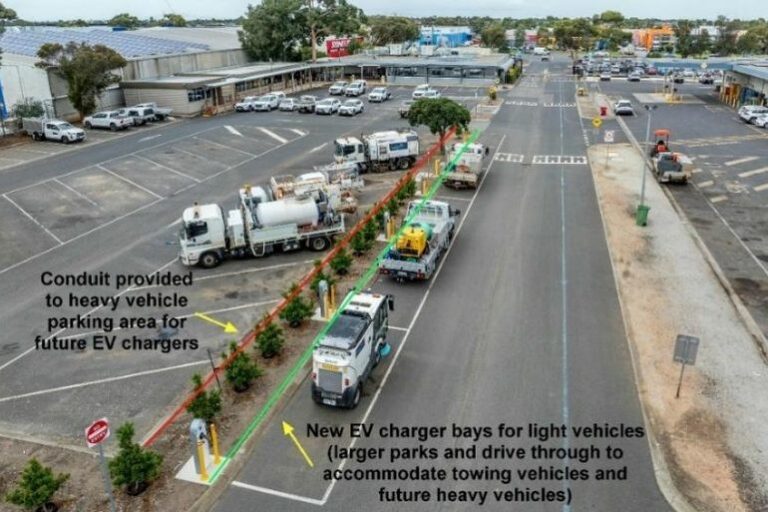
Its current charging installation caters for light EVs, but the underlying infrastructure was designed with future heavy fleet electrification in mind.
The work included a new main switchboard and an increase in the main isolator from 320A to 800A to support a future supply upgrade.
Additional capacity was allowed in switchboards for future chargers, while conduits were oversized to accommodate additional cabling.
Conduits were also installed alongside heavy vehicle parking bays while the civil works for the light vehicle charging area were being completed.
The objective was to avoid having to repeat major ground works when electric heavy vehicles are added to the fleet.
Wyndham’s detailed design ultimately included 24 AC chargers at the depot, a 40kW mobile DC charger in the workshop, approximately 250 metres of new conduit or cable runs and a load management system connected across the charging distribution infrastructure.
Future-proofing isn’t just about EVs
Another lesson from the project is that vehicles may not be the only new electrical load appearing at a depot.
The infrastructure design report recommends considering equipment likely to be electrified during the same planning horizon, including tools, mowers and building heating and cooling.
For an organisation planning a 10-year fleet transition, electrical demand from these other assets could become relevant when assessing how much spare capacity is genuinely available for vehicles.
Solar, battery storage and other energy technologies can also form part of charging strategy assessments, though the appropriate solution will depend on the individual site.
Parking is part of the charging system
During detailed design, engagement with operational staff found that the existing light vehicle parking area was unsuitable for the proposed charger installation because of space and parking constraints.
One of the more practical lessons from Wyndham was that an electrical design can work on paper and still not work operationally.
The chargers were subsequently moved to an underutilised area of the depot, creating a dedicated EV charging zone.
That change required additional civil works, but the report found it produced a more practical outcome with better parking conditions.
For fleet managers, this highlights why charger location should not be determined purely by the shortest cable route from a switchboard.
Traffic movements, vehicle dimensions, overnight parking, shared vehicles, workshop access and future vehicle classes all influence whether a charging layout will work once vehicles arrive.
Avoid building infrastructure without a fleet plan
Future-proofing does not mean installing oversized infrastructure everywhere just in case it might eventually be required.
That could simply bring forward capital expenditure unnecessarily.
The stronger approach is to develop a credible fleet transition plan, understand which vehicle classes are likely to electrify and then determine which infrastructure decisions are difficult or expensive to change later.
Extra conduit capacity installed while a trench is already open is a different investment decision from purchasing chargers that may not be needed for five years.
Similarly, providing room within a switchboard can be very different from paying for a network supply upgrade before demand requires it.
The value is in identifying those decisions early.
For fleet managers planning depot charging, the WAGA experience suggests the objective should be to install what the fleet needs now while making the next stage easier to deliver.
That can reduce duplicated civil works and allow charging infrastructure to grow alongside the fleet rather than becoming an obstacle to the next round of electric vehicle replacements.