


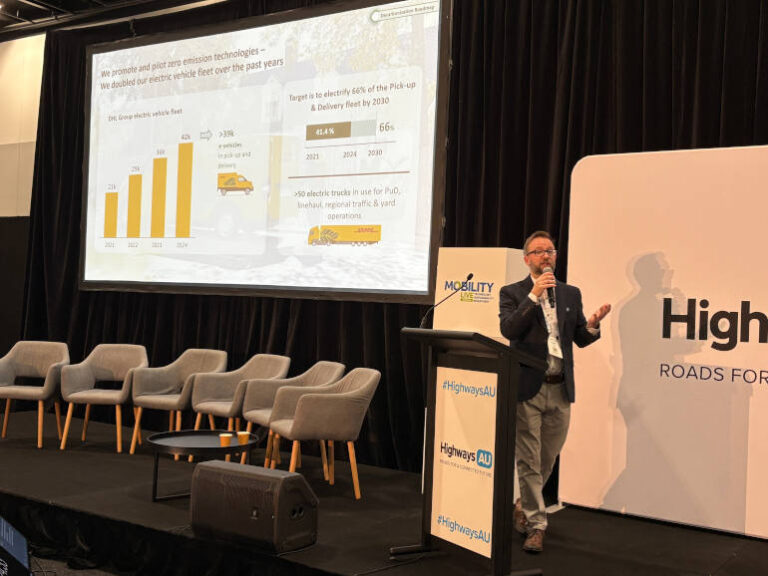
At Mobility Live 2025 in Sydney, Toby Groom, Global Head of EV Logistics Solutions at DHL, shared how one of the world’s largest logistics companies is driving deep, science-based cuts in emissions across its global operations — and why collaboration is the only way to reach net zero.
“Our emissions peaked in 2021,” Groom said. “If we want to hit these targets coming down from that 2021 number, we need to reduce our emissions significantly — and we have to have targeted measures to do that. This is not a ‘we’ll be okay near the end of the decade.’ This is now.”
For DHL, that means cutting emissions from 40 to 29 million tonnes of CO₂ by 2030 to stay aligned with Science Based Targets initiative (SBTi) requirements. The company’s decarbonisation plan targets its largest sources of emissions — air freight, road transport, and facilities — while investing heavily in technology, renewable energy, and sustainable fuels.
Investing in sustainable aviation fuels
Air freight accounts for 68% of DHL’s emissions, making aviation a priority. DHL has already used 188,000 tonnes of sustainable aviation fuel (SAF) between 2020 and 2024 and will double that figure this year. SAF now makes up 3.5% of the company’s total jet fuel mix, but DHL already purchases nearly 10% of the global supply of SAF.
“The challenge is availability,” Groom explained. “It’s not that we can just buy more — there’s such a limited amount of sustainable fuels available. And it comes with cost.”
Partnerships with Neste, Shell, and other fuel producers are helping scale supply, but Groom emphasised the urgency of investment and policy support: “The volume of sustainable fuel isn’t there. We need to be in this and understand those elements.”
Electrifying road transport
DHL has become one of the world’s largest operators of electric delivery vehicles, with 39,000 EVs in pickup and delivery services — representing over 41% of its fleet. The company aims to raise that to 66% by 2030, with new electric trucks and light commercial vehicles being added across all markets.
“We’ve doubled our electric vehicle fleet between 2021 and 2024,” said Groom. “But this isn’t just about mature markets — we’re rolling out electric vehicles globally. We need structurally sound energy systems to support them, powered by renewable sources, so we’re not shifting emissions from one scope to another.”
He acknowledged that electric truck adoption remains challenging due to cost and range. “An electric truck is still two to three times the price of a diesel truck,” he said. “Right now, there’s still a premium — but that’s early in the evolution.”
Green buildings and circular operations
All new DHL facilities are designed to be CO₂-neutral from the outset, using solar PV, heat pumps, automation, and energy-efficient HVAC and lighting systems. “Lighting alone has made a huge impact,” Groom said. “But that’s only one lever — we have 20 standard levers for every new build.”
DHL’s EV Centres of Excellence — including three in Australia — are also part of the solution. These sites support EV supply chains, battery recycling, and repair services to help accelerate fleet electrification and enable circular economy models.
Collaboration and “insetting”
Groom said that DHL’s customers are driving the pace of change. “Our customers are asking for this — they need to reduce their emissions, and we have to enable that. You’ll notice I haven’t mentioned offsetting. This is about insetting — direct decarbonisation in our operations.”
Demand for DHL’s “GoGreen Plus” services, which offer low-emission transport options, is growing by 54% year-on-year, largely driven by small and medium enterprises.
2050 vision: decarbonisation across all modes
By 2050, DHL aims to have achieved full decarbonisation across all transport modes. Aviation will rely heavily on SAF and eventually hydrogen or battery-electric aircraft, with early trials already underway in the US.
“We’re involved in one for the Alice fleet — short 250-kilometre flights using battery-electric aircraft,” Groom said. “It’s early days, but it’s happening.”
In shipping, sustainable marine fuels such as biofuels, methanol, or ammonia will play a key role, though Groom noted the regulatory hurdles for new fuels entering ports.
The scale of the challenge
DHL’s global operations cover 39 million square metres of facilities, with projected vehicle energy demand of 2.5 terawatt-hours by 2030. Groom described the scale as “absolutely staggering,” adding that no single company can achieve this transition alone.
“We can’t do it alone. We need infrastructure, technology, and regulation to align. We need governments to standardise reporting and support scalable charging infrastructure,” he said. “Private companies can’t do all this themselves.”
Groom closed with a message to the wider industry — one that resonated across the fleet audience at Mobility Live:
“If you want to go fast, go alone. If you want to go far, go together. Let’s decarbonise together.”
Key takeaways for Fleet Managers:
- DHL’s emissions peaked in 2021; it aims to reduce to 29 Mt CO₂ by 2030.
- 68% of emissions are from air freight — 9.8% of global SAF already purchased.
- Over 39,000 EVs in DHL’s fleet; 66% target by 2030.
- All new facilities built to be CO₂-neutral using solar, heat pumps, and automation.
- Global decarbonisation strategy driven by insetting, not offsetting.
- Collaboration with customers, governments, and technology providers is essential to scale change.