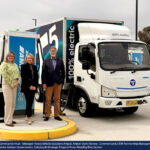


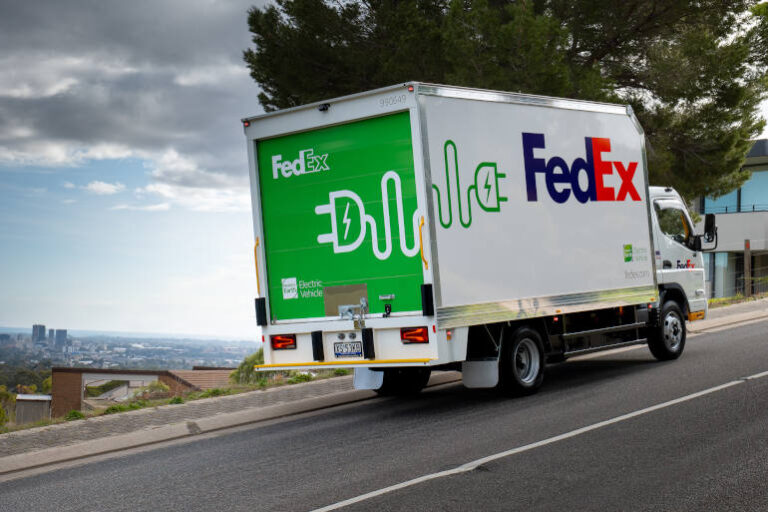
Federal Express Corporation (FedEx) has taken a significant step toward its global sustainability goals by introducing 55 electric vehicles (EVs) into its Australian parcel pickup and delivery fleet. The mix of Fuso eCanter trucks and Mercedes-Benz eSprinter vans will begin operating in metropolitan areas, with the first phase already underway in Adelaide.
Adelaide First, with National Expansion Planned
The rollout starts with 15 Fuso eCanters in Adelaide before expanding to Melbourne, Sydney, and Brisbane as charging infrastructure develops. FedEx says the expansion will continue into more metropolitan and regional areas over time.
Both vehicles will be used in daily parcel pickup and delivery services. The eCanter has an estimated range of up to 200 km per charge and avoids up to 13.2 tonnes of CO₂ emissions per year compared with a diesel truck travelling 30,000 km. The eSprinter offers a 1.5-tonne payload capacity, 264 km of range, and avoids 8.5 tonnes of CO₂ annually compared with its diesel equivalent.
FedEx: “A pivotal moment in our operations”
Peter Langley, Regional Vice President, FedEx Australasia, said the decision marked an important milestone for the company’s local operations.
“The introduction of these electric vehicles to our pickup and delivery fleet in Australia marks a pivotal moment in our operations. It is an important initial step we have taken to help reduce the environmental impact of our pickup and delivery operations while continuing to provide the efficient and reliable service our customers expect.”
He added that the move reflects growing consumer expectations:
“As e-commerce continues to grow and consumers become more environmentally conscious, we believe that embracing electric vehicles is a strategic imperative for a cleaner and more sustainable future. We are not just delivering parcels and freight; we are taking tangible steps to help build a more sustainable future for the communities we serve.”
This rollout supports the FedEx Corporation’s global commitment to electrify all parcel pickup and delivery vehicles by 2040 and achieve carbon-neutral operations across its business lines in the same timeframe.
Daimler: “FedEx is setting the benchmark”
The order also represents a major win for Daimler Truck, with the Fuso eCanter forming a key part of the rollout.
Daniel Whitehead, President and CEO of Daimler Truck Australia Pacific, said:
“FedEx is setting the sustainability benchmark globally and we are thrilled to support this amazing leadership in Australia with the Fuso Canter, the most advanced electric small truck in the market. We know FedEx will provide a great example of how companies and their customers can benefit from high-quality electric trucks.”
Andrew Assimo, Vice President of Sales, Marketing and Operations at Daimler Truck, said the eCanter’s advanced safety and driveline technologies made it a natural fit for FedEx.
“The Fuso eCanter features unmatched technology, from its clever e-axle to its next-level active emergency braking capabilities, and we know they will help FedEx deliver the kind of service that it is famous for. We are excited to see the FedEx Fuso eCanters out on the road, delivering for customers while producing zero exhaust pipe emissions.”
More Than Just Trucks
While vehicle electrification is the focus of this initiative, FedEx is also investing in other sustainability measures including aircraft modernisation, sustainable fuels, renewable energy, more efficient facilities, and carbon sequestration research.
What it Means for Fleets
For Australian fleets, FedEx’s decision highlights two key developments:
- Electric delivery vehicles are moving from trial to mainstream adoption in metropolitan operations.
- OEM collaboration is vital—with Daimler positioning the eCanter as a ready-to-go solution for logistics providers.
With e-commerce volumes still rising, the lessons FedEx learns from this deployment are likely to influence broader adoption across both corporate and government fleets in the coming years.
- EVs are turning employees’ homes into fleet fuel stations
 For decades, fleet fuel management has been relatively straightforward. Give the driver a fuel card, let them visit a service station and receive an invoice detailing the transaction. Electric vehicles are changing that model because the organisation can suddenly be responsible for procuring the energy used to power its fleet — and some of that
 - Foton and Ampol Target Electric Truck ChargingFoton Mobility Distribution (FMD) and Ampol have signed a Memorandum of Understanding to explore charging solutions for electric truck fleets, with a focus on helping operators charge at depots, commercial hubs and public charging sites. The collaboration will investigate charging options across Ampol’s AmpCharge public network and private facilities for FMD’s fleet, logistics and business
- Ausgrid’s charging strategy goes well beyond the depotInstalling chargers at the depot might be the obvious starting point for fleet electrification. For Ausgrid, it wasn’t going to be enough. As the electricity network continues electrifying passenger vehicles, vans and trucks, it has developed a charging strategy designed around how employees actually use fleet vehicles. Speaking during the Fleet News Group Awards finalists
- Home Charging Enters a New Growth PhaseEvnex has passed 20,000 connected charger installations across Australia and New Zealand, with rapid growth reflecting the shift of home EV charging from an early-adopter product to mainstream infrastructure. The Christchurch-based manufacturer shipped its first charger in 2017. While reaching the first 10,000 installations took eight years, the next 10,000 were added in just nine
- Ampol’s $225 million Evie deal puts a new value on public EV chargingAmpol’s proposed $225 million acquisition of Evie Networks could prove to be a significant milestone for Australia’s EV charging sector, putting a substantial transaction value on a public charging network that was built well before electric vehicles became a mainstream consideration for Australian fleets. Ampol Energy has entered into an agreement to acquire 100% of