


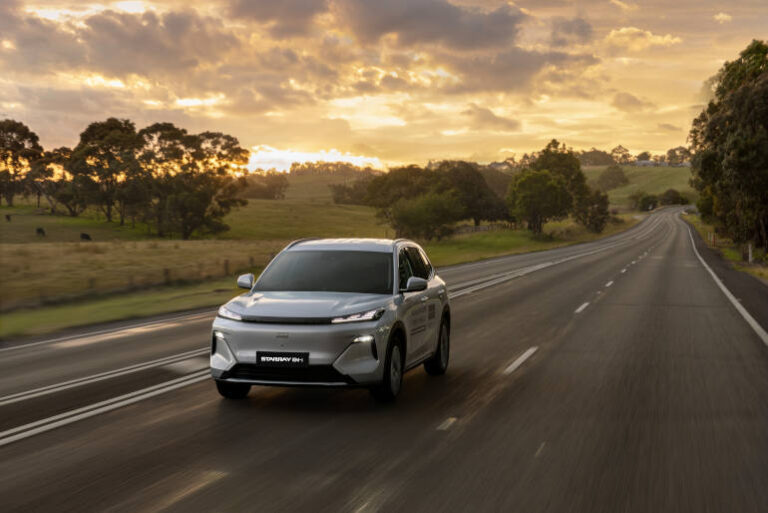
Global automaker Geely Auto Group has set a new GUINNESS WORLD RECORDS™ title for fuel efficiency, with its plug-in hybrid SUV, the Geely Starray EM‑i, completing the Sydney–Melbourne coastal drive with the lowest recorded fuel consumption for a production PHEV SUV.
The record was achieved during a supervised, real-world challenge conducted between 9 and 10 December 2025, covering 1,056 kilometres of mixed driving conditions. The vehicle recorded a verified fuel consumption of 3.83L/100km, outperforming its official NEDC rating of 4.4L/100km and establishing a new benchmark for plug-in hybrid efficiency on Australian roads .
Why this matters for fleets
For Fleet Managers and Sustainability Managers working with limited fleet data and evolving emissions targets, the record highlights the growing role of plug-in hybrids as a transitional technology. Unlike controlled laboratory testing, the Sydney–Melbourne coastal route was deliberately chosen to reflect real operating conditions, including urban congestion, variable terrain and summer heat.
This approach mirrors how most corporate fleets operate: mixed duty cycles, inconsistent access to charging infrastructure and varying driver behaviour. The result demonstrates how modern PHEVs can deliver low fuel consumption without requiring a fully mature charging network or immediate behavioural change across the workforce.
Technology focused on real-world efficiency
The Starray EM-i is built on Geely’s GEA architecture and features the company’s EM-i Super Hybrid Technology. Its powertrain combines a high-efficiency 1.5-litre internal combustion engine with an integrated 11-in-1 electric drive system and a 29.8kWh battery. The system enables seamless switching between electric, hybrid and engine-only operation to optimise energy use across different driving scenarios .
According to Dong Wan, Director of the Energy Control Department at Geely Research Institute, the purpose of the challenge was to demonstrate practical benefits rather than theoretical performance. He said the route selection and conditions were designed to replicate everyday use and validate the system’s energy-management capability in real-world environments .
A practical option for low-maturity fleets
For organisations early in their fleet-management maturity journey, plug-in hybrids can provide an immediate pathway to emissions reduction while broader policies, data capture and charging strategies are still being developed. From a Finance Manager’s perspective, lower fuel consumption combined with familiar refuelling practices may also reduce risk during the transition away from internal combustion vehicles.
While battery electric vehicles remain the long-term objective for many fleets, record-setting demonstrations such as this reinforce the role PHEVs can play in bridging operational gaps, particularly for regional travel, long distances and fleets with limited depot charging.
Global momentum, local relevance
Since its global debut, the Geely Starray EM-i has achieved cumulative sales of more than 114,000 units across multiple international markets, including Australia. The successful Australian record attempt reinforces the vehicle’s adaptability to local conditions and highlights the increasing competitiveness of global OEMs in delivering efficient, lower-emission fleet options .
For fleet decision-makers, the key takeaway is clear: real-world efficiency data is becoming just as important as laboratory ratings when evaluating future fleet powertrains—and plug-in hybrids are rapidly narrowing the gap between traditional vehicles and full electrification.