

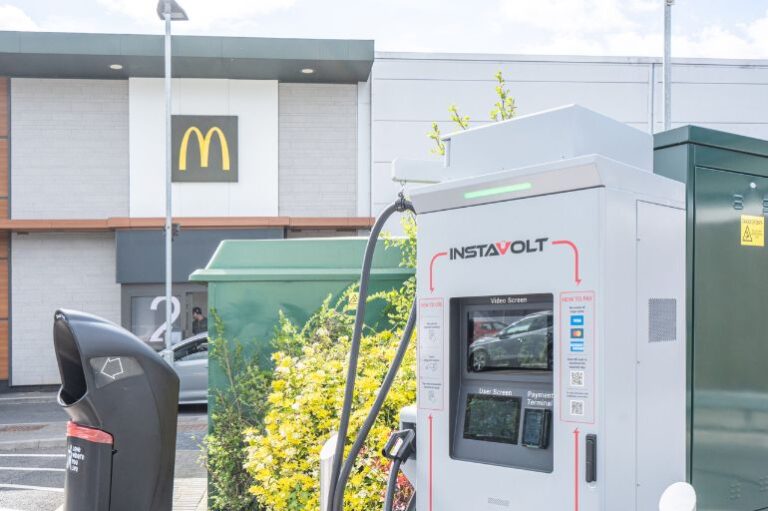
In a major step forward for EV infrastructure in the UK and Ireland, InstaVolt has announced the installation of ultra-rapid electric vehicle chargers at 250 McDonald’s locations, marking a key milestone in the companies’ growing partnership.
Since the first charger was switched on at McDonald’s Port Talbot in December 2020, the collaboration has gained impressive momentum. Today, over 500 InstaVolt chargers are live across McDonald’s sites, helping EV drivers cover more than 120 million miles without generating any tailpipe emissions — the equivalent of nearly 5,000 laps of the globe.
“Working with McDonald’s has been a cornerstone of our strategy to deliver reliable and convenient nationwide EV infrastructure,” said Delvin Lane, CEO of InstaVolt.
“Their well-located restaurants give us the perfect platform to reach communities across the UK and Ireland. We’re incredibly proud of what we’ve achieved together so far and look forward to growing our partnership further.”
For Fleet Managers planning new depot strategies, or Sustainability Managers looking to encourage driver adoption of EVs, this partnership demonstrates how integrating charging into everyday routines — like stopping for coffee or a meal — can support long-term decarbonisation.
The chargers installed through the partnership are ultra-rapid, enabling most EV drivers to add an 80% charge in around 20 minutes. For fleet and novated lease drivers using vehicles during lunch breaks or between site visits, this helps reduce downtime while still supporting environmental goals.
Live Data and Seamless Experience
A key part of the charging experience is visibility and uptime, and InstaVolt’s collaboration with Zapmap ensures drivers can view real-time status updates across both the app and web platform. This transparency builds confidence and reduces range anxiety — an important consideration for fleets operating across multiple regions.
Mike Spencer, Vice President of Development at McDonald’s UK & Ireland, reinforced the company’s customer focus:
“McDonald’s is committed to delivering a great customer experience and our ongoing partnership with InstaVolt means we can do just that. Providing accessible charging points enables customers with electric vehicles to visit one of our restaurants for a coffee or a meal and get an average of an 80% charge in 20 minutes.
“This is a brilliant milestone to have reached, and as we look to open 200 new restaurants over the next four years, continuing to make charging points available, where possible, will remain a priority.”
Serving Over 1.5 Million Drivers
The partnership has already enabled more than 1.5 million charging sessions, offering fast and convenient access to charging at destinations that are familiar and easy to find.
The environmental impact is just as impressive. The emissions saved from these 120 million electric miles are equivalent to planting 750,000 trees and letting them grow for a decade — a tangible reminder of how low-emission transport contributes to climate action.
A Broader Sustainability Strategy
McDonald’s isn’t new to the sustainability space. All electricity used by its restaurants in the UK and Ireland is 100% renewable, sourced from wind and solar energy. The company also converts used cooking oil into biodiesel to fuel delivery vehicles, topping up with other sustainable sources as needed.
For Finance Managers seeking partners with strong ESG credentials, McDonald’s environmental commitments and investment in EV charging show a continued focus on future-ready infrastructure.
Looking Ahead
With EV adoption accelerating and the UK pushing toward its zero-emission vehicle targets, partnerships like this offer a blueprint for accessible, scalable charging solutions. As McDonald’s continues to open new locations and InstaVolt expands its network, EV drivers across the region — including fleet, business, and private users — stand to benefit from greater coverage and faster charging.
The InstaVolt-McDonald’s partnership is a clear demonstration that everyday habits, like grabbing a coffee or burger, can be reimagined as an opportunity to reduce emissions and drive the transition to electric transport.




