


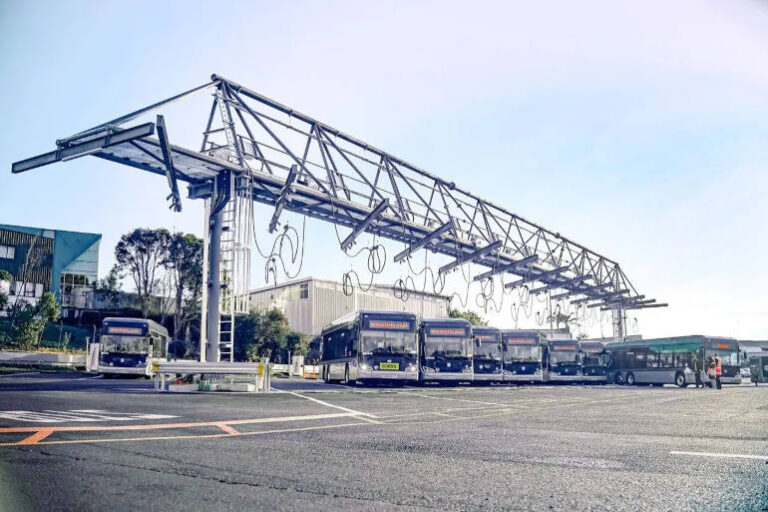
Auckland has taken a major leap toward zero-emission public transport, with Kinetic unveiling New Zealand’s first large-scale overhead gantry bus charging system at its upgraded Glenfield Bus Depot.
Delivered in partnership with Auckland Transport (AT), ABB, and Singer Electric, the new system can charge up to 20 electric buses at once — and support a total of 34 buses on site — making it the largest and most space-efficient charging facility of its kind in the country. The upgrade supports the rollout of 31 new zero-emission buses (ZEBs) on Auckland’s North Shore, helping AT move closer to its goal of a fully zero-emission fleet by 2035.
A smarter, cleaner depot design
Kinetic’s Glenfield depot now stands as a showcase for how innovation can solve the spatial and operational challenges of fleet electrification. Rather than lining up nose-to-tail, buses park diagonally beneath a steel gantry structure carrying 20 overhead charging outlets. Drivers connect using retractable leads that keep cables safely off the ground, improving safety and reducing wear.
At the heart of the site are five ABB HVC 360 power cabinets, each capable of delivering up to 360 kW across four outlets, supported by seven ABB Terra 180 kW dual-outlet chargers. Combined, they provide a total charging capacity of around 3 MW. Dynamic power allocation allows energy to shift between outlets depending on demand — for example, prioritising one bus for a fast top-up while slowing others once they’re nearly full.
Kinetic leading New Zealand’s transition
For Calum Haslop, Managing Director of Kinetic New Zealand, Glenfield is more than just an infrastructure project — it’s a statement of intent.
“The introduction of 31 new zero-emission buses to our Glenfield depot marks another important step in the evolution of Auckland’s public transport network. What makes this milestone particularly exciting is the integration of an overhead gantry charging system, which allows us to charge multiple vehicles efficiently, safely, and at scale within our existing depot footprint.”
Haslop added that Auckland now operates more zero-emission buses than any other city in Australasia, and the Glenfield upgrades will help ensure the network can support continued growth.
“These new buses, and the associated electric infrastructure, will help us achieve a fully zero-emission bus fleet by 2035. They’ll be used on a range of Auckland Transport routes, including routes 82, 923 and 924, which will be entirely operated by zero-emission buses from later this year.”
Engineering excellence from Singer Electric
Kinetic partnered with Singer Electric to deliver the electrical infrastructure and civil works for the gantry structure. Managing the only megawatt-scale charging installations completed in New Zealand to date, Singer has become a trusted partner for large-format EV charging projects.
Jason-Lee Wood, Project Supervisor at Singer Electric, said the Glenfield project demanded precision and collaboration.
“It was a project with a lot of moving parts. Our role was to coordinate the electrical components, anticipate issues, and make sure everything from transformer placement to gantry positioning came together. That’s what we do best — ensuring technology can actually work in the real world.”
He added that the benefits of the overhead system are already clear.
“The gantry saves ground space, reduces wear on charging cables, and makes life easier and safer for drivers. We templated every piece of equipment before construction to make sure it all fit within the depot’s tight footprint. The layout is efficient and future-ready.”
ABB technology powering the next generation
The Glenfield depot marks the first deployment of ABB’s HVC 360 solution in New Zealand, with ABB providing both the high-capacity power cabinets and fast chargers.
Bailey Gorst, ABB National Sales Manager – eMobility, said the project demonstrates how advanced charging systems can be adapted for complex, existing depots.
“It demonstrates what large-scale depot electrification looks like in a New Zealand context, with a unique combination of gantry charging, a complex brownfield site, and smart load management.”
Singer Electric acts as ABB’s licensed electrical contractor and agent for New Zealand. Gorst said this partnership ensures a seamless transition from design to operation.
“They know the equipment, understand the site constraints, and make sure the solution works on the ground, giving operators confidence. That’s critical when deploying technology of this scale.”
Smart power and collaboration driving success
Power to the depot is supplied by two 750 kVA transformers configured with a bus tie for redundancy. Load management is handled by Evis Z software, which ensures charging stays within site power limits while delivering fully charged buses every morning. The smart system avoids costly over-capacity charges and strengthens operational resilience.
Wood said the collaboration between all project partners was key to Glenfield’s success.
“Kinetic, ABB, Auckland Transport — everyone pulled in the same direction. Glenfield is proof that you can take a very constrained site and still deliver world-class electrification.”
Auckland Transport’s Director of Public Transport and Active Modes, Stacey van der Putten, said the Glenfield upgrade is a cornerstone of the city’s Mission Electric programme, helping cut emissions and improve the passenger experience.
Powering the future of zero-emission transport
For Auckland Transport and Kinetic, Glenfield represents the next step in an ambitious journey toward fully decarbonised public transport. With more depots set to follow, the project sets a benchmark not just for New Zealand but for the wider region — proving that even legacy bus depots can be transformed into high-capacity, zero-emission charging hubs.
As New Zealand works toward net-zero transport by 2050, the Glenfield gantry stands as both a practical solution and a symbol of how collaboration and innovation can drive the fleet transition forward.