


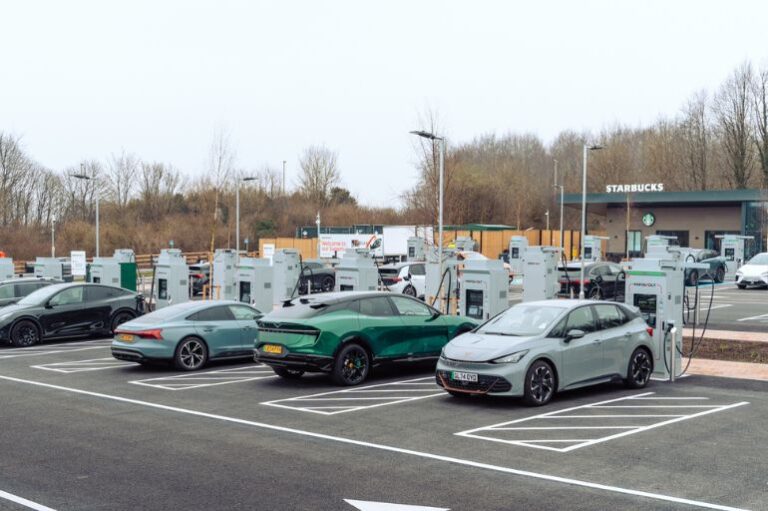
The UK’s electric vehicle (EV) charging infrastructure continues its rapid expansion, with new figures from Zapmap revealing an 8,670-strong surge in public charge point installations in the first half of 2025 — up 27% year-on-year. The total network now stands at 82,369 charging devices (110,486 EVSEs) across 40,479 locations, pushing the country closer to the UK Government’s target of 300,000 charge points by 2030.
Fleet Managers and Sustainability Managers watching overseas markets will see the UK’s performance as a benchmark, particularly in the growth of high-powered hubs and the focus on equitable access for drivers without off-street parking.
Ultra-Rapid Hubs Lead Infrastructure Growth
Charging hubs — sites with six or more rapid or ultra-rapid chargers — remain the fastest-growing segment. A total of 136 new hubs were installed in the first six months of 2025, bringing the national total to 673.
“These hubs are popular with electric car drivers, especially to support en-route charging on longer journeys,” said Jade Edwards, Head of Insights at Zapmap. “They also show the future direction for the EV infrastructure, with faster charging times, an increased focus on sustainable energy systems and locations which deliver enhanced amenities.”
Notable deployments include:
- Osprey Charging’s 24 x 300kW charge points across two Merseyside sites, and 16 more at a new Watford hub launched with Legal & General;
- Be.EV’s 12 ultra-rapid units at Hattersley Trade Park and a “Manchester Charging Oasis” repurposing a derelict fuel station;
- Source’s first ultra-rapid hub at Edinburgh’s Ocean Terminal (12 bays);
- RAW Charging’s installation of eight AC and eight ultra-rapid chargers at the National Trust’s Stourhead estate.
With 1,598 new ultra-rapid chargers added in the last six months, the UK now has 8,619 150kW+ chargers — a 23% increase. For the first time, ultra-rapid devices now outnumber rapid chargers.
Growth Beyond the South East
Regional distribution is also improving. Nine of the UK’s 12 regions now boast over 1,200 high-powered chargers (50kW+), and six have over 1,500. Scotland posted 29% year-to-date growth in high-powered units, while the North West grew 21%.
Even more impressive is the North East, where total charge points across all power ratings have increased by 40% year-on-year. The East of England and West Midlands followed closely with growth above 38%.
Vicky Read, CEO at ChargeUK, said: “It’s particularly encouraging to see growth accelerating outside of the South East. The continued rise in the number of high-profile and high-powered hubs to support en-route charging gives confidence to drivers and helps the sector remain on track for the Government’s ambition of 300,000 chargers by 2030.”
She also called for policy support to maintain momentum: “To keep the roll out on track… the Government can support the sector by equalising VAT on public charging to five per cent, addressing the rise in standing charges, and extending the Renewable Transport Fuel Obligation to include EV charging.”
LEVI-Funded Rollout Targets On-Street Charging Gap
The lower-powered end of the network (<50kW) still accounts for the majority of chargers — 65,671 devices, or almost 80% of the total. This includes a growing focus on on-street chargers to support EV adoption among households without driveways.
In H1 2025, 3,709 new on-street chargers were added, taking the total to 29,227. While Greater London accounts for 20,490 of those, other regions are catching up. In fact, the rest of the UK grew its on-street stock by over 25% (from 7,106 to 8,737) in just six months, compared to London’s 11% growth.
This shift is driven in part by the LEVI (Local Electric Vehicle Infrastructure) scheme and its predecessor, the ORCS (On-Street Residential Charging Scheme). There are currently 80 LEVI-funded projects underway, with 19 open to tender.
Key announcements include:
- Brighton and Hove City Council partnering with char.gy to deliver over 6,000 on-street chargers;
- Suffolk County Council receiving £5.3 million in LEVI funding to install another 6,000 devices in partnership with Believ;
- Barnet Council working with char.gy to install 1,000 chargers over the next three years, with 60% funded by ORCS.
Mid-Year Outlook: Infrastructure, Demand, and Equity
“The EV landscape at the mid-point of 2025 looks significantly different to six months ago,” said Zapmap’s Jade Edwards. “We’re always pleased to see strong growth in en-route charging and hubs… but we’re now also beginning to see LEVI funding awards feeding through the system, offering the 40% of people who do not have access to off-street parking increased opportunities to charge close to home.”
She added: “We look forward to seeing what further measures the government can introduce to make access to public charging more equitable.”
For Fleet Managers and Finance Managers building business cases for fleet electrification, these developments point to a maturing ecosystem that better supports high-utilisation vehicles and longer-distance operations — with lessons for Australia as the local market scales up.




