


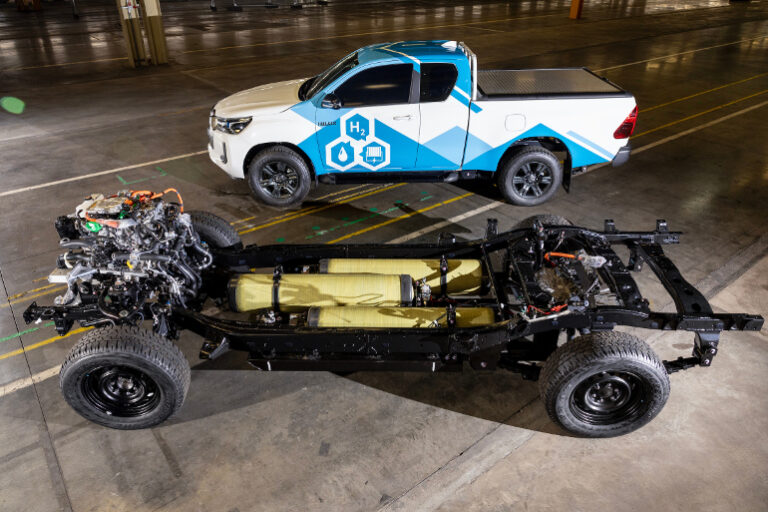
Toyota will introduce a hydrogen fuel-cell HiLux in 2028, extending its multi-pathway approach to lower and zero-emission fleet vehicles.
The planned HiLux FCEV will sit alongside Toyota’s newly launched battery-electric HiLux, plug-in hybrid RAV4 and performance hybrid LandCruiser 300, giving fleet buyers a wider range of powertrain options based on how and where vehicles operate.
Toyota says the hydrogen-powered HiLux is being developed for fleets that require zero-tailpipe-emissions technology but can take advantage of back-to-base refuelling opportunities.

That operating model will be critical. Hydrogen remains limited by the availability of public refuelling infrastructure, but it may have a role in depot-based fleets where vehicles return to a known location and refuelling can be planned around their daily operations.
For organisations that operate in remote areas, carry heavier loads, travel long distances or need rapid refuelling, a fuel-cell powertrain could eventually offer a different pathway to battery-electric vehicles. Like a battery-electric vehicle, an FCEV uses an electric motor to drive the wheels and produces no tailpipe carbon dioxide emissions. However, it stores hydrogen on board and generates electricity through the fuel-cell system rather than relying solely on a large traction battery.
Toyota has not released technical specifications, range, payload, towing capacity or pricing for the HiLux FCEV. Those details will determine which fleet roles it can serve when it arrives.
The company’s announcement is nevertheless significant because it confirms Toyota sees a future for more than one electrified vehicle technology in commercial fleets.
Toyota Australia Vice President Sales, Marketing and Franchise Operations John Pappas said the company’s multi-pathway strategy was designed around different customer needs and operating conditions.
Toyota now offers petrol, diesel, conventional hybrid, plug-in hybrid, battery-electric, performance hybrid and fuel-cell electric options across its Australian vehicle range.
The HiLux BEV, launched at the same time as the announcement, is aimed primarily at mining, government and business fleet customers. It uses a 59.2kWh battery, dual electric motors and all-wheel drive, with Toyota claiming up to 315km of NEDC range for pick-up variants and up to 245km for the cab-chassis.
The future HiLux FCEV could give fleets another option where battery charging is difficult to manage or vehicles need a shorter refuelling stop than conventional charging allows. However, the business case will depend heavily on access to hydrogen supply, depot infrastructure, vehicle utilisation and the cost of operating the technology.
For fleet managers, the message is that the transition away from conventional petrol and diesel will not be a single-technology exercise. Battery-electric vehicles are likely to suit many predictable return-to-base roles, while plug-in hybrids can support drivers transitioning from conventional vehicles. Hydrogen may become relevant for a smaller group of fleets with the infrastructure and operational profile to support it.
Toyota’s 2028 HiLux FCEV plan keeps hydrogen in the conversation for Australian fleets — but the viability of the vehicle will rest on whether hydrogen refuelling infrastructure develops at the same pace as the technology.